《無我茶會Sans Self Tea Gathering 180條》
蔡荣章著Author:Rong-tsang Tsai
ISBN 978-957-9690-08-9,“无我茶会Sans Self Tea Gathering 180” ,First edition: 1999.9, Second edition: 2010.9,《无我茶会180条》,1999.9第一版,2010.9第二版,台北陆羽茶艺股份有限公司.2012.05.20修订版.-English Translator : Katherine Yip,英语翻译:叶德明.
Chapter 6 Pre-event Preparation for Sans Self Tea Gathering
53 ‘Simplicity and Modesty’: the principle behind the use of tea ware for Sans Self Tea Gathering.
A Sans Self Tea Gathering is to be carried out in as simple a manner as possible; the same goes with personal tea ware for the occasion – one can look to ‘travel tea ware’ as a guide. Going simple will help significantly cut down on time spent preparing, using and packing tea ware; meanwhile, time saved will enable us to experience and enjoy the atmosphere and ambience of the tea gathering.
Precious tea ware is best kept at home. Participants are encouraged to bring along practical pieces. Though the rare fines will usually make quite an impression during the ‘tea ware appreciation and networking’ session, this will draw comparison as participants may rack their brains trying to determine which ones to bring to catch attention. They would be so worried about their precious tea service throughout the event that they will miss what is essentially an enjoyable experience. More often than not, simplicity could be the best policy in life — fame, wealth, possession, and ways and means alike.
When we mentioned ‘precious’, we refer to the yardstick for participants in general. However, for those who often bring such tea ware along and find no problem with this, we will not name-tagged such ‘unsuitable’.
54. The basic ware for Sans Self Tea Gathering
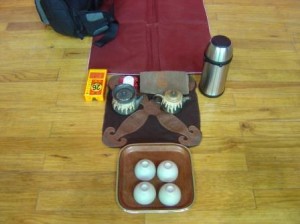
For a gathering with floor seats, bring along ‘seating cushion’. As everyone has to brew tea, ‘teapot’ or ‘tea bowl’ for whisking matcha is essential, so are ‘teacups’. The number of teacups would depend on what is listed in the ‘Notification’. If teapot is used, bring along a ‘tea pitcher’ for distributing tea; even if tea is evenly poured into the cups from the pot for the first brewing, it will not be easy to attain the same level of evenness in strength for subsequent brews. Pour tea into the pitcher first before serving, because the teacups would have been offered to different fellow tea drinkers – if we pour tea directly from the teapot into individual teacups, the tea infusion served first will be weaker than that served later; and , going back and forth to ensure even strength is too much of a hassle. A ‘tea serving tray’ will come in handy for serving tea from the tea pitcher or tea bowl (in the case of whisking matcha).
For convenience’s sake, put the right amount of tealeaves into the teapot beforehand, if you prepare to use one. This saves the trouble of bringing along the ‘tea caddy’. However, if matcha is to be served, the ‘tea caddy’ is a must, so are the ‘tea scoop’ for scooping out the tea powder and ‘tea whisk’ for whipping up the matcha.
Hot water is a must for both brewed and whisked teas. Bring along a thermal flask with boiled water of the required temperature. As duration for brewing is crucial, a ‘timer’ with seconds display or a watch is essential to help keep track of time. A ‘tea towel’ will help catch any drip in the course of tea brewing or serving; and it can be used to wipe the used cups when we are packing after the tea gathering.
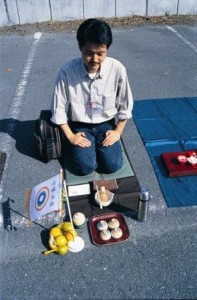
Lay a piece of ‘tea brewing cloth’ on the floor (or on the table, if applicable). Place the tea ware on the cloth. Make sure there is enough space at the outer edge for the others to offer tea to you. You may use either the cloth for wrapping the tea ware or a dedicated ‘pot wrapping cloth’ for this purpose.
Put the tea ware into your ‘carrying bag’, and you are ready to attend the Sans Self Tea Gathering.
55. Some practical tips about the ‘Tea Ware’ for Sans Self Tea Gathering
There should be a strainer at the base of the teapot’s spout to prevent tealeaves from blocking the flow of tea. The mesh should be very fine to catch even the very tiny residue. Otherwise, residue with some tea infusion may be left at the bottom of the teacups, affecting not just the water temperature, but making it difficult to wipe dry the teacups afterwards. A ‘strainer’ incorporated at the opening of the tea pitcher could complement the straining function of the teapot. Tea pitchers are used to distribute tea infusion into individual teacups. It is important that these pitchers have ‘anti-dripping’ design; otherwise, tea infusion may spill and wet the brewing area of fellow participants. (If a rug is used at the brewing area, quickly use the tea towel or tissue paper to absorb the tea infusion to avoid leaving any stain which could be hard to remove)
The size of the teapots and tea pitchers should be considered in relation to the number of cups. Avoid using teacups with a capacity of more than 50cc. Tea infusion should only fill 4/5 of the cups because each participant will be served a few rounds. Large teacups would require large teapots/tea pitchers as well as water flasks, which could be inconvenient when being carried around. Use weightier teacups. Do not use delicate teacups such as the eggshell porcelain for outdoor tea gatherings to avoid spillage in a sudden draft. Fluted-shape teacups with small base are not advisable, as they may spill with a quick gust of air or being carried around on the tray
The serving tray should be just big enough for the cups. Also, avoid trays with very slippery surface to eliminate the risk of spillage when the cups are being carried around.
56. How is the best way for tea ware to travel?
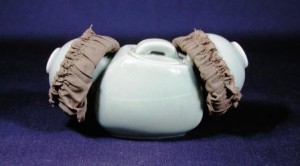
Each item for the Sans Self Tea Gathering has to be packed in a damage-free manner. Teapots, tea pitchers or tea bowls could be wrapped carefully with a ‘wrapping cloth’. Tea cups, be they stacked on top of each other, bundled up or ‘hooked’ onto the teapot and be wrapped together, must have ‘cup covers’ for extra protection; otherwise, they may be damaged by pressure. The thermal flask must be positioned upright and wobble-free, and not knocking against other tea ware in the carrying bag.
Organize the carrying bag into a few parts: one for the thermal flask; one for major tea ware such as teapot, tea pitcher and teacups; one for the tea serving tray, tea towel and timer; one for the seating mat; and one for personal items such as camera. This way, packing will be a lot easier. If possible, use a shoulder bag for ease of movement and flexibility.
When tea ware has to be transported in your checked-in baggage for an overseas Sans Self Tea Gathering, protect each item with personal clothing in a hard-case luggage. If in doubt, bring them along in your hand luggage.
57. Things to note about the protective/wrapping materials for the tea ware
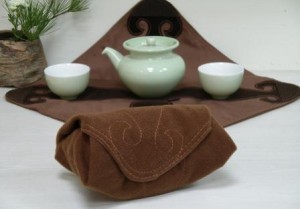
Apart from safety, protective/wrapping materials for the tea ware must also be considered in terms of hygiene, odour and appearance. ‘Hygiene’ means that the materials and printing on it must be pollution-free and easy to wash. Materials with ‘odour’ will stay on the tea ware or be absorbed by the tealeaves; hence, it is important to choose odour-free materials. ‘Appearance’ refers to the fact that the wrapping and unwrapping of the tea ware is a part of the ‘tea-brewing’ experience – ease of use and visual appeal will affect the mood of the participants. You may use the original commercial packaging or towels at home. While these will save you the worries about hygiene and odour, they may not be stylistically refined enough.
58. Which ‘tea’ should I bring?
This would cover the type and grade of tealeaves. ‘The type’ would depend on what is stated in the ‘Notification’ issued by the organizer; but the principle is to welcome ‘all types of tea’ or teas in a broad category. ‘The grade‘would be largely a personal choice, as long as it does not have an unpleasant smell or taste, and is not something you don’t like, because it would go against the aspiration of Sans Self Tea Gathering to encourage us to ‘accept and appreciate teas of all kinds’.
On what occasions would the organizer require a specific category of tea be used? For example, if a Sans Self Tea Gathering is planned for early spring to remind us of the arrival of the season, the Notification may make it clear that green tea is preferred; however, there will not be any restriction on the types. As for a memorial tea gathering, the organizer may request participants to bring along a certain type of tea because of its relationship with the person to be honoured.
59. How should be ‘tea’ be carried? (When should we put tealeaves into the teapot?)
With the exception of ‘powdered tea’, tealeaves can be added into the teapot before leaving home. In the spirit of ‘simplicity and frugality’ of the Sans Self Tea Gathering, there is no need to bring along the tea caddy. Some of us may be worried about the quality of the tealeaves transported this way. Fret not. This is acceptable on the day itself, provided that the teapot is dry and there is no distinct odour or off-smell in the carrying bag. For tea gathering to take place the following day, get ready a tea caddy and leave it in the luggage. Put tealeaves into the teapot right before you leave for the tea gathering the next day.
Powdered tea has to be whisked in the tea bowls, and there is no way it can be placed in the bowls and be carried to the venue. It is, therefore, necessary to bring along a separate powdered tea container.
60. How to prepare the tea ware if two types of tea are to be brewed?
In the spirit of ‘simplicity and frugality’ advocated by the Sans Self Tea Gathering, we will not think along the line of ‘discarding the residue > rinse > and then put in another type of tealeaves’ when the organizer requests two teas be brewed. Instead, prepare an extra teapot, and pack another tea separately. The same set of teacups will be used.
Normally, such requests would be made for a gathering that lasts longer, or at a venue that is conducive for staying longer, or of long missed friends. There may be an intermission, or some other activities in between for the first and second situations mentioned above.
61. Preparing water for brewing and the choice of thermal flask
One of the rules of a Sans Self Tea Gathering is ‘to be self-equipped without expecting anything from the organizer’. As such, each participant will have to bring along water for brewing. Given the improved temperature retention technology nowadays, the slight temperature drop in the flask will not affect the brew. However, if the water is kept in the flask longer than half a day, it is necessary to add hot water. The best time and place to do so is during meal break at the eatery you dine in.
Decide water temperature according to the type of tea you are going to brew. Make it 3°C to 5°C higher than required to provision for temperature drop on the way. Furthermore, the basic way of brewing adopted by the Sans Self Tea Gathering requires no pot warming. Use hot water to rinse the thermal flask before adding hot water to it will help eliminate heat loss. If the outside of the flask feels hot after hot water is poured in, insulation is inefficient and it is time to change the flask.
Opt for travel-size instead of household flasks. The size of thermal flask would depend on the number of cups to be served and rounds of brewing. Choose flasks made of impact-resistant and unbreakable materials, and look for one-push open button design – not only is this more convenient than the stopper type for pouring water out, you will not end up having a big splash in case the flask topples.
62. Sitting posture at a Sans Self Tea Gathering
Unless in the rare occasion where chairs and tables are made available, Sans Self Tea Gathering are normally held with participants sitting and brewing on the floor. How then should participants sit? One can sit with parallel legs and bent knees (as in kneeling), with crossed legs and bent legs, or in a half-lotus position. We encourage kneel-sitting because it is more elegant and makes it easier for the participants to rise and serve tea. However, it would need a bit of practising for the inexperienced. Try gradually lengthen the time as you practise. Meanwhile, small collapsible chairs are allowed for participants with knee problem which do not allow them to sit on the floor.
Floor seating encourages closer interaction apart from the fact that there are no chairs and tables blocking the way. This goes with family members brewing tea together. What’s more, sitting on the floor allows you to feel the earth beneath you, giving rise to the feeling of harmony between man and land.
63. Some practical tips about the seating mat
Seating mats are essential since Sans Self Tea Gathering supports the idea of floor seating. In an outdoor setting, there will be small stones on the ground, so it is good to have the seating mat made of stretchable and durable materials; loose, spongy ones are not suitable.
Considering that Sans Self Tea Gatherings are organized in different locations, it is best to use tea ware that travels well. By the same token, seating mat has to be easy to carry. Consider seating mats that can be folded. A simple DIY version goes like this: Get a piece of dense sponge. Make a fabric cover slightly larger than the sponge and sew to divide it into four compartments. Cut the sponge into four squares of equal size. Insert a cut piece of sponge into a compartment and sew up. This way, you will have a seating mat that can be folded one-fourth of the size it opens up. Make sure the mat, when opens up, is large enough for you to be seated. If you are going to kneel-sit, the length of the mat should be slightly more than the distance between your knee and toes when seated. The width should be slightly more than that of the body when seated.
64. What should we bring along in addition, if it rains before the tea gathering or the ground is sandy/muddy?
Bring along a lightweight, water-proof cloth if the ground is wet or muddy. Lay it on the ground and put the seating mat and tea ware on top of it. This should take away the worries.
Why lightweight cloth, you may ask? We don’t suggest using plastic sheets because they are mostly lacking in visual appeal and are too slippery to stay in place, unless you can find some nice ones with a ‘cloth’ feel. By comparison, water-proof fabric looks more appealing. Lightweight material is easy to bring along and clean afterwards. This cloth should cover the area of the seating mat and brewing area; and yet, it should not be so big that it exceeds the area allocated by the organizer and may cause a slip or trip.
65. Attire and shoes for Sans Self Tea Gathering
This would depend on the occasion – formal gatherings require proper attire; for occasions among friends, casual clothing is fine. Whichever the case, the clothes you wear must allow you to be seated and brew tea with ease. Neckties and accessories such as long necklaces should be secured in place to avoid it finding its way into the tea infusion or hitting the tea ware.
Should the venue require participants to remove their shoes throughout the event, pay attention to the colour and thickness of the socks/stockings – a pair of very transparent silk stocking would create the impression of one being bare-footed.
For venue that does not require participants to take off their shoes throughout the event, choose shoes that can be ‘put on’ and ‘taken off’ easily. It will be inconvenient, not to say unbecoming, if you have to tie or untie your shoelaces or pulling your shoes strenuously on or off each time you get back to your seat or rise to offer tea.
66. What kind of preparation is required for a tea gathering that calls for tea time snacks?
If tea time snacks are to be shared during the tea gathering, participants have to prepare both the snacks and serving utensils. As the name suggests, these snacks are to be taken with tea. A small quantity will serve the purpose, since each participant will get to enjoy snacks brought along by several fellow participants. The flavour of these snacks should harmonize with that of the tea – avoid snacks that are too strong, too salty, too spicy or too sour in taste. Equally inappropriate will be snacks containing parts that require us to spit out at the end or those that are too chewy, as these will cause inconvenience and create anxiety. Bring along snacks that are easy to handle, preferably individually packed.
The number of servings should match that of cups to be served. For example, the Notification specifies four cups are to be served, then bring along four servings of snack. If the participants are expected to offer tea to onlookers, the Notification will specify the amount of extra snacks required.
We should also prepare utensils for serving snacks. Bring along two small dishes; alternatively, use two pieces of paper towel. One of these should be placed on the tea serving tray for the snacks you’ve brought along; the other at an appropriate spot at the tea brewing area for others to offer snacks to you. Remember to pack equipment such as bamboo knife, if required.
67. Example of tea brewing at a Sans Self Tea Gathering: Small teapot brewing
As mentioned, Sans Self Tea Gathering encourages the use of travel tea ware for fuss-free tea brewing. There is, however, no restriction on the style and brewing method. The ‘small pot’ brewing which we are going to talk about and the ‘lidded-cup’ brewing and ‘powdered tea’ brewing which we will discuss later are but for reference only.
Take your seat, and lay the seating mat on the floor. Stand behind the rear end of the mat, take off your shoes, and sit on the mat. Place the carrying bag on your right. If the ground is wet or too sandy/muddy, lay the cloth liner first before laying your seating mat, aligning the rear end of both. If there is no cloth liner, shift your seat slightly to avoid the inconvenient surface, provided this does not affect the order and the overall arrangement of the seats.
Place the tea serving tray in front of the seating mat. Leave some space between the tray and the seating mat as the tea brewing area. Take out the tea ware. Say you have bundled two teacups with the teapot together, and the other two teacups with the tea pitcher (in the event that each participant is to bring along four teacups). Take out the bundle with teapot first, unwrap and place the teacups and teapot on the tea serving tray. Put the wrapping cloth and cup covers back in the bag. Then, take out the bundle with the pitcher, unwrap, and lay the wrapping cloth (which doubles up as tea cloth) between the seating mat and tea serving tray. Remove the teapot from the tray and put it on the tea cloth, then put the two cups from the second bundle on the tray. Arrange the four cups properly, and make sure the teapot and tea pitcher are at the centre of the tea cloth.
Leave some space at the front end of the tea cloth for others to place their cups when they offer tea to you. Leave some space at the rear end of the tea cloth as well, to accommodate the tea towel and timer (tea towel could be replaced by paper towel, and timer could be replaced by your watch). For special reasons such as space constraint or children participate in brewing, the tea serving tray could be positioned to the right of the tea cloth to make the tray more accessible. Shift the tea cloth a bit to the left.
Take out the tea towel and timer. Place them behind the teapot and tea pitcher. The thermal flask should be placed to the left of the tea cloth (In general, participant will use their right hand to hold the teapot, and pour the water using their left hand).
According to standard procedure, tealeaves would have been put into the teapot. When it is the scheduled time for brewing, pour an appropriate amount of hot water from the flask into the teapot, and then sit quietly while tracking the time. Don’t be distracted; have your mind settled down and track your time by simply counting your breath. When it is about time, check your timer to ascertain timing and pour all the tea infusion into the tea pitcher. Then, pour tea from the pitcher into the teacups. Hold the tea serving tray with both hands and rise to offer tea. Leave the last cup of tea on your tray and return to your seat. Place the cup on your tea cloth.
When everyone has finished the first cup, you may start brewing a second time. Follow the same routine – track the time, sit down quietly and pour the tea into the cups. This time, put the pitcher and tea towel on the tea serving tray. Hold the tea serving tray with both hands and rise to offer tea. Pour tea from the pitcher into the cups you have already offered; use the tea towel to catch any drip. Return to your seat and pour a cup for yourself.
When it is time for packing, wipe the cups you have drunk from with the tea towel. Bring along the tea serving tray and collect the cups you have served others. Return to your seat and place your cup onto the tray as well.
Screw back the cover of the flask (during the gathering, it is not necessary to do so each time after you have poured hot water; just close the inner opening will do), put it back into the carrying bag, and then put back the tea towel and timer. Put two of the cups onto the tea cloth, and move the teapot to the tray. Take out two cup covers from the bag and put them on the two cups. Use the tea cloth (which doubles up as a wrapping cloth) to wrap the tea pitcher and the two covered cups into a bundle, and put this back in the bag. Take out the other wrapping cloth and the remaining cup covers. Pack the teacups and teapot carefully and put them back into the bag. Put back the tea tray. Finish by folding the seating mat and cloth liner and put them back.
68. Example of tea brewing at a Sans Self Tea Gathering: Lidded cup brewing
You may want to brew with a lidded cup. In this case, you would have packed the lidded cup, the tea pitcher and cups into three separate bundles (some may want to wrap equal number of cups separately with the lidded cup and pitcher, making two bundles). Begin by laying the seating mat. Put the tea serving tray in place, and take out the bundle of ‘cups’. Unwrap and put them on the tray, two in a stack; keep some space free on the tray. Then, take out the ‘tea pitcher’ and unwrap, leaving it temporarily on the tray. Finally, take out the ‘lidded cup’. Unwrap and lay the wrapping cloth on the floor as the tea cloth. Move the tea pitcher to the centre of the tea cloth, side by side with the lidded cup. Leave some space at the front end of the tea cloth for others to place their cups when they offer tea to you. Meanwhile, place the tea towel and timer at the rear end of the tea cloth.
Tealeaves would have been added to the lidded cup beforehand. Brew tea by pouring in hot water. Track the time for the desired strength. Take up the lidded cup and pour all the tea infusion into the tea pitcher. Then, pour tea from the pitcher into the teacups. Offer tea with the tea serving tray. From the second brewing onwards, offer tea with pitcher on the tray, and pour tea into the cups you have already offered.
At the end of the gathering, pack tea ware individually. Put them back into the carrying bag in the reverse order.
69. Example of tea brewing at a Sans Self Tea Gathering: Powdered Tea Brewing (and Drinking)
For powdered tea to be served as the Sans Self Tea Gathering, follow the ‘Whisked Powdered Tea for Small Cups’ format. Powdered tea is whisked in the tea bowl before being poured into small cups to be served. As far as preparation concerned, wrap teacups and tea bowl into the first bundle, the tea caddy of powdered tea the second, and the tea scoop and tea whisk the third. Follow the standard procedure to lay the seating mat and tea serving tray. Take out the second and then the third bundles, unwrap and put the tea caddy of powered tea, tea scoop and tea whisk on the tray. Take out the first bundle, use the wrapping cloth as tea cloth and lay it on the floor. Place the tea bowl at the centre of the tea cloth, the tea caddy to its left, and the tea scoop and tea whisk to its right. The tea cups should be placed on the tray.
Add an appropriate amount of powdered tea to the tea bowl, add water and whisk. Hold the bowl and pour it into the cups (use a ‘spouted tea bowl’, i.e., a tea bowl with a serving spout). Offer tea to others with the teacups on the tray. From the second brewing onwards, whisk the tea and bring over the tea bowl for serving.
When it is time for packing, pour some hot water into the tea bowl. Swirl the water around for a while and then pour it into your own cup; this will help dislodge the tea powder residue in the cup. Take this as a ‘parting drink’ and finish it in one if not two cups. Fellow tea drinkers may do the same – pour some hot water into the cup with powdered tea residue, swirl and drink before wiping the cup.
70. There is no pot warming or cup warming in the description of the methods above. Why?
As the simple approach of a Sans Self Tea Gathering goes, the steps of putting in tealeaves, appreciating the appearance, taking in the aroma and warming the cups and others have been eliminated. Tealeaves are to be put into the teapot before leaving home.
Appreciating the appearance and taking in the aroma of the tealeaves would help tea brewers decide the brewing methods. Should the guests be invited to do the same, it will complicate the procedure on the one hand, and disturb brewers from making correct judgement on the other. One of the principles observed by a Sans Self Tea Gathering is “making an effort to brew well”. Tea brewers need to have thorough understanding of the tealeaves before brewing. They will judge the amount to be used by appreciating the appearance of the tealeaves. Meanwhile, brewing time becomes extremely important after two to three brewings, and one way to ensure sound judgement is by taking in the aroma. Pot warming helps prevent teapot from drawing too much heat from the water. To compensate for the omission of pot warming, just increase the water temperature when you are preparing the water, or slightly extend the duration of brewing. Cup warming helps prevent tea infusion from cooling too fast. Considering the relatively short distance between participants, and the duration from the time tea is offered to the time it is consumed, the tea infusion would not have cooled significantly. As such, this step can be eliminated.
71. Lighting requirement for an evening Sans Self Tea Gathering
An evening Sans Self Tea Gathering reminds participants just how beautiful a night it is. Participants would have to bring along their own lighting device, which would have to comply with the following requirements:
a. It must be easy to carry, safe and hassle-free. If the outing involves a flight journey, check if the fuel is allowed to be checked-in.
b. Bring along, or create your own lighting equipment. This will add colour and diversity to a wonderful evening event.
c. Pay attention to wind-proof design that keeps it out of draughts – this is important especially with candle or oil lamps.
d. Choose light that shines downwards. Make sure it lights up the tea ware, especially the tip of the spout to ensure you can see clearly the height of the stream of water being poured into the teapot. Do not rely on hand-held lighting device (such as a torch); this may accidently points at the others when you put it down on the floor.
e. The lighting should last for an hour and a half, and above. Light up your area from the time of preparation – do not wait until you begin brewing. This is to make sure the ‘tea ware appreciation and networking’ session is bright enough for the participants. For battery-operated device, bring a spare set for replacement.
72. What is to be achieved with a Sans Self Tea Gathering?
A Sans Self Tea Gathering enables participants to embrace the spirit of the Way of Tea, including an absence of hierarchy, no expectation of reciprocity, setting aside of personal preferences, and an effort to improve and progress. There are no facilitators or event directors, and silence is observed throughout the gathering to reveal the beauty of collective rhythm. The aim of the tea gathering is achieved if the above has been fulfilled.
Making new friends during the pre-event ‘tea ware appreciation and networking’ session or other post-event activities, and catching up with old friends at the gathering could be considered added values of Sans Self Tea Gathering.
Some participants may find it too much of a hassle to travel this far with tea ware on tow for just a few rounds of tea. There may even be a sense of loss if the gathering fails to bring out the characteristics of Sans Self Tea Gathering.
To enrich the experience, one may include post-event activities such as talk, music performance or hiking.
73. How to enjoy Sans Self Tea Gathering in a relaxed manner?
Avoid focusing too much on socializing, and make sure you prepare yourself well, as follows:
a. Familiarize yourself with the rules of Sans Self Tea Gathering. This way, you will not make mistakes that may spoil your mood.
b. Prepare all the necessary items and make sure they work properly. Avoid poorly-designed tea pitcher that drips, teapots with insufficient straining capacity, and seating mats that are too soft to cushion you comfortably against small stones – these will stop you from fully enjoying the experience.
c. Practice brewing beforehand. Know how much water is needed for a certain number of cups, the required water temperature, and the way to brew a perfect cup. It will be too late to apologize if what you offer is far from being perfect.
d. Find a way to sit comfortably on the floor, and get used to it. This requires practice, whichever you are going to sit – numbness and pain will take away the pleasure you should be feeling at a Sans Self Tea Gathering.
74. Choose tea ware that travels well for Sans Self Tea Gathering.
Get yourself a dedicated set of ‘Sans Self Tea Gathering Tea Ware’ – this not only comes in handy, but also doubles up as a travel set.
It could be further simplified to ‘a pot, two cups and a flask’ if you are travelling alone. Put the covers on the teacups and hook them onto the spout and handle of the teapot. Wrap them with a wrapping cloth into a bundle. Bring along a travel-size flask of hot water.
When you are on the plane, on the train or visiting a friend, simply unwrap the bundle and lay the wrapping cloth on the table as tea cloth. Place the teapot at the centre, and the two cups in front of the pot, side by side. Tealeaves would have been added to the teapot before you leave home, so just pour water from the flask, track the time (with the timer, your watch, the wall clock or by mental counting). When the appropriate strength is attained, pour all the tea infusion into the cups by going back and forth (The amount of water must be correct to ensure all the tea infusion is emptied. By going back and forth, the strength of tea will be even between the two cups). When you are enjoying the tea alone, take the first cup followed by the second cup. When you are on a visit, offer a cup to your friend. When you are on the plane on the train sitting next to a stranger, offer a cup to him/her. Three rounds afterwards, you may pack your tea ware and continue with the journey. When you are back at the hotel, clean and leave the pot, cups, cup covers and wrapping cloth to dry. The following day, you may add some tealeaves to the teapot, and with ‘a pot, two cups and a flask’, set off for another satisfying day accompanied by tea.
(3454)


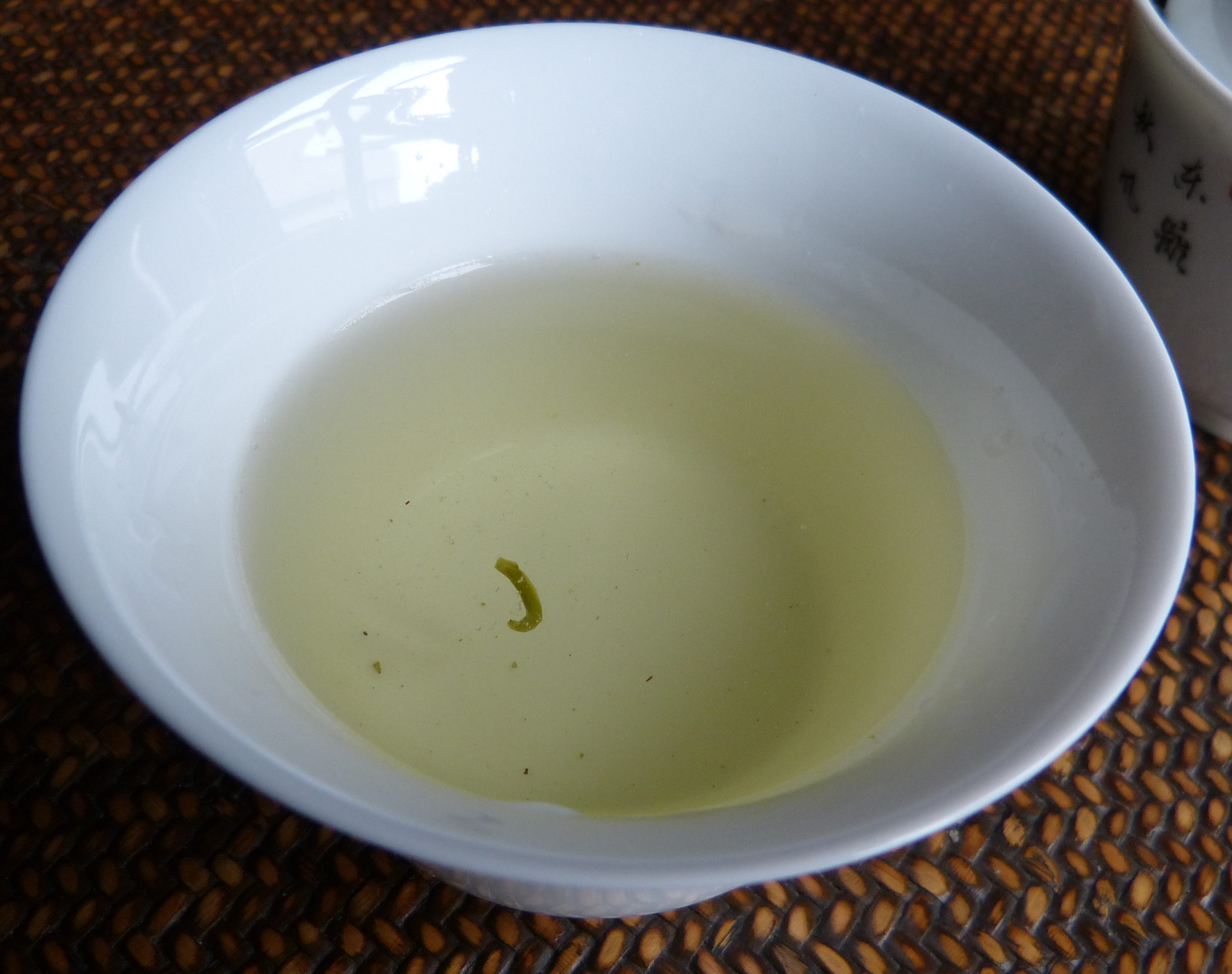
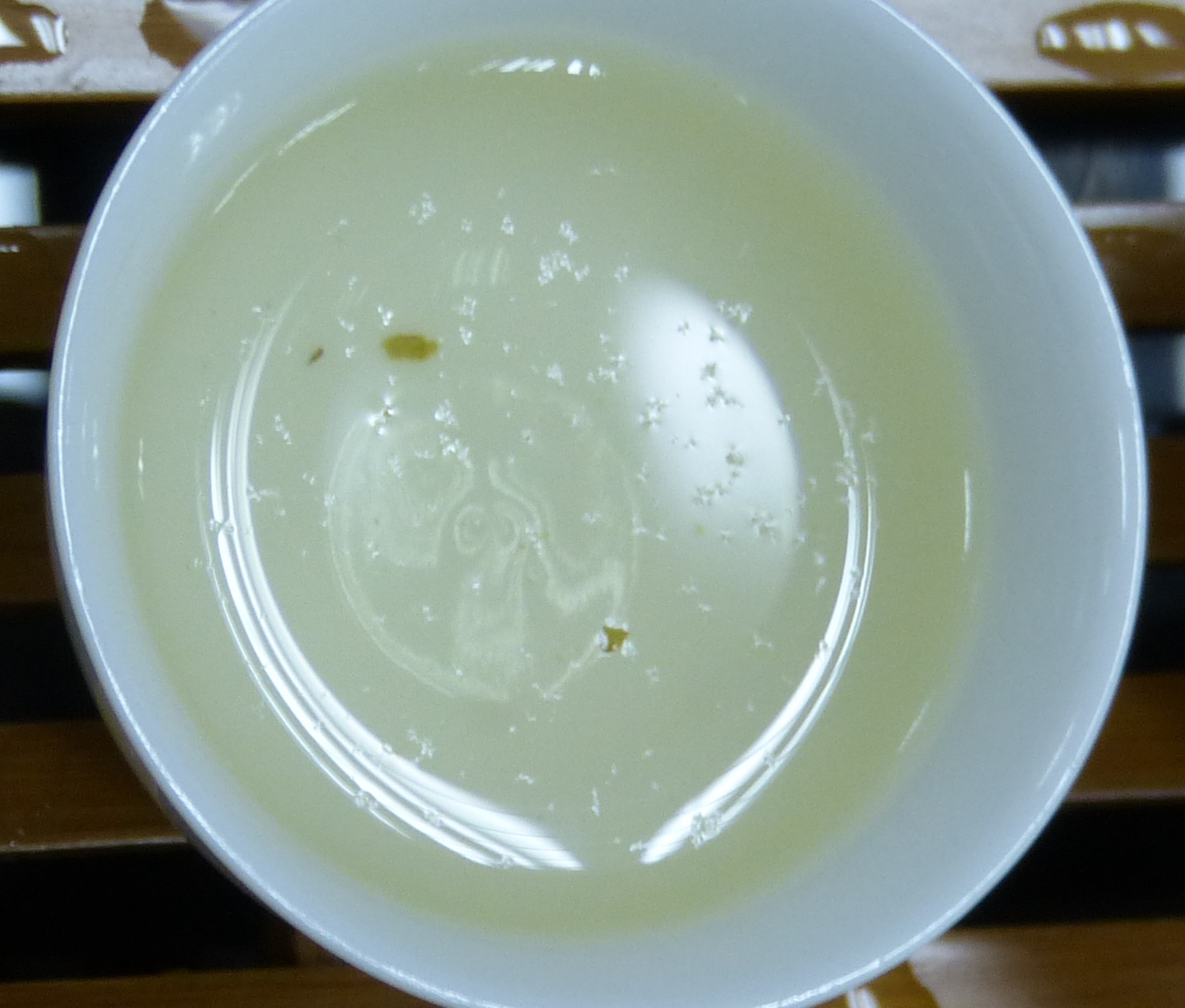


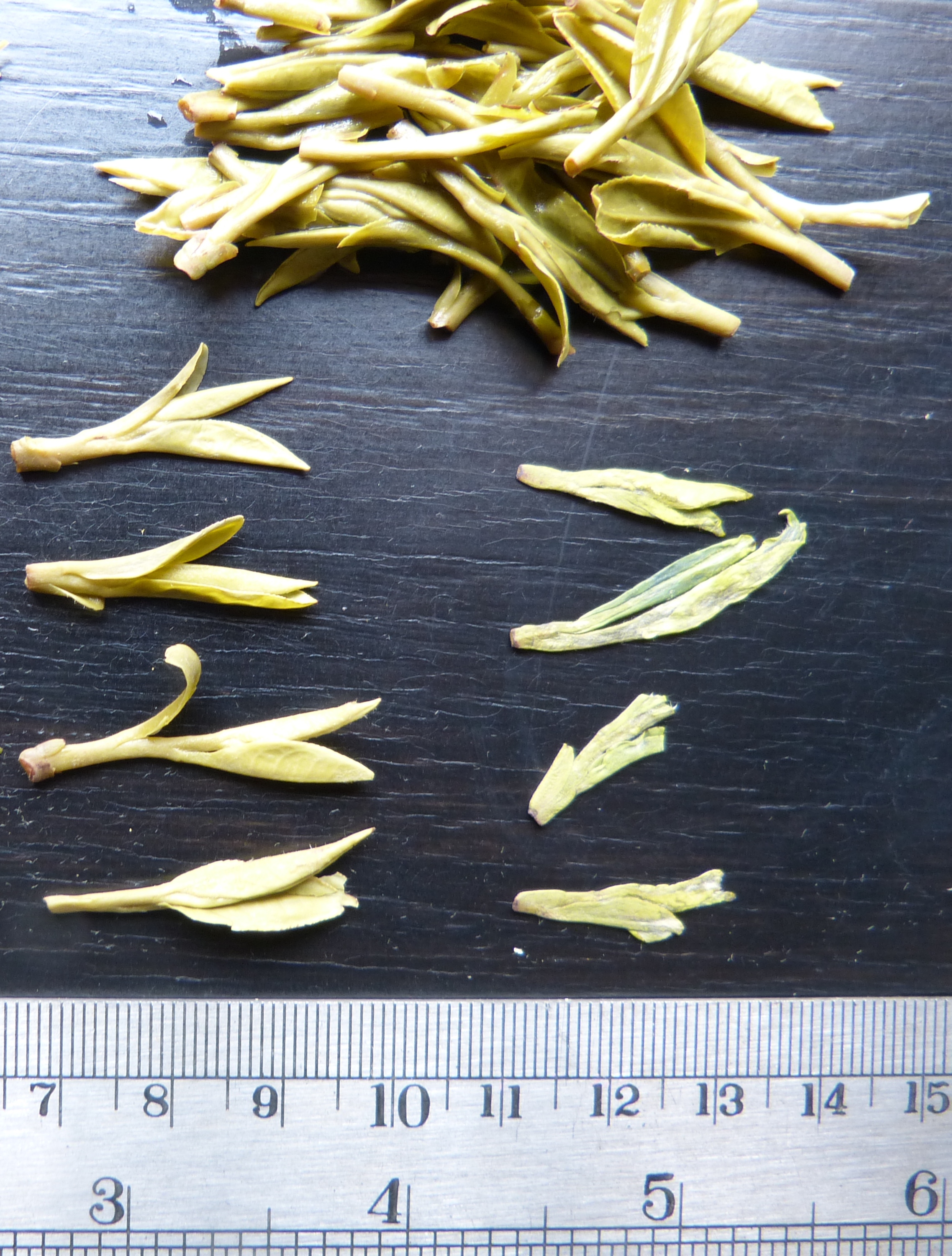




 欣赏茶底,完整无暇的叶心显露,可爱极了。舍不得,还可放进嘴里细细咬。碧螺春茶味细腻堪慢品,各个状况的外形也可值得一一观赏。


