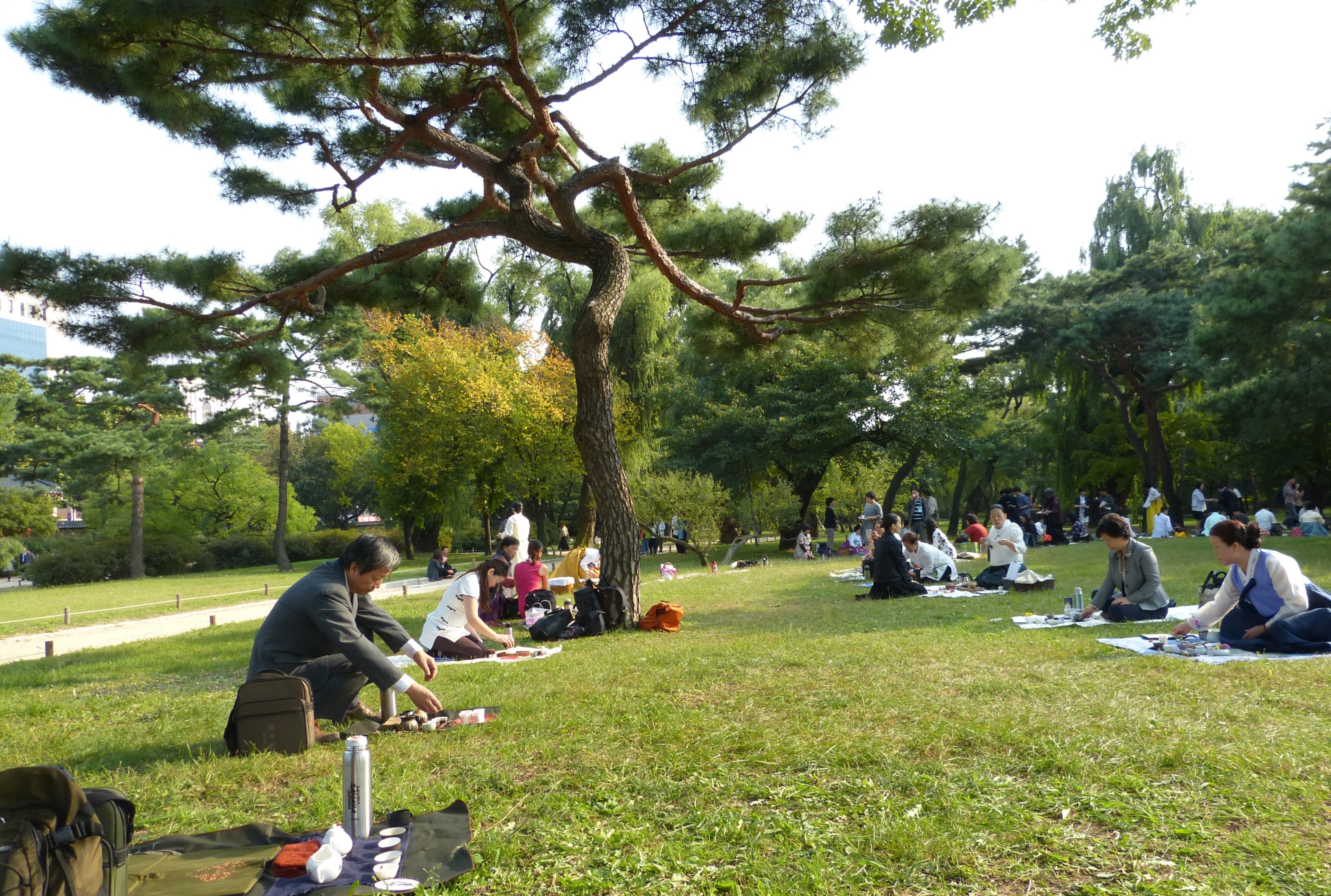
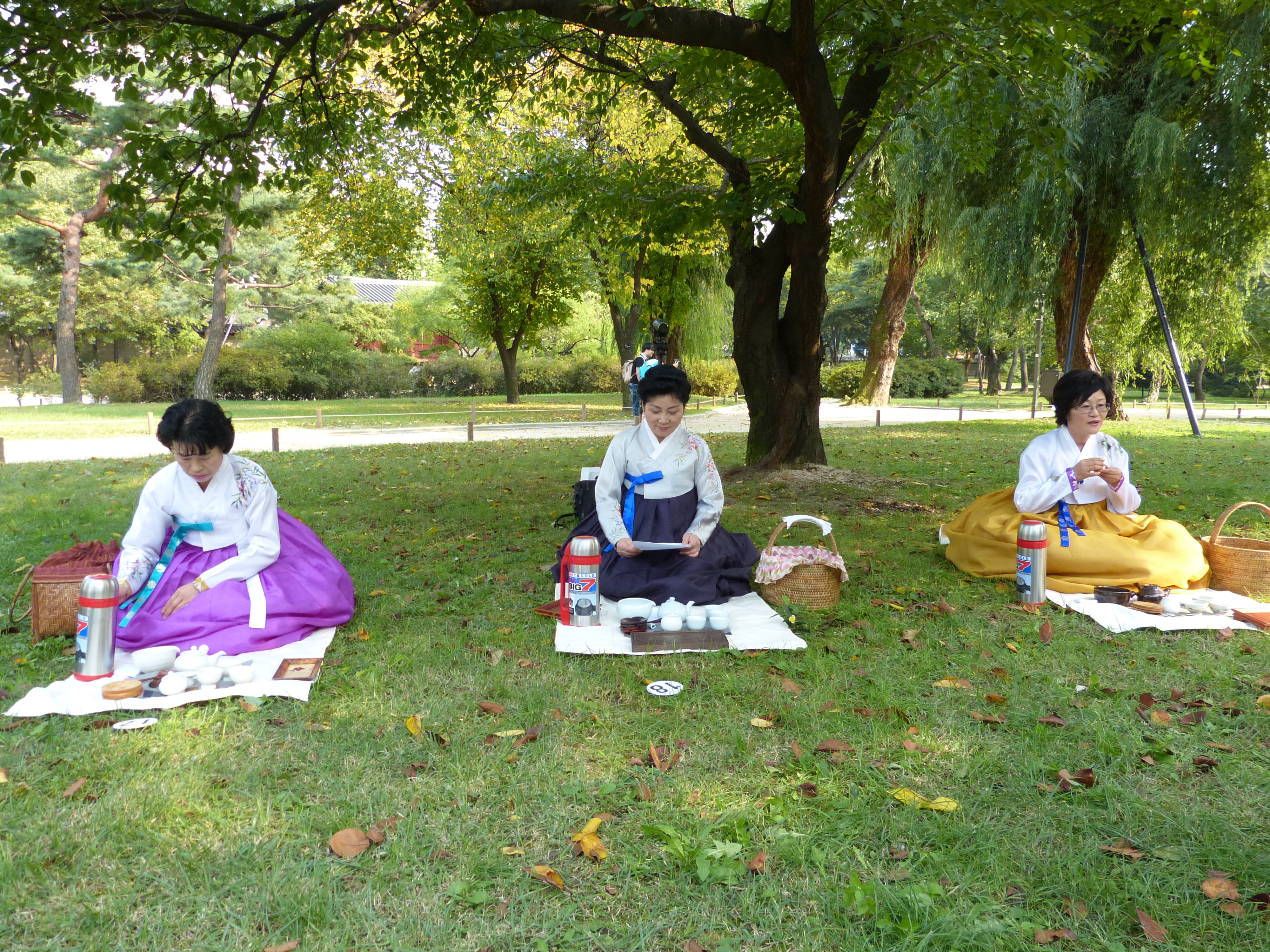
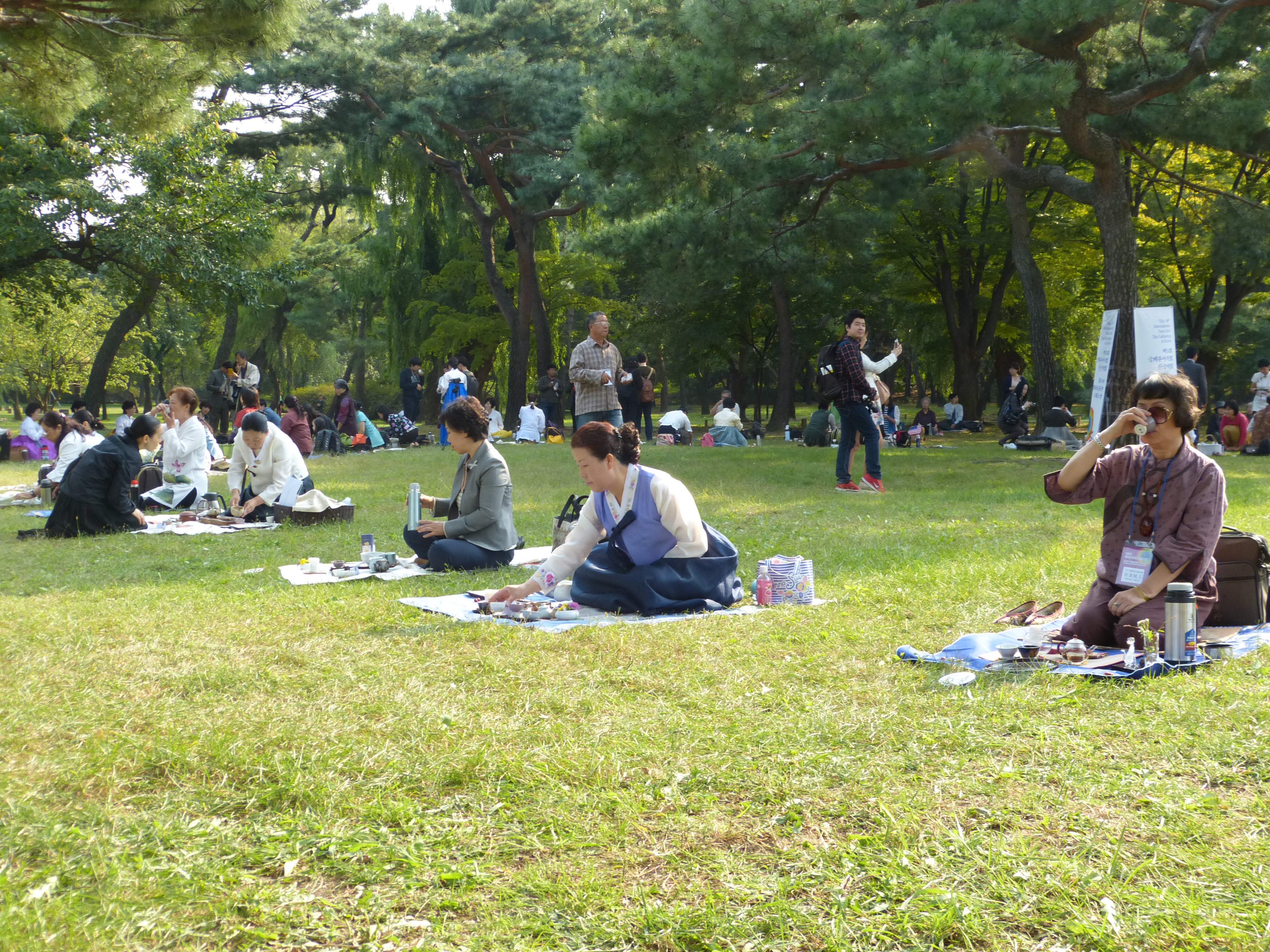
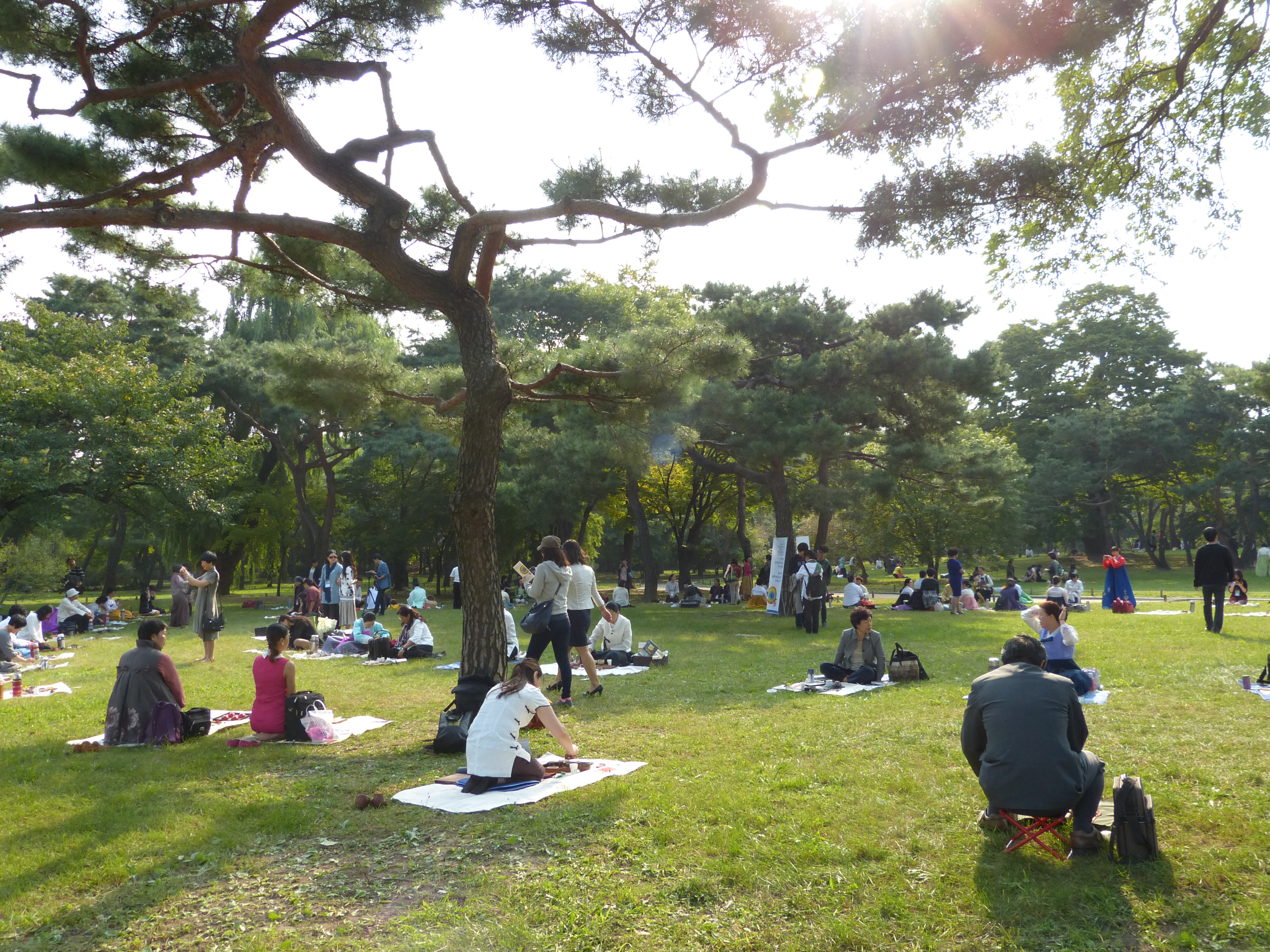
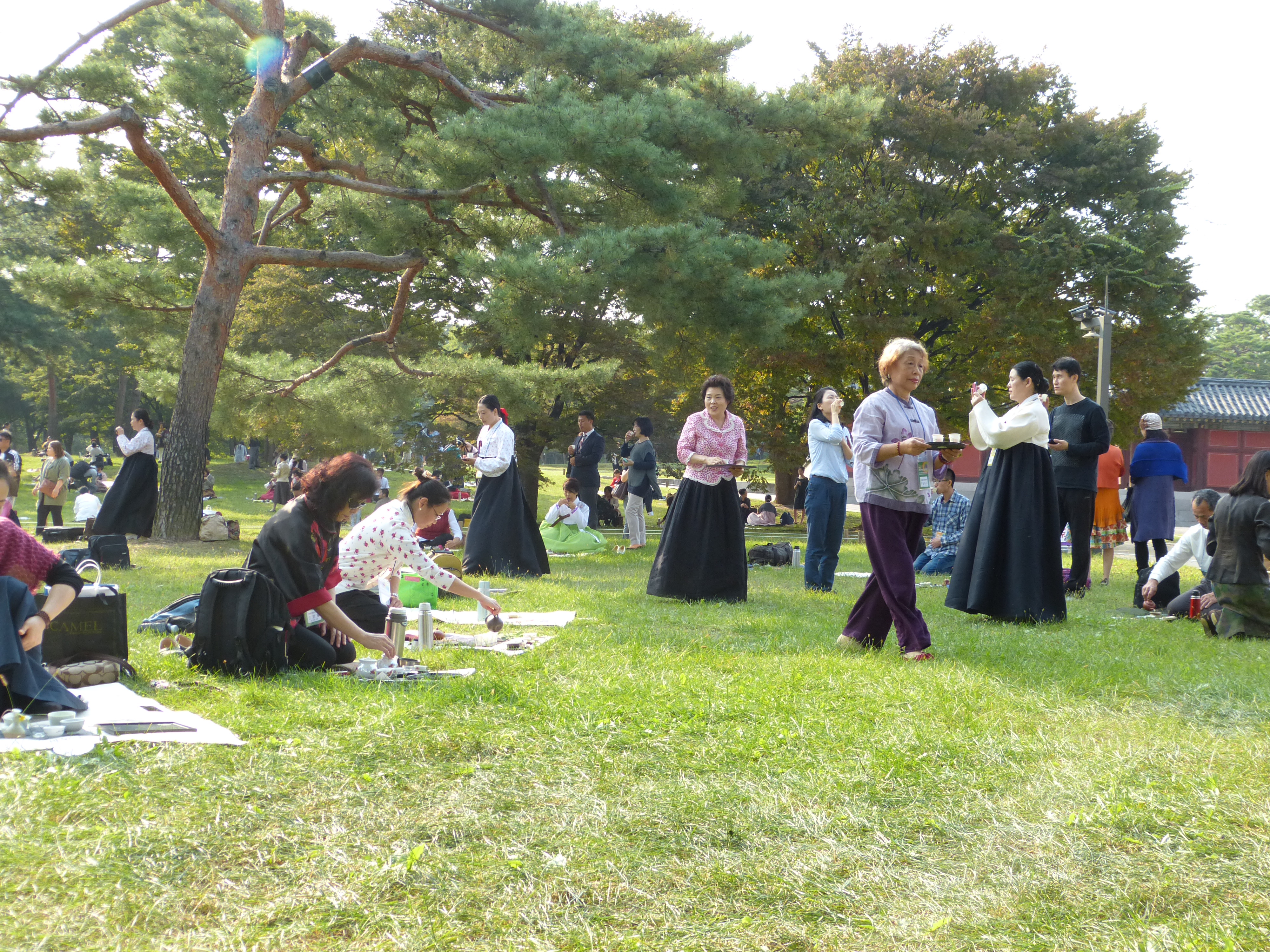
第14届国际无我茶会,2013.10.12第1场,在首尔昌景宫。
 (1888)
(1888)
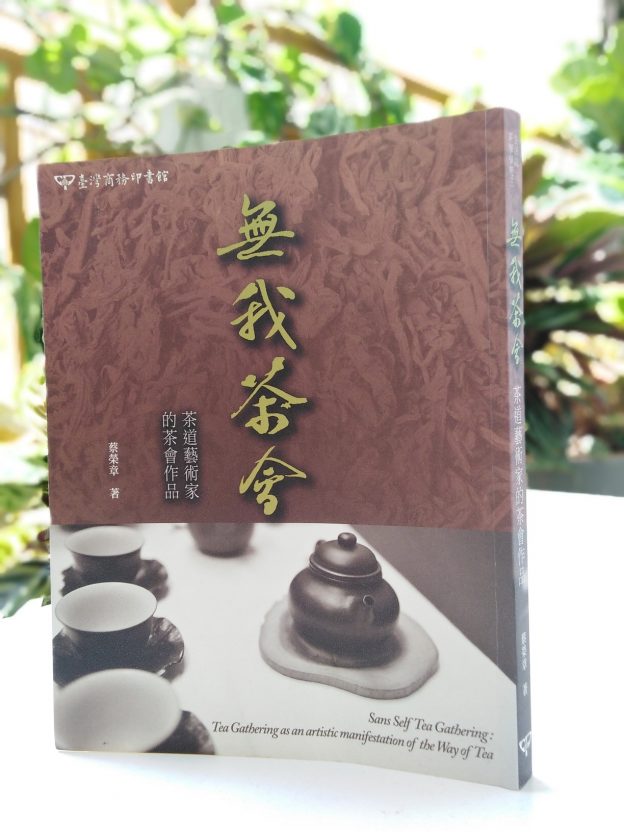
許玉蓮的跋–無我茶會的理想國《無我茶會-茶道藝術家的茶會作品》蔡榮章著
二0四八年二月一日.晴
我拿著老師給我的地圖,來到地球北緯24°4′51″,東經117°31′54″的所在地,那裏有個小山坡,斜坡路兩旁有大樹有草,空氣是靜、涼的。我一步一步往上走,坡上原來有座木头筑造的平台,由十二根大树头架起,約比我矮一點的高度,其棚顶用帆布遮盖,其南、北、西三面由許多蔓延性植物披挂下來當作圍牆,東面敞開,只見平台上滿滿坐了一地的年輕人,他們正全神貫注聽著面前一位長者說話。我再走前幾步, 只聽到那長者說: 「無我茶會最重要的是把茶泡好………」,我蹑手蹑腳爬上平台與那群年輕人坐在一起,一會兒,不懂從那裏走出一位少年,雙手捧著一碗茶畢恭畢敬奉給我。就這樣我也聽了半天長者的泡茶課。
太陽下山的時候,下課。那少年又冒出來把茶碗收回去。
我問:你們在做什麽?那長者是誰?
他說:他是我們茶道長者,已經百歲,定時在這茶道講壇開課,每一社區有志要成爲茶道老師的人都要來這裏聽他的課,我自小媽媽就叫我來做茶道義工,他住在講壇後的小屋,有十三位像我這樣的學生,輪流侍奉他的生活與上課所需。今天是我的奉獻日,我要負責老師的飲食和茶事。
隨後我說我要找地方投宿,奉茶少年說可住入他家,所以我就住入他的家了。
二0四八年二月二日.有風
奉茶少年要去探望舅舅,我跟著一起去。他說:半年前舅舅突然患疾,醫生一直無法醫治,舅舅便回到家裏修養。
到了舅舅家,看見有三個男人圍聚大飯桌,埋首在一張畫滿箭頭的地圖紙。
少年說:舅舅在我們社區的下水道防漏工作部服務了二十多年,他天天在下水道鑽來鑽去,最熟悉整個下水道的形勢、方向和道路的駁接補漏情況,他要在離世前把這些所有實際經驗都記錄下來,他說現有的地圖已經過時。那兩位是自願來幫忙畫地圖、代書的大學生。
舅舅看見我們,叫我們過去,指點給我們看下水道的來龍去脈。他因疾頭發脫落,身體瘦弱,說話聲音低低的,精神卻靈活。
舅媽捧出茶來,一碗一碗交我們手上,陪著我們喝。
茶後她問舅舅:社區豪華大墓園的人剛剛又來推銷豪華大喪禮,問你要不要預購?
有個小女孩從舅媽身後閃出來,抱著舅舅,她說:爸爸吩咐我們無須擔心,把他的骨灰撒在一號山頭就可以了。
二0四八年二月三日.大晴
早晨醒來,少年全家高高興興換上幹淨衣服,利落地各自准備了茶葉與茶具,說要泡茶去。少年叫我也收拾一套。
他說:我們每一個社區每周有自己約定的時間,到茶道廣場進行無我茶會。
我說:誰會去?
他說:大家都去,包括地方首長、明星、左鄰右裏,大家會將那個早上時間預先安排好,真走不開的話,每個家庭也有代表去。
我說:誰做工作人員呢?
他說:誰做都可以,我自小知道那個工作團好像自然形成的,誰有時間就誰做,誰要請假便找人代替。
抵達茶道廣場,大家默契地進入無我茶會的律動。
觀摩聯誼時聽到兩位老人對話,記錄如下。
甲:無我茶會強調對「無」與「有」的信念,到底是怎麽回事?
乙:你不喜歡的,就把它忘掉,那是「無」, 重新建立你喜歡的,那是「有」,生命永遠在你掌握之中。
甲:名譽地位是我喜歡的, 就無需丟棄了?
乙:不丟棄會變成包袱,要丟棄, 要不在乎它。重新再建構你喜歡你覺得榮耀的名譽與地位。每天清晨起來, 還沒有想到什麽事之前,是多麽輕松,我們每次參加完無我茶會都要還原成那個「什麽都無」的樣子,再去重建新的「有」。
甲:如果我原來就「無」任何東西,要怎麽建立「有」?
乙:如果原來就一「無」所有,原來就窮困潦倒,那窮困潦倒就是原來的「有」,現在要把它丟棄,從「無」中重建新的「有」,重建新生命。
二0四八年二月四日.陰
吃完早飯,少年的媽媽邀我入茶席,精精致致地泡了一道茶給我喝,並告訴我少年回校參加升學研討。學校聘請了各個學派的專家來演講,讓學子了解各流派學說以及自己的興趣後才思考進修那個科系。他會在校裏呆上一天。
媽媽叫哥哥帶我四處走走。哥哥說:散散步吧。我們就出發了。走到河邊銀杏樹下,我們發現一只跌失的錢包,厚厚的裝了很多鈔票,哥哥拾起幾根樹枝,在地上豎起成三腳架的樣子框住錢包。
我問:有什麽作用?
他說:讓路人看見,別把它原本位置錯亂,讓失主回頭找時容易發覺。
過了河,漸漸走到熱鬧街道,我們在候車站停下來,候車站有一排電腦設備,有幾人在操作,哥哥也去排隊,我問他要做什麽?
他說:報稅。政府定時告知確實的繳稅額。我們從銀行轉賬即可。
約五分鍾後,哥哥辦好了,他又告訴我政府各有關部門的計劃、事項、工程等都可以在路邊這些電腦系統詢知、討論和跟進。
接著哥哥帶我到市立圖書館,我們在歷史資料收藏室找到一位年輕管理員,哥哥把資料冊子交還,找了另一份新的資料擬登記帶走,年輕管理員望望那份資料的題目和日期,與哥哥說:這一份還不夠呢,另有三份更詳盡的類似資料,在某櫥某格某編號。
二0四八年二月五日.陰
傍晚,少年的爸爸給我們煮茶,正喝著時,鄰居氣敗急壞走進來說:新聞報道 A作家跳樓自殺,死了。他是我最喜歡的作家。
我們問:爲什麽呢?
鄰居說:都說他過時了,不受歡迎了,大衆都不買他的書了,他受不了這種冷落而消沈。
爸爸給鄰居大大力的擁抱,再給他一碗茶喝。大家一時間都陷入無言。
臨睡前,我聽到少年與爸爸在陽台上對話。
少年:人死了是何意義?
爸爸:完成了這一輩子的「活」、 這一輩子的「有」。
少年:死後又是什麽?
爸爸:死就是這輩子的結束,是種「無」 。
少年:死後的肉體與靈魂呢?
爸爸:都分解成各種最基本的原素了, 只是快慢不一。
少年:爲什麽快慢不一?
爸爸: 火化最快,自然腐化第二, 在冷凍環境最慢。靈魂分解速度與意志力有關。
少年: 分解後呢?
爸爸:再被其他生物與非生物所用, 不論是肉體的還是靈魂的。
少年:生死也是一種「有」與「無」?
爸爸:對,死是「無」,還原成各種基本原素是「有」, 基本原素組成新的生物或非生物又是另一次「無」與「有」。
少年:基本原素組成新的生物是不是叫投胎?
爸爸:不是, 只是原素的重新組合, 包括了生物與非生物。
二0四八年二月六日.雨
期限已到,我來到我第一天抵達的地方,准備啓程回家。
在一片細雨中,我看見茶道讲坛变了样子,其棚顶、其南、北、西三面墙由一种我不知名的金属器覆盖着,估计以防风雨,許多年輕人穿着雨衣往茶道講壇的方向走去,已经在平台上的年轻人魚貫而入找到自己的位置就坐下。同一時间,我也看見那茶道長者撐著雨傘緩緩走上講壇。
二0一三年二月一日.晴
回到家第一件事情,我打開筆記本,看看本學期最後一個研究項目,老師出的題:「你去看看他們的無我茶會做得怎樣了,地址與時間在這裏」。我將考察日記作爲交給老師的報告, 並在總結欄記下我觀察所得的答案:一切無恙,繼續前行。
許玉蓮
二0一三年一月六日
于紫藤茶藝學習中心
 (2667)
陆羽茶道教室的经营模式
蔡荣章
20130925周三小方块WEDNESDAY TEA CORNER
台北陆羽茶艺中心的茶道教室1981年1月4日开始第一个班别“茶艺讲座”的上课,这个阶段的上课是免费的,包括上课使用的茶叶、茶具与非泡茶课时每人的盖碗茶(泡茶课时已经有茶喝了)。但必须繳交新台币500元的保证金,8次课上完,泡茶考试与学科考试及格取得结业证书后退回保证金。缺课时可以在以后任何一期补上所缺的那次课,考试不及格时也可以在以后任何一期的同样考试时补考,不必再繳费用,补完课、补完试,依旧发给原期的结业证书并行退费。
除了基础班的茶艺讲座,后续开设的班别亦复如此。为执行上完课才可毕业的规定,每次上课必须签到,缺席的那次必然是空白,等补课时方行补签。
保证金的收费方式一直维持到1986年,为求茶文化教育的独立发展,改变成收费的制度。开始是将保证金的500变成收费的500,然后逐渐调高,从800到1000,从1000到1200、2000元不等,依课程所需的成本而定。收费的制度下,依然是上完全部学时并通过考试才发证,补课补考依然不另行收费。但是这样的收费标准,直到目前仍然无法支付包括房租在内的所有成本,除非班别密集得天天午晚皆是,每班的学员数都能够在30以上。
陆羽茶艺中心之所以能够采取这种几近公益式的教学方式,是因为它另有茶具开发部门,生产的茶具透过关系企业天仁茗茶与天福茗茶的销售网向外销售。“陆羽茶艺”品牌的茶具支持着教学,教学支持着茶具的研发(包括知识的与形象的),但这种做法要依赖经营者对茶文化的支持、相信茶文化与企业的永续经营是相互链接的,而且拥有经济支撑项目的营利能力。还得告诉学员,让有心办好茶学教育的单位能够赚钱,我们才能够享受更好的品茗氛围。陆羽茶道教室至今仍然处于需要扶持的状况,茶文化的私塾教育要能健康发展,学习费用还得提高,大家享受茶汤与茶道艺术(不只是茶叶商品)的需求还待大大醒觉。
1996年4月13日为期一年的师资班开课后,上完全部课程后才能结业的办法改成了:出席率达到80%以上(长年上课要一次不缺是不容易的)。补课的规定依旧,虽然必须等到一年后(尚无法并排开两个师资班)。可以补足80%的出席率,也可以补满全部课时。
陆羽茶道教室为了可以贯彻泡好茶的理念,制定了两个非得把茶泡好的制度与课程:
a. 从1983年起每年举办1-2届的泡茶师检定考试。检测的办法是在各类茶中抽取三样,依指定的茶具与供茶需求(如泡几道、泡给几个人喝),在40分钟内把茶泡出。如果能将茶汤泡出一定标准,且有80%以上的稳定度,就可通过术科考试,再通过学科考试(制茶、识茶、泡茶、茶具、茶史等方面的知识),就可以取得泡茶师证书。这个泡茶师检定考试的制度,除引导大家重视泡茶、重视茶汤外,也培养一些能够泡好茶的茶文化工作者、在茶事活动上有批精炼的先锋部队。
b. 除了1982年12月开设的泡茶讲座外,复于1999年10月25日起开设了“泡茶研习班”,利用“车轮式泡茶练习法”,一组五六位学员轮番上阵,第一位就坐后“置茶”与泡第一道,第二位泡第二道,第三位泡第三道,—-第五位泡第五道并去渣清具。每道茶冲泡之前都将茶壶传阅,每人看淸壶内的茶况,记录下自己所判断的“浸泡时间”。等茶泡好,大家品赏过茶汤,老师做出标准浸泡时间的判断(茶汤浓度标准时则依原冲泡时间,不标准时则提出标准时间)。每人算出自己的误差值(秒数),五道以后再计算总误差。就这样一次又一次地练习,以不同的茶叶与茶具为题,求得误差值的减少。这种泡茶练习除对茶况的认知外,必须关注置茶量、水温、前数泡的太浓或太淡、与前泡“间隔时间”的长短、茶壶出水的速度等等,是学习掌握茶汤浓度很有效的办法。
上面不厌其烦地介绍陆羽茶道教室在“学茶者必须认真且付出代价的学习” 、“必须具备泡好茶能力”的理念下所做的努力,也说明一个茶道教室,不论是学校体系还是民间的单位,有了思想与目标的指引,它的课程体系才容易显得有个性与富生命力。
(2024)
《無我茶會-茶道藝術家的茶會作品》Sans Self Tea Gathering:Tea Gathering as an artistic manifestation of the Way of Tea
2013.10.01,臺灣商務印書館:The Commercial Press,Ltd.
ISBN:9789570528749
蔡荣章自序:無我茶會——茶道藝術家的茶會作品
第一章無我茶會的基本形式與做法
001.無我茶會的基本形式
002.無我茶會特殊做法及七大精神
003.無我茶會為何非要單邊奉茶不可
第二章場地問題
004.室內以什麼場地為宜
005.室外以什麼場地為宜
006.一定要在幽靜與風景優美的地方舉辦嗎
007.下雨怎麼辦
008.舉辦夜晚無我茶會時,場地需要多亮的公共照明
009.地形特殊,無法達成連續性隊形,怎麼辦
010.在舞台從事示范性表演時的座位排法
011.作為紀念性無我茶會時,場地如何應變
012.席地而坐時,一個人的空間需要多少,兩人相隔的距離該多少,座位前面應保留多少活動空間
013.這個場地能容納多少人
014.茶會在野外舉行,衛生問題如何克服
第三章場地的准備
015.場地規划圖
016.座位的標示
017.號碼牌的排列方向
018.「向心坐」與「背心坐」
019.場地有外人走動時,怎麼辦
020.與圍觀群眾的區隔方法
021.號碼牌的制作
022.座位標示圖的應用
023.茶會名稱的標示
024.音響的設置
025.解說員與表演者的位置
026.紀念性無我茶會
027.座位的控制
第四章報到時段
028.抽簽、簽名等報到手續
029.人多時,如何縮短抽簽與簽名的時間
030.報到人數的掌握
031.人數與座位的控制
032.想讓沒帶茶具的朋友也一起參加茶會,怎麼辦
033.以無我茶會作為歡迎茶會時怎麼做
034.帶着幼兒一起參加,應否設置「母子簽」,坐折疊椅區者如何抽簽
035.「對時」如何實施
036.要設「引導人員」嗎
037.茶會進行間要不要有專人負責臨時發生的事情
038.缺席的座位號碼牌如何處理
039.工作人員何時入場
040.遲到的人怎麼辦
041.表演者、解說員等的座位安排
042.因無可奈何的原因使得茶會無法依原定時間進行,如何補救
043.無我茶會是大家一起參與的茶會
第五章與會者會前的准備
044.無我茶會茶具「精簡」的要求
045.無我茶會的基本道具
046.無我茶會的「茶具」應注意哪些使用上的功能
047.如何攜帶茶具才好
048.保護茶具的包裝器材有何應留意的地方
049.帶什麼「茶」才好
050.「茶」如何攜帶
051.泡兩種茶葉時,茶具如何准備
052.泡茶用水的准備及對保溫瓶的要求
053.無我茶會就座的方式
054.坐墊的功能要求
055.會前下過雨,或擔心坐在有泥的地方,應增加什麼配備
056.無我茶會的服裝與鞋子
057.茶會間安排有茶食享用時,如何准備
058.無我茶會泡茶法舉例之一:小壺茶
059.無我茶會泡茶法舉例之二:蓋碗茶
060.無我茶會泡茶法舉例之三:抹茶
061.上述泡茶法舉例,為何都沒有提到溫壺、燙杯等動作
062.無我茶會對「夜晚茶會燈」的要求
063.參加無我茶會應達成多少目的
064.如何輕松愉快地享受無我茶會
065.逍遙於茶會的廣場
066.無我茶會的茶具就是「旅行用茶具」
第六章就位與聯誼時段
067.每人的坐墊應如何放置才會整齊
068.就座后號碼牌如何處置
069.杯子正放還是倒扣的好
070.向圍觀者奉茶時,對外奉茶的杯子要陳列出來嗎
071.安排有「供應茶食」時,帶來的茶食要不要擺放出來
072.夜晚無我茶會時,茶會燈放哪兒比較好
073.戶外風大時怎麼辦
074.茶會前下過雨,場地潮濕怎麼辦
075.戶外昆蟲的問題
076.「茶具觀摩與聯誼」何時開始、何時結束、有何替代方案
077.茶具觀摩的禮節
078.如何發揮聯誼的效果
079.如何對圍觀群眾發放「簡介」
第七章無我茶會的泡茶與奉茶
080.無我茶會使用「簡便泡茶法」
081.何時開始泡茶、何時開始奉茶
082.第一道如何奉茶,杯子放在哪里
083.奉茶時,杯子由誰拿取,無法蹲下的人如何奉茶,走動不便的人如何奉茶,盲友的茶會如何應變
084.第二道以后如何奉茶
085.奉茶時要不要說「請喝茶」,被奉者要不要說「謝謝」
086.奉茶一定要依前后的次序嗎
087.奉茶時從座位的哪一邊出去
088.奉茶時遇「空位」及「不泡茶者」,怎麼辦
089.若許多位「品茗后活動」的表演人員未能一起泡茶,如何讓他們有茶喝
090.若設有解說員,如何奉茶給他
091.如何奉茶給圍觀的人
092.泡茶杯數與泡茶次數如何決定
093.泡兩種茶時,如何操作
094.泡茶用水不足時,如何補充
095.茶會間若安排有茶食享用,如何進行
096.茶會沒安排供應茶食,可因自己泡抹茶而提供茶食嗎
097.紀念性無我茶會等特種場合的奉茶法
098.對圍觀者的詢問及要求,如何因應
099.奉茶間的禮節
100.什麼時候開始喝茶,從哪一杯開始喝
101.喝茶時應快快地喝還是慢慢地喝
102.茶葉浸泡期間,做什麼才好
103.泡茶進度超前或落后時,有何調節的方法
104.如何避免攝錄像破壞氣氛
105.無好惡之心的真諦
第八章品茗后活動與收拾
106.何謂「品茗后活動」,如何進行,與「會后活動」有何不同
107.品茗后活動如何與演出者協商
108.品茗后活動要不要設置表演台
109.泡完茶,要不要當場清理茶具
110.如何預防收拾茶具后,壺盅的殘水外流
111.收拾茶具前之擦杯動作,意義何在
112.何時開始擦拭自己用過的杯子
113.收杯禮節
114.茶具如何收拾
115.泡茶結束后還剩有茶湯怎麼辦
116.個人泡茶位子的復原
117.茶會如何結束
118.公共設施的收拾
119.茶會后全體合影
120.有些「人」或「事」需要特別感謝或說明時,怎麼辦
121.無我茶會表現的茶道藝術
第九章茶會進行間
122.奉茶方法發生了錯誤怎麼辦
123.別人奉給您的茶少了一杯,怎麼辦
124.所泡的茶倒不完怎麼辦
125.遇到自己喝不下的茶怎麼辦
126.不愛喝茶,或今天不能喝茶,但又喜歡參加茶會,怎麼辦
127.奉茶時,發現自己的前一杯茶尚未被喝掉,怎麼辦
128.收杯時,遇到剩有茶湯怎麼辦
129.茶沒泡好,可以做些補救措施嗎
130.泡茶時發現水量或泡出的湯量明顯不足,有何應變方法
131.可以倒一杯給反方向的芳鄰嗎
132.杯子的衛生問題
133.不知道喝的是什麼茶,可以問嗎,可以贊美他嗎
134.最后一道茶奉完,可以走到景仰的人那兒要杯茶喝嗎
135.會后可以與別人交換茶具作紀念嗎
136.茶會結束后可以再約些人原地繼續泡茶嗎
137.無我茶會可以使用非茶的飲料嗎
138.無我茶會錯誤最多的地方
139.無我茶會的「自由」與「法制」
第十章主辦單位的會前准備
140.舉辦無我茶會的時機
141.如何擬定無我茶會的名稱
142.勘察場地
143.有哪些工作需要專人負責
144.誰是無我茶會的工作人員
145.「公告事項」的制作
146.「會前說明會」的舉辦
147.「工作檢查表」的應用
148.茶會記錄
149.如何掌握參加的人數
150.無我茶會的各項進度需要多少時間
151.參加無我茶會的人,應如何識別
152.無我茶會要義圖
第十一章茶會的推廣
153.無我茶會推廣工作如何進行
154.將無我茶會列入茶道教育課程
155.四學分的無我茶會課程安排
156.無我茶會又為茶道加了藩籬嗎
157.無我茶會道場的設置
158.無我茶會茶具完整性的重要
159.無我茶會的機動性與擴充性
160.如何使無我茶會的風格與特性突顯出來
161.無我茶會是隨意還是嚴謹
162.無我茶會為什麼不設貴賓席與長官致詞的時間
163.無我茶會進行間為什麼不放音樂
164.「品茗后活動」演出人員最好也是參加無我茶會的人
165.推廣性無我茶會的舉辦
166.無我茶會在其他場合的應用
167.無我茶會的英、日、韓譯
168.什麼是無我茶會的國際組織
169.無我茶會需要統一的會旗與會歌嗎
170.無我茶會的傳播
171.無我茶會的字面意義是什麼
172.無我茶會不只是一種茶會形式
173.一人到千萬人的無我茶會
174.無我茶會的四美
175.無我茶會是要求精致的一種茶道體系
176.無我茶會對個人與群體的影響
第十二章無我茶會簡史
177.無我茶會的創辦
178.無我茶會的出生背景
179.為什麼有無我茶會的誕生
180.從獨飲到無我茶會
181.第一次無我茶會的舉辦
182.第一次公開舉辦的無我茶會
183.第一次國際無我茶會
184.無我茶會專書的出版
185.第一座無我茶會紀念碑在武夷山
186.從「無我茶會推廣委員會」到「國際無我茶會推廣協會」
187.無我茶會大事年表(1989~2015)
第十三章對外解說稿
188.無我茶會解說稿
许玉莲跋1:無我茶會的理想國 (2921)
《無我茶會Sans Self Tea Gathering (Wu-Wo Tea Ceremony)180條》
蔡荣章著Author:Rong-tsang Tsai
ISBN 978-957-9690-08-9,“无我茶会Sans Self Tea Gathering(Wu-Wo Tea Ceremony) 180” ,First edition: 1999.9, Second edition: 2010.9.《无我茶会180条》,1999.9第一版,2010.9第二版.台北陆羽茶艺股份有限公司.2012.05.20修订版.-English Translator : Katherine Yip,英语翻译:叶德明.
Chapter 14 Presenter’s Script for Sans Self Tea Gathering
A Sans Self Tea Gathering requires neither an event director nor master of ceremonies. However, the Organizer may assign a presenter to brief observers about the procedure and the meaning behind this unique form of tea gathering, if it is held in public. Such arrangement helps promote Sans Self Tea Gathering; it facilitates understanding of the concept, which is not to be confused with event facilitation.
Presenter’s Script for Sans Self Tea Gathering
| Steps |
Subject |
Talking Points |
|
1.Placing of number plates |
a. Event report |
a. Ladies and gentlemen, we will be hosting a Sans Self Tea Gathering at __________ (time). Please join us. During the tea gathering, our fellow brewers will be offering tea to you. |
|
b. What is Sans Self Tea Gathering |
b. Participants of Sans Self Tea Gathering bring along their own tea wares. Seated in a circle or loop, they serve tea to fellow tea drinkers; this way, each participant enjoys tea brewed by different persons. It is essentially a form of tea gathering where everyone brews, serves and drinks tea. | |
|
c.On-site happening
|
c. Seat number plates are being placed. Participants are seated in a circle or loop. Later on, they will take their places according to the numbers they have drawn. This realizes the first principle of Sans Self Tea Gathering, namely “there is no hierarchical differentiation.” |
___(number) participants are attending this tea gathering; therefore, the number plates will be arranged in __(number) circles or loops.
d.Engaging the crowd
d. Ladies and gentlemen, today, each participant will be brewing four cups of tea, two of which will be served to you, our dear guests. Please stay with us. You will get to enjoy different types of tea (including those from Japan, South Korea, China ……).
e.Introducing the main and co-organizers
e. This Sans Self Tea Gathering, entitled _________(name of tea gathering), is held in conjunction with the _______ (occasion). It is organized by (the International Sans Self Tea Gathering Promotion Association) (and ____), and co-organized by _____. The Organizers wish to express their gratitude to the parties and individuals who have lent us their assistance and support.
2.Signing in
a. Drawing lots
a. Ladies and gentlemen, as you can see, the participants are arriving. Seats are determined by random drawing; no one knows who will be next to them until they are seated. This embodies the spirit of the tea gathering whereby we accept things the way they are – there is no hierarchical differentiation.
b.Participating parties
b. Participating in today’s ____ (name of tea gathering) Sans Self Tea Gathering are (all) fellow tea drinkers from ____ (I can see participants (from Japan) coming in….) .
c. Taking the seats
c. Participants are now taking their places according to the drawn numbers; some of them are already taking out their tea ware.
d. Tea Utensils
d. Ladies and gentlemen, take a look at these tea wares, how they are wrapped and being carried about. Tea ware for Sans Self Tea Gathering should be kept simple. Hot water is stored in the participants’ thermal flasks. There are different kinds of tea ware, too, including those for (matcha). Participants are free to make their choices of tea ware and brewing methods, thus realizing the second principle of Sans Self Tea Gathering: that “there is no restriction as to the school or regional practice in brewing”
e.Tea ware appreciation and networking
e. When tea ware is laid, participants may proceed to appreciate others’ tea ware, and greet and talk to each other. This is what we called the “Tea Ware Appreciation and Networking” session. It is a good time for photos; once brewing begins, no photos are allowed. Participants may ask non-participants to take photos for them outside the circle.
If the owner is not around, or no permission is given, participants should not touch the tea ware of the others when they are appreciating it.
3. TeaBrewing
a. When to brew tea
a. When the “Tea Ware Appreciation and Networking” session is about to end, participants will return to their seats and begin brewing. Timing is stated in the “Notification” distributed prior to the tea gathering. There is no event director or master of ceremonies at the venue; everyone follows the pre-determined schedule, just as the third principle of Sans Self Tea Gathering goes: “Everyone follows pre-agreed arrangement”. When there is no event direction at the tea gathering, people could focus on the beauty of collective rhythm. Today, I am here to explain to you what Sans Self Tea Gathering is all about. Imagine I was not here talking, the impression of the tea gathering would be much more graceful.
b. Venue clearing
b. When brewing begins, the area inside the circle or loop formation must be cleared so as not to compromise the integrity of the venue. Filming crews and photographers have to move out; if necessary, take a few snap shots and leave the area promptly.
c. Observing silence
c. No talking is allowed once brewing begins; everyone will concentrate on making tea. Participants offer tea to each other without verbal exchanges, such as “thank you” and “have some tea, please” – a slight bow, and a smile, is enough. A peaceful and tranquil environment is conducive to an aesthetic experience and the bond between people, matters and space the tea gathering brings. This is another characteristic of Sans Self Tea Gathering, namely “Appreciating mutual-understanding and the beauty of collective rhythm”.
d. Ways of serving tea
d. Ladies and gentlemen, now you will see how tea is served. Each participant offers tea to the three fellow participants on his (left), and reserves the last cup. This way, tea is served in the same direction. “Uni-directional flow of tea serving” is a rule of Sans Self Tea Gathering. When you serve tea to your left and receive tea from your right, you are “expecting no action of reciprocity”, which is one of the seven principles of Sans Self Tea Gathering.
e. Setting aside personal preferences
e. The four cups of tea a person drinks could be entirely different, because the choice of tealeaves is personal. Sans Self Tea Gathering wishes each person to accept and appreciate tea without letting personal preferences get in the way. Preference rules out things you don’t like, which could be something intrinsically wonderful. By rejecting, we could be depriving ourselves of the blessings in life. “Setting aside personal preferences” is the way of tea that Sans Self Tea Gathering advocates.
f. Getting better each time
f. Not all tea is masterfully brewed. There may be one or two cups that are downright bitter and astringent. When this is the case, we should ask ourselves: “Have I brewed a bad pot, too?” “Brewing a good pot” is basic. Bad brew is a disgrace to ourselves, disservice to the others, and yes, to the tea brewed. “Getting better each time” is one of the seven principles of Sans Self Tea Gathering.
g. Second cup
of tea/round of serving
g. The participants will be serving their second cup of tea to our guests. Today, you will be drinking various kinds of tea brewed by fellow tea drinkers from different places (Taiwan,…). This is indeed a gathering of friendship and goodwill. Hold on to the cup; this will be used for the fourth round of serving.
h. Third cup of tea/round of serving
h. The third cup of tea will be served with the tea pitcher; again, it will be served to the three persons on one’s left with a cup reserved for oneself.
i. Alternatives for the directional flow of tea serving
i.Tea can be served either to your left or to your right. Likewise, it is not a must to offer tea to your three immediate neighbours; alternative arrangements can be made. For example, one may be serving tea to the second, fourth and sixth fellow tea drinkers, or the first, third and fifth fellow tea drinkers next to him, on either side, as long as the arrangement is made clear in the Notification in advance.
j. A brief history of Sans Self Tea Gathering
j. Sans Self Tea Gathering was introduced in Taiwan in 1990. Today, it has won worldwide recognition. This unique form of tea gathering takes place in different countries, including China, Japan, Korea, Singapore, Malaysia, etc. They take turn hosting an international Sans Self Tea Gathering at given years. This year (next year), we will be having the __th International Sans Self Tea Gathering at _______(country/place) in _______(month). You are all welcome to join us.
k. Fourth cup of tea/round of serving
k. The fourth cup is now ready. This is dedicated to all our guests. This time, it could be a different person serving you a different kind of tea. With the Way of Tea, we are encouraged to brew for others, even strangers. This practice is certainly upheld in a Sans Self Tea Gathering.
l. Cups used by the guests
l. Ladies and gentlemen, enjoy your tea. The participants will begin packing their tea ware shortly. To avoid any inconvenience and to stay friendly to our environment, they will collect the cups they have distributed. (If the cups are given away as souvenirs, revise the script)
m. Embracing the ‘beauty of the void’
m. When the last brew has been taken, there will normally be a short session of music appreciation that demonstrates the ‘beauty of the void’ embraced during a Sans Self Tea Gathering. This is a time when participants relish the aftertaste, and refresh their memory on what has happened in the course of the gathering. The music comes on without any introduction and requires no applause. As the music fades away, participants begin collecting their tea ware and the tea gathering is coming to an end. (Revise the script if other forms of post-tea activities are arranged. Omit if no such activities are arranged.)
4. After-tea Procedures
a. Post-tea activities
a. (No explanation is required)
b. Wiping the cups
b. Before packing, wipe each used cup to avoid it being too messy when others come and collect their cups. This gesture is in line with the spirit of the Way of Tea, whereby we put others’ interests first. The tea ware will have to be washed when one is back at home.
c. Collecting the tea cups
c. After wiping the used cups, participants will proceed to collect their tea cups from other participants, (as well as tea cups from the guests, along the way). Silence is still observed.
d. Packing the tea ware
d. After the cups have been collected, pack tea ware properly.
e. Tea ware for travelling
e. Ladies and gentlemen, pay attention to these ‘travel’ tea ware used by the brewers. You may want to prepare a set similar to this, so you can enjoy tea when you are travelling or going out with your family. Note the way these items are packed: Tea cups must come with ‘cup covers’. Two of the cups are ‘hooked’ onto the teapot and bundled up with a wrapping cloth, while the other two cups are stacked with the tea pitcher and bundled up with another wrapping cloth. The idea is to proceed in a well-planned, systematic manner to the very end. There is this common saying: What has begun well must end well.
f. Service Counter
f. Ladies and gentlemen, (The Sans Self Tea Gathering Promotion Association) operates classes on the Way of Tea conducted by experienced instructors at different places. There are also classes on Sans Self Tea Gathering at fixed time and venues. For more information, please proceed to our service counter.
g.Thank you
g. We would like to express our gratitude to ______ for providing us with ______ for the today’s Sans Self Tea Gathering. (Omit if not applicable)
h.The End
h. Ladies and gentlemen, we appreciate your feedback about this Sans Self Tea Gathering. Thank you for participating, and we look forward to brewing tea together next time.
i. Group photo
i. To commemorate this special occasion, we would like to invite all our guests to come together for a group photo.
This Sans Self Tea Gathering has come to an end. We would like to thank everyone for a wonderful time together. See you soon.
(3592)
《無我茶會Sans Self Tea Gathering 180條》
蔡荣章著Author:Rong-tsang Tsai
ISBN978-957-9690-08-9 “无我茶会Sans Self Tea Gathering180,” First edition: 1999.9, Second edition: 2010.9《无我茶会180条》1999.9第一版 2010.9第二版 台北陆羽茶艺股份有限公司.2012.05.20修订版-English Translator : Katherine Yip英语翻译:叶德明
第十四章 無我茶會解說稿
無我茶會進行間是不設指揮與司儀的,但若在公共場所舉辦,為讓參觀的來賓知道是怎麼一回事,也達到推廣的目的,可安排一位解說員從旁說明茶會進行的方式及其意義。但仍然是對外解說的性質,而不是主持茶會的進行。
188.無我茶會解說稿
|
進度 |
話題 |
解說大要 |
|
1. 安置號碼牌 |
a. 活動報導 |
a.各位來賓,本會場將于ˍˍ時ˍˍ分舉辦一場「無我茶會」, 歡迎各位來賓參加,會中每位泡茶者都將奉茶給各位來賓。 |
|
b. 何謂無我茶會 |
b.無我茶會是一種茶會的形式,大家自備茶具圍成圈圈泡茶,泡完茶每人都要起來奉茶,因此每個人都可以喝到別人泡的茶。所以說無我茶會是人人泡茶、人人奉茶、人人喝茶的一種茶會形式。 |
|
|
c. 現場 動態 |
c.現在會場正在安置號碼牌。無我茶會是圍成圈圈泡茶,等一下與會者就憑抽到的號碼就坐。這是無我茶會的第一個精神:「無尊卑之分」。 本次無我茶會預計有ˍˍ人參加,所以號碼牌要圍成ˍˍ圈。 |
|
|
d. 留住 群眾 |
d.各位來賓,為能讓大家共同參與,本次無我茶會將泡茶四道,其中兩道茶要奉給參觀的來賓,請大家不要離開,等一下就可以喝到泡茶者自己帶來的各種茶(包括日本、韓國與中國……的茶)。 |
|
|
e. 主協辦 |
e.本次無我茶會名為ˍˍ無我茶會,是為(配合)ˍˍ而舉辦,由(國際無我茶協)、(與ˍˍ)主辦,ˍˍ、ˍˍ協辦(承辦),感謝協助這次茶會的單位與個人。 |
|
|
2. 報到 |
a. 抽籤 |
a.各位來賓,現在參加泡茶的人已陸續到來。無我茶會是以抽籤決定座位,誰會坐在誰的旁邊都不知道,這是茶道無尊卑之分的一種精神,而且隨遇而安。 |
|
b. 參加單位 |
b.今天參加ˍˍ無我茶會的有(都是)來自ˍˍ的茶友,(我們看到(日本)茶友已經到達會場……)。 |
|
|
c. 就位 |
c.抽完簽的茶友找到座位,把茶具擺設出來。 |
|
|
d. 茶器 |
d.各位來賓請注意他們所準備的茶器以及攜帶、包裝的方法。無我茶會是使用簡便的茶器,熱水也是用保溫瓶帶著來。另外也請大家留意,每人準備的茶器各有不同,甚至於(粉末茶)的器具也出現了,這表示無我茶會所用的茶器及泡茶法是不拘的,這也是無我茶會第二個精神:無地域與流派之分。 |
|
|
e. 觀摩、聯誼 |
e.將茶具準備妥當後,與會人員就起來看看別人帶來的茶器,並相互問候、交談,這是無我茶會「茶具觀摩與聯誼」的時間。他們利用這段時間拍照留念,等開始泡茶後,就不准起來拍照了,要拍照只有請不參與泡茶的人在圈外進行。 欣賞茶器時,如果不是主人在場、並徵得同意,規定是不能觸摸的。 |
|
|
3. 泡茶 |
a. 何時泡茶 |
a.「茶具觀摩與聯誼」到了快結束的時候,與會者就要回到自己座位,開始泡茶。這個進度都載明在事先發給與會者的「公告事項」內。無我茶會進行間是不設指揮與司儀的,一切都依事先的約定進行,這是無我茶會的第三項精神:「遵守公共約定」。—群人進行茶會,沒有指揮,可以讓大家體認群體律動之美。今天因為是為了讓大家知道何謂「無我茶會」,所以才設有對外解說,如果沒有我的干擾,場面一定會優雅許多。 |
|
b. 清場 |
b.開始泡茶後,圈內的人就要離開,圈內有人會破壞會場的完整性。拍照錄影的人也請在圈外,非要搶個鏡頭不可時,也要快快離開。 |
|
|
c. 清淨 |
c.開始泡茶後就不可以說話了,專心泡茶,奉茶時也不必說「請喝茶」,對方也不必說「謝謝」,如果碰面了,鞠個躬,笑一笑就可以。這樣寧靜的氣氛,才容易體會出茶會的美感,以及人與人間、人與物間、人與地間的互動關係。這是「無我茶會」另一項要求:「體會群體律動之美」。 |
|
|
d. 奉茶法 |
d.各位來賓,您看現在泡好茶的人要出去奉茶,每人奉茶給(左)邊三位茶友,最後一杯留給自己。這是無我茶會「同一方向奉茶」的規定。每個人都同一方向奉茶,這是一種「無所為而為」的奉茶方式,我奉茶給左邊的,但喝到的茶卻來自右邊。我們希望大家放淡「報償之心」,學習無所為而為地做一件事,這「無報償之心」也是無我茶會七大精神之一。 |
|
|
e. 無好惡之心 |
e.每個人喝到的四杯茶可能都是不一樣的茶,因為茶是由每人自己帶來。無我茶會希望每人都以超然的心情接納、欣賞這些茶,不要有好惡之心。好惡之心太重,會把很多福氣排除在外,因為你不喜歡的東西並不一定是壞東西。「無好惡之心」也是無我茶會所要推廣的茶道精神。 |
|
|
f. 求精進之心 |
f.這幾杯茶也不一定都泡得很好,可能有一杯泡得又苦又澀。這時應反省自己,是不是也把茶泡壞了,「把茶泡好」是茶道修行上最起碼的課程,否則對不起自己,對不起別人,對不起茶,因此「求精進之心」也成了無我茶會的第七大精神。 |
|
|
g. 第二道茶 |
g.今天的第二道茶要奉給參觀的來賓,大家可以品嘗到由各地(臺灣—-)茶友所沖泡的各種茶,這是和平的親善大會。用過的杯子暫時拿在手上,第四道茶還要奉茶給您。 |
|
|
h. 第三道茶 |
h.第三道茶是持茶盅出去奉茶,依然是奉給左邊原來的那三位及自己一杯。 |
|
|
i. 奉茶方向的變 化 |
i.奉茶的方向不一定非向左邊不可,也可以向右邊。奉茶的對象也不一定非相鄰的三位不可,也可以變化為二、四、六或一、三、五。只要在事前發給大家的公告事項中說明清楚即可。 |
|
|
j. 茶會簡史 |
j.無我茶會於1990年在臺灣正式推出,現在已演變成國際性的活動,中、日、韓、星、馬……等國平時已自行在國內進行,並於固定年份輪流在一個地方召開大型國際性的無我茶會。今年(明年)已是第ˍˍ屆,將於ˍˍ月在ˍˍ舉行。歡迎大家一起參加。 |
|
|
k. 第四道茶 |
k.現在是第四道茶,也是奉給參觀的貴賓,這次可能是不同的人奉給您不同的茶。茶道有項精神就是泡茶給別人喝,甚至給陌生的人喝,這項精神在無我茶會中更是突顯得清楚。 |
|
|
l. 來賓手上的杯子 |
l.各位來賓,您手上的茶慢慢喝,等一下收拾茶具時,奉茶的人會來把杯子收掉。我們不要造成大家任何的不方便,也不要造成環境任何的污染。(若是贈送的紀念性杯子,則改變說詞) |
|
|
m. 空白之美的應用 |
m.喝完茶,無我茶會往往會安排一小段音樂欣賞,讓大家回味一下茶味、回味一下茶會的種種,這是連接在品茗後的一段空白之美,所以音樂在大家喝完最後一道茶後自然響起,沒有介紹,也無需鼓掌,音樂結束時也一樣。大家在音樂的餘音消失後,開始收拾茶具,結束茶會。(不同之品茗後活動則變更說詞,若未安排此項活動則省略) |
|
|
4.品茗後 |
a. 品茗後活動 |
a.(不做解說) |
|
b. 擦拭杯子 |
b.與會者收拾茶具之前,要先把自己用過的杯子擦拭一下,當然只是做初步的處理,免得別人收回時太不整潔。這是茶道處處為對方著想的精神。全套茶具回去後再行清洗。 |
|
|
c. 收杯子 |
c.與會者擦拭完杯子,出去將自己的杯子收回,(順便收回參觀者手上的杯子)。這時依舊保持安靜。 |
|
|
d. 收茶具 |
d. 他們把杯子收回後,將茶具收拾妥當。 |
|
|
e. 旅行用茶具 |
e.各位來賓,請注意泡茶的人使用的這一套旅行用茶具。大家也可以準備一套這樣的茶具,以後出國、或與家人出去旅行,就可以這樣喝茶。請大家也注意他們包紮茶具的方法,杯子用杯套套著,一壺兩杯用一條包壺巾包裹,一盅兩杯又用另一條包壺巾包著。收拾茶具的時候要有條不紊,不能到了尾聲就亂成一團。我們有句話:收拾與開場一樣重要。 |
|
|
f. 服務台 |
f.各位來賓,(無我茶會推廣協會)在各地方設有指導老師與茶道教室,每星期固定的時間在各地還有教授無我茶會的聚會,詳細資料歡迎到會場服務台索取。 |
|
|
g. 感謝 |
g.本次ˍˍ無我茶會,承蒙ˍˍ提供……,在此特表謝意。(若無需要則省略) |
|
|
h. 結束 |
h.各位來賓,如果您對本次無我茶會有何寶貴意見歡迎提供給我們。感謝大家參與本次無我茶會,希望下次您能和我們一起泡茶。 |
|
|
i. 合影 |
i.無我茶會結束前都會安排合影留念,也藉此表達與會者依依不捨之情。各位來賓,本次無我茶會就到此結束,感謝各位來賓與我們一起共度這段美好時光。謝謝。
|
(2482)
《無我茶會Sans Self Tea Gathering (Wu-Wo Tea Ceremony)180條》
蔡荣章著Author:Rong-tsang Tsai
ISBN 978-957-9690-08-9,“无我茶会Sans Self Tea Gathering(Wu-Wo Tea Ceremony) 180” ,First edition: 1999.9, Second edition: 2010.9.《无我茶会180条》,1999.9第一版,2010.9第二版.台北陆羽茶艺股份有限公司.2012.05.20修订版.-English Translator : Katherine Yip,英语翻译:叶德明.
Chapter 13 A Brief History of Sans Self Tea Gathering
172. The Origin of Sans Self Tea Gathering
The prevailing ethos pertaining to tea in Taiwan in the 1990s gave birth to a unique form of tea gathering. The concept was initiated by Rong-tsang Tsai, then general manager of Taipei’s Lu Yu Tea Art Centre in 1989. The inaugural Sans Self Tea Gathering was held in 1990.
173. What led to the birth of Sans Self Tea Gathering?
There were both internal and external factors. The one mentioned above was an internal factor. Meanwhile, there were two external factors. Firstly, as was the tradition, a person would brew and serve tea to a few guests; or, a few brewers serving a larger number of guests. The problem was, this hardly reflected the spirit of the Way of Tea. There was the need to introduce a new format whereby everyone brews, serves and enjoys tea. Secondly, it was hard to effectively promote the Way of Tea because the number of participants was small. An aspiration to host a new kind of tea gathering for a larger group of people to share the Way of Tea became the catalyst behind Sans Self Tea Gathering.
174. The first-ever Sans Self Tea Gathering.
On May 26, 1990, Rong-tsang Tsai presented the draft of the ‘Sans Self Tea Gathering’ framework during the first ‘Teacher Training Course of the Way of Tea’ by Lu Yu Tea Art Centre; feedback and comments were collected from those present. At the end of the discussion, it was decided that a pilot Sans Self Tea Gathering for 12 participants would be held at the妙慧佛堂 near Lu Yu Tea Art Centre. This was the first -ever Sans Self Tea Gathering. A review was held immediately afterwards, and the decision for a second Sans Self Tea Gathering was made. The format of Sans Self Tea Gathering was subsequently confirmed after three experimental tea gatherings.
175. The first Sans Self Tea Gathering in public
It has been the practice to have a tea gathering after the certificate presentation ceremony of ‘Assessment Examination for Lu Yu Tea Brewers’. On June 20, 1990, a Sans Self Tea Gathering was held at the Guangfu Auditorium of the Zhongshan Hall in Taipei in tandem with the 13th Certificate Presentation Ceremony. There were 70 participants, comprising both veteran and new tea brewers. The Tea Brewer Certificates were presented to the graduates by the veterans after the tea gathering. This was the first Sans Self Tea Gathering held in public.
176. The first International Sans Self Tea Gathering
Sans Self Tea Gathering was first introduced to members of the Japanese and Korean tea fraternities during one of the gatherings for the exchange of tea culture. They were bowled over by this unique form of tea gathering, and brought back writings and videos for sharing with fellow tea drinkers. On December 18, 1990, the first International Sans Self Tea Gathering took place at the Meditation Centre of 「十方禪寺」in Taipei. More than 70 fellow tea drinkers from China, Japan and Korea attended the tea gathering. In the earlier days, Sans Self Tea Gathering were mostly held at Buddhists temples or meditation centres because of the spacious environment.
177. Publications of Sans Self Tea Gathering
To promote Sans Self Tea Gathering, ‘Wu-Wo Tea Ceremony’ was launched in March 1991. Available in Chinese, Japanese, Korean and English, it is a concise guide to the format and spirit of Sans Self Tea Gathering.
At the beginning of 1997, a set of teaching materials about Sans Self Tea Gathering was compiled to facilitate class discussion. This was essentially a set of 180 related issues observed over the years. In early 1999, the ‘Chinese International Sans Self Tea Gathering Promotion Association’, in response to the need of the ‘Classes on the Way of Tea’, undertook to produce six textbooks for tea studies. ‘Wu-Wo Tea Ceremony, 180 Steps’ was selected as one of the six textbooks. It was published in September the same year, ahead of the others. This was a more comprehensive record of the ideologies and served as an ‘operational manual’ of Sans Self Tea Gathering.
In the winter of 2012, we updated ‘Wu-Wo Tea Ceremony 180’ and incorporated some conceptual interpretation. It was translated into English and renamed 《Sans Self Tea Gathering: Tea Gathering as an artistic manifestation of the Way of Tea》.
178. The First Sans Self Tea Gathering Stone Tablet at the Wuyi Mountain
At the second International Sans Self Tea Gathering held on October 17, 1991, a memorial stone tablet was erected in the courtyard of the Wuyi Mountain Villa located at the foothill of the Manting Peakt, a day before the morning event, thanks to the effort of everyone concerned, and in particular the assistance of deputy managing director Liu Caihua and director Lin Xing of the Wuyi Mountain Villa. On the front of the stone tablet was carved the subject of the event: ‘Sans Self Tea Gathering at Manting Peak’ and an inscription translated as follows: ‘On October 17, 1991, more than a hundred tea aficionados gathered together at the Manting Peak. Each person brought along his/her own tealeaves and tea ware. Seated in a circle, each participant brewed four cups of tea, and offered three of these to fellow drinkers on the left while reserving one for own consumption. This way, everyone brewed and served tea on equal standing’. On the back of the stone tablet was carved: ‘The Spirit of Sans Self Tea Gathering’ and an inscription translated as follows: ‘Seats are decided by random drawing, not seniority and status. Tea is served to the left and received from the right, without expectation of reciprocation. Tea, regardless of its quality, is received readily. Brew the best tea possible and aspire to keep improving. The event proceeds as agreed without the need of direction for the cultivation of understanding and cooperation as a team’.
Our gratitude also goes to renowned calligrapher Huang Meifeng for the calligraphy of the tablet inscription and famous stone carver He Shuangshui for carving it out.
179. From ‘Sans Self Tea Gathering Promotion Committee’ to ‘Chinese International Sans Self Tea Gathering Promotion Association’
During the fledgling period of its development, Sans Self Tea Gatherings were held at the Lu Yu Tea Art Centre; seminars and related activities were organized in the name of Sans Self Tea Gathering Promotion Committee. In August, 1994, the ‘Chinese International Sans Self Tea Gathering Promotion Association’ was established with the approval of the Taiwanese Government. It is an independent incorporated association with its registered address at the Lu Yu Tea Art Centre, where the office of the Association was located, thanks to the Lu Yu Tea Art Centre.
180. Milestones of Sans Self Tea Gathering (1989~2012)
1990.05.26 Discussion of the draft proposal of Sans Self Tea Gathering
1990.06.02 The 1st pilot Sans Self Tea Gathering
1990.06.23 The 1st Sans Self Tea Gathering in public was held in tandem with the 13th Certificate Presentation Ceremony for Tea Brewers
1990.11.14 This unique idea was introduced to overseas tea drinkers during the ‘Purity’ Sans Self Tea Gathering held at a Buddhist Temple where 20 Chinese and Japanese tea drinkers gathered together
1990.12.18 The 1st international Sans Self Tea Gathering was held in Taiwan. Participants included Chinese, Japanese and Korean tea drinkers.
1991.03.01 ‘Wu-Wo Tea Ceremony’, a book dedicated to Sans Self Tea Gathering, was published in Chinese, Japanese, Korean and English.
1991.03.27 Sans Self Tea Gathering was incorporated into the curriculum of Lu Yu’s the Way of Tea classes from its 50th Tea Brewing Seminar onwards.
1991.05.12 70 people participated in the ‘Mother’s Day Familial Bonding’ Sans Self Tea Gathering held at the National Chiang Kai Shek Cultural Centre, Taipei.
1991.08.04 100 fellow tea drinkers gathered by the Lily Pond at the Taipei Botanical Garden for the ‘Lily Appreciation’ Sans Self Tea Gathering.
1991.09.08 50 tea drinkers organized a ‘Back to the Basics’ Sans Self Tea Gathering at the浩然敬老院.
1991.10.17 About 100 Chinese, Japanese and Korean tea drinkers participated in the 2nd International Sans Self Tea Gathering held at the Wuyi Mountain. A stone tablet was erected to commemorate the occasion.
1991.10.20 Members from the Taiwan delegation who had attended the 2nd International Sans Self Tea Gathering hosted a Sans Self Tea Gathering briefing at the Hong Kong Museum of Tea Ware.
1992.05.05 A briefing on Sans Self Tea Gathering was held during the 3rd Festival of Ceramics Art at Yixing.
1992.05.07 A briefing on Sans Self Tea Gathering was held at the Huxin Ting, Shanghai
1992.09.20 60 people from Taipei and Kaohsiung participated in the ‘Monastery’ Sans Self Tea Gathering held at the Main Shrine of Fo Guang Shan Monastery, Kaohsiung
1992.11.09 The 3rd International Sans Self Tea Gathering took place in Japan, with one session each at Kinkaku-ji , Choan-ji and Amanohashidate. These gatherings were attended by 200 Chinese, Japanese and Korean tea drinkers.
1993.02.06 Rong-tsang Tsai suggested using rainbow as the source of inspiration for the design of the flag of Sans Self Tea Gathering during the ‘YuanXiao Lantern’ Sans Self Tea Gathering at the house of fellow tea drinker Liao Chunyu.
1993.10.13 The 4th International Sans Self Tea Gathering was held at the Imperial Palace (Gyeongbokgung) of Korea, with 350 Chinese, Japanese and Korean tea drinkers attending the event.
1994.05.01 The Lu Yu Tea Art Centre set up the ‘Sans Self Centre’ dedicated to the training of Sans Self Tea Gathering.
1994.05.08 500 people attended the ‘Jiaxu Mother’s Day Familial Bonding’ Sans Self Tea Gathering at the Square of the National Chiang Kai-shek Memorial Hall.
1994.08.10 120 international students attending the annual general meeting of the International Association of Students in Economics and Business Management participated in a Sans Self Tea Gathering Demonstration and Practice session held at Lai Lai Sheraton (now Sheraton Grande Taipei Hotel), Taipei.
1995.05.31 The Way of Tea Society of the Christ’s College in Guandu, Taipei, hosted the inaugural Tea Studies Seminar. A Sans Self Tea Gathering was held in the evening in tandem with the certificate presentation ceremony.
1995.10.27 The 5th International Sans Self Tea Gathering had two tea gatherings held at Wuyi Mountain’s scenic spots of Yun Wo and Peak Yunu respectively, each with about 200 participants.
1996.05.05 The year’s ‘Mother’s Day Familial Bonding’ Sans Self Tea Gathering was simultaneously held in 10 cities and towns in Taiwan, attended by more than 1,200 people.
1996.09.25 An evening Sans Self Tea Gathering attended by the Prison Warden and 50 inmates was held at the Taiwan Wuling Open Prison, Taitung. The gathering was themed ‘Celebrating the Moonlight of Wuling with Fragrant Tea’.
1997.01.12 A talk and demonstration on ‘The Organization and Spirit of Sans Self Tea Gathering’ was held at the Lecture Hall, Hong Kong Museum of Art during the Hong Kong Tea Art Competition. A 50-people Sans Self Tea Gathering was held after the session at the Tsim Sha Tsui Waterfront.
1997.01.14 30 Malaysians participated in a Sans Self Tea Gathering Workshop at the Chan She Shu Yuen (Chan Clan Temple Library) located in Jalan Petaling
1997.02 A set of teaching materials about Sans Self Tea Gathering was compiled as ‘Wu-Wo Tea Ceremony, 180 Steps’ for class discussion.
1997.03.08 Taiwan’s United Daily News published a 2/3 page story on Sans Self Tea Gathering and Tea ware on-the-go. The title was: ‘Renaissance of Chinese Tea – a world with no seniority, reciprocation and preference – Sans Self Tea Gathering expresses the Beauty in Quietude’.
1997.11.22 The 6th International Sans Self Tea Gathering was held at the National Chiang Kai Shek Cultural Centre, Taipei with a thousand people attending; following which a Sans Self Tea Gathering was held at the Koahsiung Chiang Kai Shek Cultural Centre on 26th November with 500 participants.
1998.03.07 The tea fraternity in Singapore hosted a multi-racial Sans Self Tea Gathering with 100 participants.
1998.05.04 The University of Peking’s Society of Oriental Tea Culture Research organized a Sans Self Tea Gathering to celebrate the university’s centennial.
1999.10.16 The 7th International Sans Self Tea Gathering, co-organized by the Zhejiang Tea Society and the Zhejiang Association of Science and technology, was held at Hangzhou, Xincheong and Tiantai respectively.
2001.05.06 A ‘Global Mother’s Day Familial Bonding’ Sans Self Tea Gathering took place in 11 cities around the world; these include 8 areas in Taiwan, and Hanzhou, Italy and Singapore, among others. More than 1,000 tea drinkers celebrated Mother’s Day by participating in the dedicated Sans Self Tea Gathering.
2001.10.07 The 8th International Sans Self Tea Gathering took place in Japan with one session each in Aichi (October 7), Shizuoka (October 8) and Inasa (October 9) ; there was a total of 250 participants
2003.04 A Lu Yu Tea Art Centre was opened in Beijing. The teaching of Sans Self Tea Gathering has since been incorporated into its Tea Art Seminars.
2003.10.16 A ’Commemorative Lu Yu Sans Self Tea Gathering’ was organized at Tianmen of Hubei Province in tandem with the seminar on Cross-Strait Lu Yu Tea Culture and Development of the Tea Industry; in addition, a ‘Cross-Strait Tea Drinkers’ Golden Autumn Sans Self Tea Gathering’ was held at the Anhui Agricultural University on October 20.
20040.05 The annual ‘Mother’s Day Familial Bonding’ Sans Self Tea Gathering evolved to the ‘World Tea Offering Day’. Tea drinkers the world over are invited to offer tea to family, friends and strangers during the first weekend of May through the participation in Sans Self Tea Gathering.
2004.08.21 The 9th International Sans Self Tea Gathering was held at the Marina City Park in Singapore with 500 participants.
2005.11.02 The 10th International Sans Self Tea Gathering took place at the Wuyi Mountain of Fujian Province, with one session each at the Wuyishan National Tourism Resort (November 2) and Wuyishan Town Stadium (November 3); there was a total of 300 participants.
2007.09.28 Tenfu Tea College (now Zhangzhou College of Science and Technology) was set up in Pantuo of Zhangzhou, Fujian Provice. The one-semester Sans Self Tea Gathering course was incorporated into the curriculum of its Tea Culture studies.
2007.10.13 The 11th International Sans Self Tea Gathering was organized in Korea, with one session each at the Wonkwang University, Iksan (October 13) and Changgyeongung Palace, Seoul (October 14); there was a total of 400 participants.
2009.10.18 The 12th International Sans Self Tea Gathering took place in San Francisco with the attendance of more than 100 tea drinkers from China, Taiwan, Japan, Korea and the United States.
2011.05.28 The 13th Sans Self Tea Gathering took place in Taiwan; a thousand-participant Sans Self Tea Gathering was organized at the National Chiang Kai Shek Cultural Centre, Taipei on the May 29. This was followed by the ‘Daybreak’ Sans Self Tea Gathering by the side of the Sun Moon Lake on the May 30 with 400 participants, and the ‘Dawn’ Sans Self Tea Gathering at the Amitabha Buddhist Temple, Alishan on May 31 with 300 participants.
2011.06.17 Documentation of information and reading materials related to Sans Self Tea Gathering began. Website: http://www.contemporaryteathinker.com
2012.05.27 美國拉斯維加斯茶文化學會在當地舉辦一場「沙漠甘泉無我茶會」。
2012.09.09 汶莱中华文艺联合会邀當地居民30人舉行無我茶會,馬來西亞紫藤文化企業集團茶藝學習中心主任許玉蓮前往指导。
(3068)
《無我茶會Sans Self Tea Gathering 180條》
蔡荣章著Author:Rong-tsang Tsai
ISBN978-957-9690-08-9 “无我茶会Sans Self Tea Gathering180,” First edition: 1999.9, Second edition: 2010.9《无我茶会180条》1999.9第一版 2010.9第二版 台北陆羽茶艺股份有限公司.2012.05.20修订版-English Translator : Katherine Yip英语翻译:叶德明
第十三章 無我茶會簡史
172.無我茶會的創辦
無我茶會是在臺灣一九九○年代前後的茶思想與環境下所研發出來的一種茶會形式,一九八九年由當時在臺北陸羽茶藝中心擔任總經理的蔡榮章創辦,一九九○年正式推出。
173.為什麼有無我茶會的誕生
無我茶會誕生的內在因素已如前述,外在因素有二:一是原有茶道聚會方式都是一人泡茶、數人為客品飲,或是多人泡茶,更多人為客品飲,如此無法將茶道精神充分表達,所以亟思一種人人泡茶、人人奉茶、人人喝茶的茶會方式。二是原有茶道聚會方式難能大規模舉辦,導致推廣效果受限,如何才能讓眾多人一起享用「茶道」,成了構思無我茶會的另一觸媒。
184.第一次無我茶會的舉辦
這是在一九九○年五月二十六日,蔡榮章將擬好的無我茶會綱要在陸羽茶藝中心正在舉行的第一期「陸羽茶道教室師資研習班」上唸給大家聽,並聽取大家的反應與意見,討論完畢,大家決定於下一個月的二日在離陸羽不遠的「妙慧佛堂」舉行12人的實驗性無我茶會。這是第一次無我茶會的舉辦,會後於現場即席進行檢討,並決定第二次的無我茶會。如此進行了三次實驗性無我茶會,也將茶會的架構確立了起來。
175.第一次公開舉辦的無我茶會
每次「陸羽泡茶師檢定考試」後,都會有一次頒證茶會,一九九○年六月二十三日是第13屆泡茶師頒證典禮,在臺北市中山堂的光復廳舉行,這次即以無我茶會的方式進行,新舊泡茶師70人先進行一場無我茶會,會後舉行頒證,由舊泡茶師分別將「泡茶師證書」頒發給新泡茶師。這是無我茶會的第一次公開舉辦。
176.第一次國際無我茶會
利用茶文化交流的機會把無我茶會介紹給日、韓茶界友人,很快地他們也愛上了這樣的茶會方式,於是利用文字、影帶讓他們帶回去教給其他的茶友。1990年12月18日就在「十方禪寺」的臺北市禪修道場舉辦了第一次國際無我茶會,共有中、日、韓七十余位茶友參加。由於佛堂或禪修道場比較容易有廣大的室內空間,所以初期常以之為無我茶會舉辦的場所。
177.無我茶會專書的出版
為便於大家推動無我茶會,乃於1991年3月出版中、日、韓、英四種語文的《無我茶會》專書,簡單、扼要地介紹無我茶會的做法及其精神。
到了1997年初,為了教學上的需要,將這些年來遇到的問題整理成了180條綱要,作為課堂上研討的依據。1999年初,「中華國際無我茶會推廣協會」應各茶道教室的要求,決定編印六本茶學基本教材,討論的結果,將《無我茶會180條》列為這六本基本教材之一,並率先於同年9月出版。這是無我茶會較為完整的思想記錄與實踐手冊。
2012年冬,《無我茶會180條》完成了一些理念性詮釋的增補,並譯成了英文,於是以《無我茶會Sans Self Tea Gathering—茶人的茶會作品》为名再行出版。
178.第一座無我茶會紀念碑在武夷山
1991年10月17日上午,第二屆國際無我茶會在中國東南的福建省武夷山幔亭峰舉行。會前經大家的努力,尤其是「武夷山莊」劉彩華副總經理與林馨主任的協助,在幔亭峰下的武夷山莊庭園內設置石碑一座,正面刻上「幔亭無我茶會記」,文曰:「一九九一年十月十七日,百餘位來自各方的茶人聚集幔亭峰頂,各自攜帶茶葉茶具圍成一圈,每人泡茶四杯,三杯奉給左邊三位茶友,一杯留給自己,人人泡茶,人人奉茶,不分彼此,天下一家。」背面刻上「無我茶會之精神」,文曰:「座位由抽籤決定,無尊卑之分;奉茶到左,飲茶自右,無報償之心;超然接納四方之茶,無好惡之心;盡力將茶泡好,以求精進之心;依計畫行事,遵守公共約定,無需指揮,培養團體默契。」
感謝名書法家黃美豐先生為我們書寫碑文,名石雕師何雙水先生為我們雕刻,以及贊助經費的諸位茶友們。
179.從「無我茶會推廣委員會」到「中華國際無我茶會推廣協會」
無我茶會創辦後,除以陸羽茶藝中心為基地,使其逐漸成熟外,並以「無我茶會推廣委員會」的組織對外舉辦各項講習與活動。到了1994年8月,經臺灣政府核准立案,成立「中華國際無我茶會推廣協會」,組織成自主性的社團法人。會址設置于陸羽茶藝中心,辦公室也由陸羽茶藝中心撥用。
180.無我茶會大事年表(1990~2012)
1990.05.26 無我茶會初稿研討。
1990.06.02 第一次實驗性無我茶會。
1990.06.23 十三屆泡茶師頒證典禮以無我茶會方式在臺北舉行,為無我茶會首次對外公開舉辦。
1990.11.14 中日茶友20名於妙慧佛堂舉行「清淨無我茶會」,為無我茶會首次向國外茶友介紹。
1990.12.18 中、日、韓70位茶友在臺北市十方禪寺舉行首屆國際無我茶會,由創辦人蔡榮章召集。
1991.03.01 中、日、韓、英四種語文之「無我茶會」專書出版。
1991.03.27 台北陸羽茶道教室從第50期「泡茶講座」起,加入無我茶會課程。
1991.05.12 「母親節親子無我茶會」在臺北中正文化中心舉辦,70人與會。
1991.08.04 百位茶友在臺北植物園的荷花池畔舉行「觀蓮節賞荷無我茶會」。
1991.09.08 50位茶友在浩然敬老院舉行「返璞歸真無我茶會」。
1991.10.17 中日韓百位茶友在武夷山幔亭峰舉辦「第二屆國際無我茶會」,由武夷山市茶葉學會會長姚月明召集,並立碑紀念。
1991.10.20 參加第二屆國際無我茶會的臺灣團員在香港茶具文物館舉辦無我茶會說明會。
1992.05.05 在宜興第三屆陶瓷藝術節上舉行無我茶會說明會。
1992.05.07 在上海湖心亭舉辦無我茶會說明會。
1992.09.20 臺北、高雄兩地60位茶友在高雄佛光山大雄寶殿舉辦「佛堂無我茶會」。
1992.11.09 「第三屆國際無我茶會」,中日韓200位茶友在日本金閣寺、長安寺、天橋立舉辦三場無我茶會。由煎茶道賣茶真流家元正木義完召集。
1993.02.06 在茶友廖純瑜家舉辦的元宵花燈無我茶會中,創辦人蔡榮章提出以彩虹為無我茶會會旗的構想。
1993.10.13 「第四屆國際無我茶會」於韓國景福宮廣場舉行。中日韓茶友350人與會。由韓國國際茶文化交流協會會長釋龍雲召集。
1994.05.01 陸羽茶藝中心開闢「無我道場」,作為訓練無我茶會的場地。
1994.05.08 五百人「甲戌母親節親子無我茶會」在臺北中正紀念堂廣場舉行。
1994.08.10 國際經濟商管學生會亞太地區年會120位各國學生代表在臺北來來大飯店舉行一場無我茶會的講習。
1995.05.31 臺灣關渡基督書院茶道社完成首期茶學講座,當晚舉行頒證無我茶會。
1995.10.27 第五屆國際無我茶會在武夷山召開,由武夷山市茶葉學會會長趙大炎召集。分別於「雲窩」(27日)與「玉女峰」下(28日)舉行兩場無我茶會,各二百人參加。
1996.05.05 這年母親節親子無我茶會分別在臺灣十個城鎮同步舉行,共有一千二百多人參加。
1996.09.25 臺灣台東武陵外役監舉辦「茶香飄武陵,邀月共飲之」的夜晚無我茶會,典獄長與五十位受刑人一同參加。
1997.01.12 香港茶藝大賽中,於藝術館演講廳舉辦一場「無我茶會之舉辦與精神所在」的演講與示範,隨後在尖沙咀海邊舉行50人的無我茶會。
1997.01.14 於馬來西亞吉隆坡茨廠街的陳氏書院舉辦「無我茶會研習營」,30位當地茶友參加。
1997.02 將歷年來發現的問題整理成《無我茶會180條》題綱,作為教學依據。
1997.03.08 臺灣聯合晚報以三分之二版面介紹無我茶會及旅行用茶具,標題為「中國茶文藝復興——無尊卑無報償無好惡……無我茶會開展茶文化沉靜之美」。
1997.11.22 「第六屆國際無我茶會」在臺灣举行,由中華國際無我茶會推廣協會理事長涂國瑞召集。先是臺北中正文化中心的千人無我茶會,26日并在高雄中正文化中心舉辦五百人夜晚無我茶會。
1998.00.00 法國茶文化協會在巴黎百貨公司舉辦無我茶會。
1998.03.07 新加坡茶界聯合當地各族群舉辦了一場跨種族的百人無我茶會。
1998.05.04 北京大學東方茶文化研究會於北大百年校慶時,在校園舉辦了一場無我茶會。
1999.10.16 第七屆國際無我茶會在杭州、新昌、天臺舉行,由浙江省茶葉學會與浙江省科學技術協會聯合主辦。
2000.10.22 義大利威尼斯大學講師Mr.Livio Zanini在Lake Garda湖濱舉行無我茶會,中華國際無我茶會推廣協會理事長陳光偉組團參加。
2001.05.06 「全球母親節親子無我茶會」於全球11個城市同步舉行,包括臺灣八個地區,以及杭州、義大利、新加坡等地,計有一千多位茶友以無我茶會方式向母親奉茶致敬。
2001.10.07 第八屆國際無我茶會於日本召開,由煎茶道賣茶真流家元正木義完召集。分別於愛知縣(7日)、靜岡(8日)、引左町(9日)三地舉辦一場無我茶會,各約250位茶友參加。
2003.04.00 北京陸羽茶藝中心成立,無我茶會的課程在基礎班的「茶藝講座」中設置。
2003.10.16 海峽兩岸陸羽茶文化與茶產業發展研討會於湖北天門市舉行「陸羽獻茶無我茶會」,20日並於安徽農業大學舉辦一場「海峽兩岸茶人金秋無我茶會」。
2004.05.00 擴大每年五月的母親節親子無我茶會為「世界奉茶日」,邀請各地的茶友在每年五月的第一個週末,共同以無我茶會等形式,奉茶給周遭的親友與不認識的人。
2004.08.21 第九屆國際無我茶會於新加坡召開,由新加坡留香茶藝創辦人李自強召集。假濱海城公園舉辦一場五百人無我茶會。
2005.11.02 第十屆國際無我茶會於福建武夷山召開,由武夷山市人民政府召集。於武夷山國家旅遊度假區(2日)暨武夷山市體育館(3日)舉行二場無我茶會,各三百人與會。
2007.09.28 「天福茶學院」(後更名為漳州科技學院)於福建省漳州市盤陀鎮成立,其中「茶文化系」設置了為期一學年的「無我茶會」課程。
2007.10.13 第十一屆國際無我茶會於韓國召開,由韓國國際茶文化交流協力財團總裁李真秀召集。分別於益山圓光大學(13日)、首爾昌慶宮(14日)舉行兩場無我茶會,各約四百位茶友參加。
2009.10.18 第十二屆國際無我茶會於美國三藩市召開,由全美茶文化学會會長林烱志召集。共有來自中國大陸、臺灣、日本、韓國等地及美國當地的茶友一百多人參加。
2010.01.10 馬來西亞紫藤文化企業集團於吉隆玻本部舉行迎春無我茶會,由茶藝學習中心主任許玉蓮召集。
2011.05.22 英國倫敦Teanamu Chaya Teahouse的Mr. Peisiong Wang在Holland Park召開無我茶會。
2011.05.28 第十三屆國際無我茶會在臺灣召開,由中華國際無我茶會推廣協會理事長王春樹召集。29日是臺北中正文化中心的千人無我茶會,30日是日月潭畔的四百人清晨無我茶會,31日是阿里山彌陀禪寺的三百人晨曦無我茶會。
2011.06.17 開始將無我茶會相關資料收錄於http://www.contemporaryteathinker.com
2012.05.27 美國拉斯維加斯茶文化學會在當地舉辦一場「沙漠甘泉無我茶會」。
2012.09.09 汶莱中华文艺联合会邀當地居民30人舉行無我茶會,馬來西亞紫藤文化企業集團茶藝學習中心主任許玉蓮前往指导。 (2129)
陆羽茶道教室的课程变迁图
蔡荣章
20130911周三小方块WEDNESDAY TEA CORNER
首先将台北陆羽茶艺中心从1980年成立到2012年间,茶道教室所开设的各种课程统计如下:
a. 1980: 茶艺讲座
b. 1982: 壶艺讲座、评茶讲座、泡茶讲座(后改成“茶法与茶会讲座”)
c. 1988: 茶思想研讨
d. 1996: 师资研究班
e. 1999: 泡茶研习班
f. 2004: 评茶研习班
g. 2005: 茶席之花、四序茶会
h. 2007: 茶文艺讲座、无我茶会、香道
i. 2009: 日本茶道、專業英語、陆羽茶经
台北陆羽茶艺中心1980年10月1日开始营运后,同年12月就启动了茶道教室的工作。因为是茶文化复兴的初期,而且是非学校体系的教学,所以要从茶学基础开始,且是以泡茶、喝茶为主的综合性课程,当时称为“茶艺讲座”。初期课程分为八次,每次二小时。第一次是茶的制造,第二次是茶的识别,第三次是泡茶原理,第四次是泡茶演练,第五次是陶艺与茶艺,第六次是茶的历史与文化,第七次是茶艺观摩(即泡茶考试),第八次是笔试、研讨、与发证。后来在第六次后增加了无我茶会而变成九次课。
随着综合性课程之后开设的是分科教育:茶具跟在茶叶之后最先受到喝茶人的关注,市场行情一日千里,博物馆也争先举办古壶收藏展,“壶艺”之词不胫而走。于是“壶艺讲座”在1982年3月开始变成茶道教室的第二个招生班别。当时的讲座内容几乎80%倾向紫砂陶艺与紫砂壶,到了1996年师资研究班成立后,才将壶艺的应有面貌完整地呈现,也就是陶瓷兼顾、中西并重。
跟在壶艺讲座之后的分科教育是1982年5月开班的“评茶讲座”。这时茶行在台湾是五步一小家十步一大家,每个主要产茶区的茶比赛揭晓日都是万人空巷。茶叶已成待客最体面的饮料,大家急于了解茶叶品质的好坏,于是茶叶评鉴、感官审评变成了热门的话题。
1983年12月23日,陆羽泡茶师检定考试首次登场。在此之前陆羽茶道教室就一直强调泡好茶的重要性,买好壶、买好茶不都是为了泡好一壶茶来品饮?而且这时候的喝茶人开始意识到了茶道、茶艺术的存在。1982年12月,“泡茶讲座”(后改成“茶法与茶会讲座”)在茶道教室开始招生。这时是一期八次的时间全部拿来研究如何把茶泡好,而且每次都要在课堂上与老师一起练习。
刚才提到茶友们开始意识到茶道、茶艺术的存在,各种茶道课程也陆续展开,但在这茶文化复兴的起始阶段若没有走出正确的方向,等到大家都处在了错误的地方,扭转就费力了。1988年6月,收集了当时已显现分歧的观念与看法,开设了“茶思想研讨”班,从制茶、识茶、泡茶、茶器、茶史、茶道、应用、推广诸方面讲解与讨论。
泡茶师检定考试每年一至二届地举办着,几年下来就会聚集不少的泡茶师。泡茶师是茶道老师的摇篮,台湾茶文化从1980年发展到1996年,茶道老师在各地的社区大学、文化中心,以及个人的茶道教室都有所需求。于是“师资讲座” 在1996年4月针对已取得泡茶师证书的人开班了。这个课程不同于分科教育,是一年期长时间的培养,每周上课一次,每次3小时,全期40周,共计120小时。课程含盖了基础课的九次内容,而且以能讲授茶艺讲座的课程作为师资培养的目标。
陆羽茶道教室的基础与分科教育都是采取一周上课二次,每次二小时的模式,因为这是社会人士较易做到的进修方法。一个班别一个班别地修习,有一天就可以把各种茶学课程学完。学完基础与分科的课程之后,有些茶友还会要求进一步的学习,于是属于高级课程的“泡茶研习班”在泡茶讲座之后的1999年10月开始招生, 每次以“车轮式泡茶练习法”进行泡茶的磨练,希望把茶汤泡得精准、把茶道的艺术境界表现出来。另外一个高级班是“评茶研习班”,在评茶讲座之后的2004年5月开设,它的培养目标放在成就一位评茶员,不但要能稳定地为数种茶的品质排序,还要在泡得不标准的情况下判断茶叶的好坏。
无我茶会在1990年正式推出,1991年开始加入到“泡茶讲座”的课程内(这时的泡茶讲座也改成了“茶法与茶会讲座”)。2003年3月,北京陆羽茶艺中心成立,新开班的“茶艺讲座”就在台北原有的课程上另加了一次无我茶会,而变成是九次课的基础班,台北在2003年11月也跟进。2007年8月,由于无我茶会已发展到成熟的阶段,而且随后在9月开校的天福茶学院(后改名为漳州科技学院)就要在茶文化系上开设2学分的无我茶会课程,所以名为“无我茶会”的独立班别在台北开始招生。
为了主动促进茶文化的发展,陆羽茶道教室不断开设了许多茶学相关课程,诸如2005年3月开始的“茶席之花”,2005年9月开始的“四序茶会”,2007年5月开始的“茶文艺讲座”(藉茶画、茶书法、茶诗、篆刻等培养审美的能力,尤其是抽象艺术),2007年10月开始的“香道”(香气的欣赏与应用),2009年3月开始的“日本茶道”(日本的抹茶法与煎茶法),2009年7月开始的专业英语(以茶文化术语的英译为主),2009年10月开始的“陆羽茶经”(唐.陆羽《茶经》解读)。有些课程后来又增设了进阶班, 如茶席之花進阶班、无我茶会進阶班等。
为什么要关心台北陆羽茶道教室的课程变迁呢?因为该教室成立于茶文化复兴初期,到现在还继续进行着上述这些课程。到2013.08.14截止,最早的基础班“茶艺讲座”已办了458期,分科教育的泡茶讲座也办了123期,从它开设的班别与前后的顺序,我们可以理解茶文化教育,尤其是在民间发展的情形。
(2569)
《無我茶會Sans Self Tea Gathering (Wu-Wo Tea Ceremony)180條》
蔡荣章著Author:Rong-tsang Tsai
ISBN 978-957-9690-08-9,“无我茶会Sans Self Tea Gathering(Wu-Wo Tea Ceremony) 180” ,First edition: 1999.9, Second edition: 2010.9.《无我茶会180条》,1999.9第一版,2010.9第二版.台北陆羽茶艺股份有限公司.2012.05.20修订版.-English Translator : Katherine Yip,英语翻译:叶德明.
Chapter 12 Promoting Sans Self Tea Gatherings and its Meaning
156. How should we promote ‘Sans Self Tea Gathering’?
To promote Sans Self Tea Gathering, the Chinese International Sans Self Tea Gathering Promotion Association has engaged ‘Sans Self Tea Gathering Instructors’ and ‘Teachers of the Way of Tea’ to conduct classes and training at both permanent and ad hoc locations, while encouraging these teachers to introduce systematic ‘Classes on the Way of Tea’ at fixed venues. The curriculum covers not only Sans Self Tea Gathering but also other areas of the study of tea.
157. Incorporating Sans Self Tea Gathering into the curriculum of courses on the Way of Tea
Following the initial efforts in promoting Sans Self Tea Gathering, this unique form of tea gathering has been incorporated into the curriculum of various courses of the Way of Tea. Sans Self Tea Gatherings are organized the world over. 《Sans Self Tea Gathering: Tea Gathering as an artistic manifestation of the Way of Tea》is an elementary textbook for the teaching of Sans Self Tea Gathering.
158. Setting up ‘Sans Self Tea Gathering’ Community Centre
We wish that ‘Sans Self Tea Gathering’ Community Centre can be set up at different places for fellow tea drinkers to attend regularly-held Tea Gatherings. A weekly Sans Self Tea Gathering could be scheduled, and participants may get acquainted with each other before and after the tea gathering. Practices can be held regularly at the Community Centre when it is not used for hosting Sans Self Tea Gatherings. Similarly, the venue can be used for imparting knowledge about tea.
159. The importance of integrity to Sans Self Tea Gathering
The tea ware for Sans Self Tea Gathering can be of any design, which makes it simple for a beginner to put together a tea set for the occasion. Meanwhile, a complete set of user-friendly tea ware not only boosts one’s interest but also the desire to acquire the necessary items when one has built up his confidence.
It is fine to prepare ten to twenty sets of spare tea ware for beginners for practice purposes, but the students must be asked to acquire their own set when they have reached a certain stage in course of practice.
160. Flexibility and Reach of Sans Self Tea Gathering
Sans Self Tea Gathering is a very flexible form of gathering. It encourages floor seating, thus eliminating the need of tables and chairs. Participants bring along their own tea ware, seating mat and boiled hot water. As such, it is possible to have the tea gatherings both indoors and outdoors.
For Sans Self Tea Gathering, there is no need of any event conductor or leader. There is also practically no limit to the number of participants — it does not matter if some participants are blocked by buildings or knolls on site, or they spread across miles. Meanwhile, participants can offer tea to onlookers during a Sans Self Tea Gathering if this is intended for the event. For example, if there are 100 participants, and each brews four cups of tea for the onlookers, 400 onlookers will be served; and if each participant brews two rounds of four cups each, they will be brewing a total of 800 cups, which means that 800 onlookers will be served. If the Organizer has arranged for a presenter, he will brief a substantial number of onlookers the nature of ‘Sans Self Tea Gathering’ and ‘the Way of Tea’ as the event progresses. The reach and spread that can be achieved by a Sans Self Tea Gathering needs no further illustration.
161. How could we highlight the style and characteristics of Sans Self Tea Gathering?
It is important to emphasize the characteristics of a Sans Self Tea Gathering as soon as you begin promoting it. Make it clear that no one should speak once brewing starts, and there is no arrangement for guests to make speeches, etc. Otherwise, the special style of Sans Self Tea Gathering will be overlooked and undermined. If the Organizer fails to insist on the standard practice right from the start – for fear of the gathering becoming too serious – and allows fellow tea drinkers to engage in conversation while sipping tea and taking snacks, participants will think that there is no difference between Sans Self Tea Gathering and ordinary tea gathering, with the only exception being the loop formation and floor seating. This way, the unique characteristics of Sans Self Tea Gathering will become oblivious in due course.
To promote Sans Self Tea Gathering the way it should be, a clear understanding of the practice and meaning is essential. This is the only way to stay true to the format and convince participants and partners. For example, if a co-organizer requests to have the person-in-charge of their company deliver a speech, explain to him that this is inappropriate. Or, the musician invited for the post-tea performance may think that a five-minute performance is too short and ask for a longer introduction, explain clearly the reason behind this arrangement. Such clarification is important to the promotion of Sans Self Tea Gathering.
162. Why is there no arrangement for VIP seating and speech of attending officials?
There is no special seating arrangement – in the midst, outside or inside the loop formation – for local celebrities or attending officials. We welcome these guests to draw lots for seating and brewing as other participants. This is every way as appropriate as having these guests seated ‘apart from the rest’. If they are unable to brew with the others but like to learn more about or advocate such tea gatherings, invite them to stay outside of the loop formation and observe or be served tea like the other onlookers.
Likewise, speech-giving by the attending official would clash with the unique style of Sans Self Tea Gathering. Instead, invite the official to brew and serve tea along with the participants. This could be more impactful. Our experience shows that the official would agree to substitute speech-giving with tea-brewing, provided we explain the procedure and meaning of Sans Self Tea Gathering in details. If he wants to give special messages during the occasion, the Organizer may suggest to have him do so during the group photo session, or after the tea gathering, or during ‘post event activities’.
163. Why don’t we have background music during a Sans Self Tea Gathering?
No music is played or being performed throughout a Sans Self Tea Gathering – from the time when registration begins to packing up – because it may weaken the ‘flavour’ of such a unique tea gathering and does not serve the purpose of music appreciation. Some people may think that background music can contribute to the atmosphere; the reality is, music can be a source of distraction; this would be worse if the songs are familiar to us. Without music, we will channel all our attention to tea, brewing, interpersonal relationship and the spirit of the tea gathering. This way, the style of Sans Self Tea Gathering will become more prominent, and the impact of the Way of Tea on everyone present will be stronger.
Music can be introduced after the last cup of tea to accentuate the ‘beauty of the void’. At this juncture, everyone at the tea gathering can sit back and listen to the music, while relishing the aftertaste of the tea. If more time for music appreciation is preferred, the Organizer may allocate a longer period for music performance as part of the ‘post-event activities’.
164. ‘Post-tea activities’ would best be carried out by participants
Organizing a Sans Self Tea Gatherings should be hassle-free. It is important to keep administration to a minimum; there are no specially-appointed organizing team members – tasks are shared by fellow tea drinkers (with the exception of special tasks such as video filming). By the same token, it would be best if participants are responsible for post-tea activities. They may stay in their respective places, or move slightly to the side where the musical instrument is, and sing or play a piece of music. This is the easiest way to fulfil the intention of illustrating the ‘beauty of the void’ because the performers are also participants.
165. Organizing a promotional Sans Self Tea Gathering
Any quiet place will be good for a Sans Self Tea Gathering among friends. However, if a Sans Self Tea Gathering is to be organized to create awareness among members of the public, it is advisable to find a popular spot with a lot of traffic. It is essential to have a presenter at promotional Sans Self Tea Gathering; otherwise, onlookers would be at a loss. Meanwhile, it would be more effective to get onlookers warm up to the idea of Sans Self Tea Gathering if they will be offered tea.
To enhance the effect of a Sans Self Tea Gathering where the public will be briefed, prepare a set of written information introducing this form of gathering, including places where those interested can take relevant lessons. It is even better if the Organizer can include a ‘trial’ tea gathering at the end of the tea gathering. Find out how many people are interested, and assign one participant as mentor to each person interested. These mentors would lend their sets of tea ware to the newcomers. As the presenter explains the procedure, the newcomers will practise with the help of their mentors by the side. This is ideal as the newcomers can put into practice – with readily-available tea ware –what they saw and heard a while ago. Pre-event preparation would be necessary. The Organizer should remind participants to bring one extra flask of hot water (or have hot water refill on site), an additional cup (or have paper cups for everyone), and put more tealeaves in the teapot (the same tealeaves can be used for brewing during this trial round).
166. Application of Sans Self Tea Gathering for other occasions
Sans Self Tea Gathering is an occasion when tea is used as a means to get together. It can also be adopted in the following ways:
a. As a teaching method for ‘tea identification’ in the study of the Way of Tea. For example, the teacher will divide students into groups of four and ask each one in a group to bring along a certain kind of tea. Adopting the format the Sans Self Tea Gathering, each member of a group will serve the tea brewed with tealeaves he has brought along. As the end, each member of a group would have sampled and learned about the characteristic of each of the four teas.
b. As a form of practice for brewing in the study of the Way of Tea. For example, the teacher will bring along, or ask the students to bring along a particular tea, with which everyone will practice brewing according to the format of Sans Self Tea Gathering. This way, each student will be able to drink four cups of the same kind of tea (assuming each serves four cups) and assess if each cup is well brewed or poorly brewed.
c. As a form of engagement or wedding ceremony. The time for ‘Tea Ware Appreciation and Networking’ session can be used for the engagement or wedding ceremony, after which the newly-wed couple can brew with fellow tea drinkers. The bride and groom serve tea to each other’s parents; while other participants serve tea according to the agreed conditions of Sans Self Tea Gathering (The seats of the bride and groom are considered those of non-brewers). ‘Serving tea to onlookers’ is effectively serving tea to guests attending the ceremony. Post-tea activities could be singing by friends and relatives, and the tea gathering may or may not be followed by a wedding banquet. What’s being advocated by Sans Self Tea Gathering can be applied to marriage, and adopting the tea gathering as a form of wedding ceremony is both symbolic and appropriate.
d. The tea gathering can also be held in memory of a person. For this purpose, The time for ‘Tea Ware Appreciation and Networking’ session can be used for ‘paying tribute to a person ’, followed by participants offering their first cup of tea to the subject of tribute. After this, tea could be offered to fellow tea drinkers or other participants of the memorial gathering. Post-tea activities could be chanting or group singing of remembrance. Such arrangement enables the subject of tribute to take the same cup of tea with everyone present – and ‘drinking literally from the same cup’ makes the occasion so much more touching and memorable.
167. ‘Sans Self Tea Gathering’ in English, Japanese and Korean
Sans Self Tea Gathering is known as 「無我茶會」in Chinese, Japanese and Korean, as the Chinese-, Japanese- and Korean-speaking audiences can readily recognized the term. In English, this unique form of tea gathering was first translated as Anatman Tea Convention, followed by Wu-wo Tea Ceremony. In spring 2012, we decided to rephrase it to ‘Sans Self Tea Gathering’, given the fact that the tea gathering celebrates the realization of ‘無’, literally ‘the absence of’ or ‘void’. ‘無我’ should be understood as ‘I who understand the idea of nothingness’. Sans, an archaic French word meaning ‘without’, has been made popular by some of the greatest literary works through the ages, including William Shakespeare’s comedy “As You Like It”. To call it a tea gathering, instead of a tea ceremony, is to better reflect its nature as the founders see it.
168. What is the International ‘Sans Self Tea Gathering’ Organization?
Tea drinkers in different countries and regions have undertaken to promote Sans Self Tea Gathering. They take turn to host large scale ‘International Sans Self Tea Gathering’ at regular intervals at agreed locations. The Organizer of an international Sans Self Tea Gathering is the Sans Self Tea Gathering Organization of the country or region. The Leaders’ Convention of an International Sans Self Tea Gathering is the occasion when member organizations of the International Sans Self Tea Gathering Organization meet up to discuss issues pertaining to the promotion of Sans Self Teat Gathering and the host of the upcoming event.
169. Is there a need of a standardized flag and anthem for the Sans Self Tea Gathering?
We had introduced a flag and an anthem for Sans Self Tea Gathering when it was first launched. These are still used in certain countries and regions. However, they have not been stated as the standardized flag and anthem, because we do not regard this an important issue.
170. What is the meaning behind ‘Sans Self Tea Gathering’ ?
‘Sans Self Tea Gathering’ is a way of thinking and a form of tea gathering pertaining to the study of tea. ‘Sans Self’ should be understood as ‘I who understand the idea of nothingness’. Only in the state of ‘nothingness’ can ‘something’ be born. One can hardly attain wellbeing if one’s mind is preoccupied with wealth, fame, status, beauty and endless chores. The state of nothingness is neither a state of ignorance nor death. An analogy of such a state will be the colourless light which is effectively a convergence of different colours. The colours in our life are distilled by ‘tea’; this enables us to enter into a state with an ‘absence of colours’.
171. Sans Self Tea Gathering for one to thousands and millions of participants
Sans Self Tea Gathering may have begun with one person. When a person brews and enjoys tea with no disturbance or distraction, it is more likely that he can savour the taste of tea, understand the brewing process, contemplate how a brewer’s state of mind affects the taste of tea, calm himself and come face to face with his true self. In fact, we encourage everyone to take tea alone, and look upon this as the basis of the Way of Tea.
When you have a clear idea of what it is like having tea on your own, you may invite your closest friend and ‘have both drinking tea alone’ – the two of you will brew tea on your own, serve each other tea, all in silence. A deeper understanding between you two can be achieved in the course of brewing, serving and drinking tea. As distraction is kept to the minimum, you will understand each other better. You will be able to experience more and learn the way to staying quiet in others’ presence. When you have achieved an understanding of a state of nothingness in the presence of another person, you may proceed to invite a small group of three to five good friends, and introduce them to this way of having tea. Practise the Way of Tea together in the spirit of ‘emptiness and solitude’. Feel the tranquility and freedom in the midst of a larger group. This way, the number of people for a Sans Self Tea Gathering can reach thousands and millions.
(2489)
《無我茶會Sans Self Tea Gathering 180條》
蔡荣章著Author:Rong-tsang Tsai
ISBN978-957-9690-08-9 “无我茶会Sans Self Tea Gathering180,” First edition: 1999.9, Second edition: 2010.9《无我茶会180条》1999.9第一版 2010.9第二版 台北陆羽茶艺股份有限公司.2012.05.20修订版-English Translator : Katherine Yip英语翻译:叶德明
第十二章 無我茶會的推廣
156.「無我茶會」推廣工作如何進行
為推廣無我茶會,臺灣的「中華國際無我茶會推廣協會」在各地設置有「無我茶會指導老師」與「茶道老師」,從事定點與非定點式的教育與訓練。並鼓勵茶道老師進而設置定點的「茶道教室」,有計劃地開班授課,除了無我茶會的課程外,還可以延伸至其他茶學領域。
157.將無我茶會列入茶道教育課程
隨著無我茶會的普遍推展,無我茶會已逐漸被列入各茶道教育的課程之中,無我茶會的舉辦也自行在世界各地進行。這本《無我茶會Sans Self Tea Gathering—茶人的茶會作品》即為無我茶會的基本教材。
158.「無我茶會道場」的設置
我們希望「無我茶會道場」在各地方設置,作為茶友們定期舉辦無我茶會的場所,每週固定時間都有一場無我茶會,茶會前後是大家聯誼的時間。定期無我茶會之外的時間則作為無我茶會演練場所,並可從事其他茶學教育。
159.無我茶會茶具完整性的重要
無我茶會的茶具並沒有要求一定的款式,所以每人不難湊出一套可用的茶具,但在初學階段,一套完整好用的茶具是很重要的,一方面引起興趣,二方面在信心建立後比較願意花心思去購置必需的設備。
所以各訓練單位不妨預備一、二十套無我茶會的茶具供初學者練習時使用,但規定在一定階段後就必須自己購置。
160.無我茶會的機動性與擴充性
無我茶會鼓勵席地而坐,所以無需桌椅,茶具、坐墊、開水都是每人自備,不論室內外,不論國內外,到處可以舉辦,是機動性很強的一種茶會形式。
無我茶會無需指揮,所以隊形拉得多長多遠皆無所謂,甚至於中間被一棟建築或一座小山擋住也無妨,人數可以無限制地擴充。無我茶會還可以奉茶給圍觀的人,一百人泡茶、每人奉四杯茶給圍觀的人,就有四百個圍觀的人可以喝到茶;若每人奉八杯茶(分二次)給圍觀的人,就有八百個圍觀的人可以喝到茶。這個時段若設有解說員從旁解說,很容易地就可以讓那麼多圍觀的人瞭解何謂「無我茶會」、何謂「茶道」。所以說無我茶會是擴充性、傳播力很強的一種茶會形式。
161.如何使無我茶會的風格與特性凸顯出來
一開始推動時,就要將無我茶會的幾項特殊做法,如開始泡茶後不准說話,不設貴賓致詞等徹底表現出來,否則大家不容易體會到無我茶會的獨特風格。例如推廣初期,有個單位不敢徹底要求,怕茶友們認為太嚴肅,就允許大家聊天,並且一邊喝茶一邊吃零食,結果大家覺得與一般茶友的聚會沒有什麼兩樣,還是聊聊天、吃吃東西,只不過是圍成一圈席地而坐罷了,以後也就不了了之。
要有效地推動無我茶會,就要徹底瞭解無我茶會的諸多特殊做法與其意義,如此才有勇氣徹底執行,也才能夠說服參加者及配合各項活動的人們。例如聯合主辦的其中一個單位要求泡茶之前讓他們的主管說幾分鐘的話,您如何說服他那是不適當的。例如您邀請於品茗後從事音樂演奏的音樂家,認為五分鐘太短了,而且要求做番介紹,您如何將「為什麼如此安排」的道理完善地表達出來,這些都是推動無我茶會很重要的準備工作。
162.無我茶會為什麼不設貴賓席與長官致詞的時間
無我茶會不在圍成圈圈的座位上設置貴賓席供地方知名人士或長官就坐,也不在圈外或圈內設置這樣的席位。我們歡迎地方人士與長官與大家一起抽籤泡茶,而且這樣所顯現的效果絕不輸給「一旁就坐」。如果他們無法一起泡茶,但有心瞭解或鼓勵這樣的茶會,我們歡迎,但請他們與其他圍觀者一樣,站在圈外觀看或接受奉茶。
同樣道理,在茶會間安排長官致詞,不但與無我茶會的風格不一致,而且效果也沒有讓這位長官一起泡茶、奉茶的好。依過去的經驗,只要有耐心地將無我茶會的做法及其意義說明給這位長官瞭解,他都同意改致詞為參與泡茶。如果另外需要傳達一些訊息,可以在會後全體合影的時候撥出一點時間給他,或在茶會之後,另外為他安排一場「會後活動」。
163.無我茶會進行間為什麼不放音樂
無我茶會進行間,從報到到收拾茶具、結束茶會,是不播放音樂或有人從旁演奏音樂的,因為這樣做徒然減弱茶會的「茶味」,也無益於音樂欣賞。有人認為若播放音樂相襯,氣氛會更好,但事實上,是部分心情與部分注意力轉移到音樂上去而已,若是一首大家熟悉的樂曲,更是厲害;如果沒有了音樂,大家的精神全神貫注在茶上、泡茶上、人我關係上、茶會的精神上,無我茶會的風格會更加凸顯,人們被茶道感染的效果會更加強烈。
與音樂的搭配是放在喝完最後一道茶的「空白之美」上,這時大家放下一切,專心聆聽音樂,回憶茶味。如果尚需要增加音樂欣賞的時間,可在茶會結束後作為「會後活動」來安排。
164.「品茗後活動」演出人員最好也是參加無我茶會的人
無我茶會舉辦起來要很輕鬆、自然才好,儘量將行政工作化為無形。所以無所謂專任的工作人員,一切工作都由參加茶會的茶友來分擔(除了攝錄影等特殊的任務)。基於這項理念,品茗後活動的演出最好也是由參加茶會的茶友擔任。泡完茶,就在原地或移動到鄰座放樂器的地方,或高歌,或演奏一段樂曲。這樣的安排,其空白之美的效果最容易掌握,因為演出的人就是喝茶的人。
165.推廣性無我茶會的舉辦
如果只是一群朋友相聚,找個寧靜的地方舉辦茶會便罷,如果為讓更多的人知道,並進而能一起參與無我茶會,那就要找個有眾多人群的公共場所舉辦。推廣性無我茶會必須設有解說人員,否則圍觀的人看不懂這群人在做些什麼,若能同時奉茶給圍觀的人,更能將大家融成一體。
設有對外解說的無我茶會,最好能提供大家一分書面資料,上面有無我茶會簡介,並告訴大家什麼地方可以學習到這樣的茶道知識。若能在茶會之後舉辦一場練習性無我茶會則效果更佳,方法是公開徵求願意參與練習的人,有多少人參加,無我茶會的茶友就多少人當指導老師,一個搭配一個,將全套茶具借給新人使用。解說員一面解說,練習的人即一面操作,指導老師從旁協助。由於有茶具,而且剛才方看過、聽過一次,這樣學習的效果會很好。只不過事先要有所準備,如要求大家多帶一支熱水瓶(或現場可以補充熱水)、多帶一份杯子(或統一以紙杯代替)、茶葉多放一些入壺(繼續沖泡原來的茶葉即可,若茶葉多放一些,練習時還可以繼續使用)等。
166.無我茶會在其他場合的應用
無我茶會除了作為大家以茶會友的一種聚會方式外,尚可在下列場合中使用:
a.茶道教學中,作為「各種茶之認識」的教學方法。例如每四個人一組,每人帶老師事先約定的一種茶,奉茶時改為每組四人以無我茶會的方式輪流供茶。這樣每人就可以喝到、認識到四種茶。
b.茶道教學中,作為“泡茶練習”的方式之一。例如統一帶某種茶,或由老師統一提供茶葉,依無我茶會標準方式奉茶。這樣每人就可以喝到、體會到泡得好或壞的四杯茶(假設每人泡四杯)。
c.以無我茶會作為訂婚或結婚的方式。「茶具觀摩與聯誼」的時間改為訂婚或結婚的儀式,然後新人與茶友一起泡茶,新娘新郎奉茶給對方父母,其他的人依無我茶會事先的約定奉茶(新娘新郎的位子視為不泡茶者),「奉茶給圍觀來賓」時則是奉茶給其他參加典禮的親友。品茗後活動可以改為親友合唱團的禮贊,茶會結束後進行餐會(或逕行結束)。無我茶會的許多理念是可以應用到婚姻生活中的,以無我茶會作為婚姻的儀式有其積極意義。
d.以無我茶會作為紀念某人的方式。這時的「茶具觀摩與聯誼」時間可以改為「紀念事項的陳述」,接著第一道首杯全奉給所要追念的人,以後才奉給圈內的茶友或其他參加追念的人,品茗後活動可以改為追念性的吟詩或合唱。這種紀念方式讓大家與所追憶的人共飲一杯茶,此種「一飲同心」的體會將使紀念活動更為感人。
167.「無我茶會」的英、日、韓譯
在中、日、韓三種語文裡,「無我茶會」都可以通用,大家也都看得懂,在英文裡,最早譯為Anatman Tea Convention, 後改為音譯的Wu-Wo Tea Ceremony, 2012年春,我們決定將無我茶會的英譯定為“Sans Self Tea Gathering”。 茶會的意義著重於對“無”的體悟,無我應被解釋為“懂得無的我”。sans 一詞取自於莎士比亞劇作《皆大歡喜》,原為法文,是“無”的意思,gathering取其聚會之意,這樣比較接近創建者對“無我茶會”的詮釋。
168.什麼是「無我茶會」的國際組織
無我茶會由茶友在各國與各地推展,並定期在某個國家或地區輪流舉辦大型的「國際無我茶會」,承接國或地區的無我茶會組織即為主辦單位。每屆國際無我茶會的領隊會議就是無我茶會的國際組織,討論有關推展事宜,並決定下屆承辦的單位。
169.無我茶會需要統一的會旗與會歌嗎
無我茶會在創辦時設有會旗與會歌,也有些國家與地區延用,但沒有將之設定為統一的會旗與會歌,因為那並不是很重要的。
170.「無我茶會」的字面意義是什麼
「無我茶會」是一種茶道思想、一種茶會形式的名稱,無我應被解釋為〝懂得無的我〞。「無」中才可以生「有」,心中充滿了財富、名譽、地位、美麗與忙碌,幸福無從產生。無我的無也不是白癡、不是死亡,而是有如光線的無,乃由七彩融合而成,紛雜的生命色彩藉「茶」將之純化為無。
171.一人到千萬人的無我茶會
無我茶會是從一人獨飲演化而來。一人中規中矩地泡茶,然後一人獨自品飲,由於沒有他人的干擾,最易體會茶味,最易瞭解泡茶過程、泡茶心情之影響茶味,最易讓自己安定下來,最易看清楚自己。所以我們鼓勵大家獨飲,甚至於認為獨飲是茶道之始。
當您能掌握自己一人獨飲的狀況後,再邀請您最親密的朋友一起「二人獨飲」,兩人靜靜泡茶,泡好茶,我給你一杯、你給我一杯。從靜靜地泡茶、奉茶、喝茶間,逐漸加深彼此的交流,由於降低了其他的干擾,彼此會看得更清楚、體會得更多,而且學會與別人一起安靜。熟悉了兩人的「無我」,開始邀集三五好友,將這種喝茶方式介紹給他們,與他們一起練習「空寂」之下的茶道,也學習多人之下的寧靜與自在,就這樣逐漸增加人數,直到千萬人。
(1931)
《無我茶會Sans Self Tea Gathering (Wu-Wo Tea Ceremony)180條》
蔡荣章著Author:Rong-tsang Tsai
ISBN 978-957-9690-08-9,“无我茶会Sans Self Tea Gathering(Wu-Wo Tea Ceremony) 180” ,First edition: 1999.9, Second edition: 2010.9.《无我茶会180条》,1999.9第一版,2010.9第二版.台北陆羽茶艺股份有限公司.2012.05.20修订版.-English Translator : Katherine Yip,英语翻译:叶德明.
Chapter 11 Pre-event Preparation and Things that Matter to the Organizer –蔡荣章Rong-tsang Tsai
144. The opportune time for a Sans Self Tea Gathering
145. How should we name a Sans Self Tea Gathering
With the exception of Sans Self Tea Gatherings organized for the sake of practice, each gathering could be given a name for easy reference and a clear focus on the theme. It should reflect the objective – for example, ‘New Leaves of Spring” Sans Self Tea Gathering held in a budding beech-maple forest as a reminder of the arrival of spring; ‘Breaking Dawn’ Sans Self Tea Gathering for sharing the experience of a moment at daybreak; or ‘Familial Bonding’ Sans Self Tea Gathering held on Mother’s Day to reiterate the strong tie between parents and children.
146. Reconnaissance
It is important for the Organizer to carry out a field visit before or after decision is made on the venue. This will shed light on the following:
a. How many people can the place accommodate? What kind of seating plan should be adopted? How flexible it is with regard to the number of seats?
b. Contingency plan for rainy day or bad weather
c. Routes, aisles and registration counter on site
d. Position of the audio console and amplifiers and sound effect, if required
e. Arrangement for the arrival of participants and parking
f. Facilities including lavatories
g. Movement and traffic of non-participants and possible crowd interruption
h. Control of lighting for evening event
i. Location for post-event group photo session
j. What kind of ‘Post-event Activities’ can be lined up?
k. How large should the signage be? Is it necessary to prepare some directional signs for the venue?
147. Which tasks are to be handled by specific personnel during the preparation and when the tea gathering is in progress?
The ‘Task List’ featured in the ‘Notification’ ensures that the persons involved are aware of their respective tasks and their contribution to successful event organization acknowledged. This ‘simplified’ way of announcement does away with separate notification and printing materials.
The ‘Task List’ details the tasks before and during a Sans Self Tea Gathering, and those responsible for these tasks. The list would include: The Organizer, the Convener, Venue Committee (which handles seat arrangement, seat number plates, seating plans, directional signs and audio setup, etc); General Affairs Committee (which is responsible for signing-in, time-synchronizing, drawing of lots, distributing tea cups for onlooking guests and stamping of passbook, etc); Networking Committee (which helps participants get to know each other and welcomes members of the media); Social Committee (which takes care accommodation, dining, transportation and health concerns of participants, especially overseas participants, as well as taking charge of on-site order and security); Record Committee (which is in charge of video filming, photography and recording of the Tea Gathering); Post-tea Activities Committee (which organizes post-tea activities);and Post-event Activities Committee (which is responsible for the arrangement of post-event photo session and post-event activities).
148. Who are the members of the Organizing Committees?
It would be ideal to have participants helping out. This way, they can move on to brew tea with the others when their tasks are completed. However, large-scale Sans Self Tea Gatherings would require video recording crew and photographers. It may also call for a dedicated service desk to attend to urgent matters throughout the event, or security personnel keeping order at the venue. In these cases, it is necessary to hire professional assistance.
149. How to inform participants of the procedure of the tea gathering (preparation of the ‘Notification’)
Prior to a Sans Self Tea Gathering, each participant will receive a ’Notification’. Besides the ‘Task List’, the ’Notification’ also specifies the following: name (theme) of the tea gathering, date and time, venue, number of participants, matters pertaining to brewing (including number of cups to be served, number of teas to be brewed and rounds of brewing), serving method (including the parties to be served, and whether onlookers are to be served), seating arrangement, post-event activities, procedure of the tea gathering and the contingency plans for rain and wet weather.
The procedure should specify both the ‘time’ and ‘procedure’, including the starting time of venue set up, participants signing-in, tea ware appreciation and networking session, brewing, post-tea activities, packing up, group photo session, post-event activities as well as the end of the post-event activities.
Inclusion of the name of companies, organizations or political parties; occasion; trade name of teas and the tea production areas in the name of Sans Self Tea Gatherings is considered inappropriate. The same goes with tea gatherings dedicated to a particular type of tea. The exception would be tea gatherings held in memory of or as a tribute to a person. This is to ensure that the tea gatherings would not be abused and turned into advertising time.
In principle, there should not be any restrictions with regard to the choice of tealeaves, unless for special reasons, such as for commemorative tea gatherings. In such cases, non-commercialized names such as ‘non-fermented teas’ or ‘post-fermented teas’ could be included in the name of the gathering.
As for ‘other agreed-upon matters’, there should not be any restrictions on the tea ware and brewing method, as well as particular style of clothing.
Sans Self Tea Gathering: Notification No:
|
Name of the Tea Gathering |
||||||
|
Date and Time |
||||||
|
Venue |
||||||
|
Venue (for rainy weather) |
||||||
|
No. of participants |
No. of types of tea |
|||||
|
Number of cups |
No. of brews for each tea |
|||||
|
Serving method |
||||||
|
Other agreed-upon matters |
||||||
|
Post-tea activities |
Post-event activities |
|||||
|
Procedure |
Task list |
|||||
|
: |
Venue set-up begins |
The Organizer |
||||
|
: |
Participants registration and seating allocation begins |
The Convener |
||||
|
Followed by |
‘Tea ware and networking’ session begins |
Venue Committee |
||||
|
: |
Brewing begins |
Signing-in Committee |
||||
| After the last brew has been taken | ’Post-tea’ activities begin |
Lot Drawing Committee |
||||
|
Followed by |
Packing up |
Networking Committee |
||||
|
Followed by |
Group photo session |
Social Committee |
||||
|
: |
’Post-event’ activities begin |
Record Committee |
||||
|
: |
’Post-event’ activities end |
Post-tea Activities Committee |
||||
|
Post-event Activities Committee |
||||||
|
‘Pre-event briefing and tea-brewing practice’ Date, time, venue and instructor |
||||||
|
Person in Charge |
Telephone No. |
|
||||
(Contact information of The Organizer)
150. How could we explain to participants the spirit and procedure of the tea gathering (Organizing the ‘Pre-event Briefing’)
Enabling participants to fully understand the spirit and procedure is a prerequisite to a successful Sans Self Tea Gathering. Information about Sans Self Tea Gathering may have been imparted during tea culture classes; however, it is absolutely necessary to host a ‘Pre-event Briefing’ for first-time participants. While the participating groups may brief their members, dedicated briefings could also be put together by the Organizer. Such ‘Pre-event Briefings’ should be clearly stated in the ‘Notification’, along with details of the date, time, venue and instructor.
It will be best if demonstration and practice could be arranged besides verbal presentation during the Pre-event Briefing. Tea ware could be brought along by the participants attending the training, or provided by the party responsible for the training. However, participants must bring along their own tea ware when they attend the Sans Self Tea Gathering, after which they can use the tea ware in their daily lives.
151. How to make sure preparation is in place before the tea gathering? (The use of ‘Task Checklist’)
Prepare a checklist with details of each task for pre-event preparation to avoid oversight.
Sans Self Tea Gathering: Task Checklist
| NO. | Description | Remarks | Checked |
|
1 |
Venue Planning | ||
|
2 |
Notification (including details of each task) | ||
|
3 |
Pre-event Briefing | ||
|
4 |
Audio Equipment | ||
|
5 |
Signage (name of the tea gathering, directional signs, etc) | ||
|
6 |
Number of Participants and Seat Control (projection of absentees) | ||
|
7 |
Seating and Serving non-brewing participants | ||
|
8 |
Seat Number Plates | ||
|
9 |
Venue Boundary Markers | ||
|
10 |
Seating Plan | ||
|
11 |
Sign-in Book at the Registration Counter | ||
|
12 |
Paper Strips for seat numbers and signing | ||
|
13 |
Time Synchronizing Tools | ||
|
14 |
Identification Tags | ||
|
15 |
Venue Coordination | ||
|
16 |
Guest Reception and Social Networking | ||
|
17 |
Post-tea Activities | ||
|
18 |
Post-event Activities | ||
|
19 |
Post-event Venue Clear-up | ||
|
20 |
Announcement and Briefing at the Group Photo Session | ||
|
21 |
Contingency Measures for rainy weather | ||
|
22 |
Cup Position Indication Plan for a commemorative Sans Self Tea Gathering | ||
|
23 |
Cups for the Onlookers | ||
|
24 |
Distribution of Promotional Leaflets | ||
|
25 |
Coordination with the Presenter | ||
|
26 |
Keeping Order at the Venue | ||
|
27 |
|||
|
28 |
|||
|
29 |
|||
|
30 |
|||
|
31 |
|||
|
32 |
|||
|
33 |
152. Record of the Tea Gathering
Compile a record of the Sans Self Tea Gathering for each ‘Organizer’. Each record should include basic information about the tea gathering, registry, key photos or video recording.
Revise, amend and make addition to the original ‘Notification’ to come up with the basic information about the tea gathering. Affix the signed strips of paper in a book according to the order of the numbers to produce a registry.
153. How to control the number of participants
The Organizer should have kept a detail record of each participant’s name, organization and contact telephone number, regardless of the fact the person registers on his own, or as part of a group. A rough estimate on the number of participants does not suffice. Furthermore, information of participants will have to be verified one by one when the date of the tea gathering draws near. Identification tags, if used, can be issued to the individuals once the personal information is confirmed to alleviate the workload at the registration counter on the day of the tea gathering.
If participants have to pay to attend the tea gathering, try to collect the fees prior to the tea gathering when they sign up, and issue identification tags accordingly when payment is made. The Organizer must think of a way to make it convenient for participants to make payment beforehand; payment on the spot is not only likely to cause delay but also makes it hard for the Organizer to control the number of participants.
154. How much time should be allocated to each step of the procedure?
Time allocated for signing in depends on the number of participants and tasks involved. A large gathering would require more time (in this case, the Organizer may consider setting up a few lot drawing stations). A paid event with an extensive task list and accommodates on-the-spot registration (whereby participants did not sign up before the day) will naturally call for longer time; all the more if cups for onlookers are to be distributed to the participants when they sign in. As such, time allocated for signing-in needs to be adjusted accordingly. Nevertheless, try to finish it within half an hour even if it is a tea gathering with a thousand participants – otherwise, the entire tea gathering may seem to drag on too long.
For the duration for the ‘Tea ware Appreciation and Networking’ session, the Organizer may want to consider the number of participants and if they know each other well. If the group is small, and degree of familiarity high, it does not require a long time – 20 minutes or less for not more than 50 people is about right. If participants are not familiar with each other, and come from different countries or regions, the duration may be extended to 30 minutes. However, if there are hundreds of participants from overseas, it is not practical to calculate the allocated time on this basis as appreciating tea ware alone may take up a lot of time. Try to limit the duration to 50 minutes to avoid having the tea gathering last for too long. For a tea gathering with 20 to 30 friends who get together often, a 10-minute session is good enough; ‘sitting quietly’ for a few minutes could be an alternative.
For a tea gathering serving three rounds of tea, 20 minutes would be enough for brewing and serving. This could be extended to 30 minutes if the gathering serves four rounds of tea, two each to onlooking guests and fellow participants. The environment rather than the ‘number of people’ is a major factor in this case. For example, it will require a longer duration if the tea gathering takes place at a scenic spot with more space in between seats; by the same token, the duration could be shortened if the tea gathering is held indoors in a small, enclosed venue.
Five minutes could be the norm for the duration of ‘Post-tea activities’ regardless of the number of participants – a duration any longer than this may undermine the impact of the ‘beauty of the void’ after tea is served and taken.
For a tea gathering with no more than 50 participants, allocate five minutes for packing up. Make it ten minutes if there are more than a hundred participants.
All in all, a Sans Self Tea Gathering should be over in an hour regardless of the number of participants. We do not encourage one that drags on – for an exceptionally large-scale event, it should not exceed two hours.
155. How to identify participants of a Sans Self Tea Gathering?
Identification is not a cause for concern among a small group of friends meeting up for a Sans Self Tea Gathering. However, it becomes a reason to worry if the tea gathering is meant for a large crowd, or participants unfamiliar with each other. Use identification tags which have the added benefits of breaking the ice among strangers.
(2165)
《無我茶會Sans Self Tea Gathering (Wu-Wo Tea Ceremony)180條》
蔡荣章著Author:Rong-tsang Tsai
ISBN 978-957-9690-08-9,“无我茶会Sans Self Tea Gathering(Wu-Wo Tea Ceremony) 180” ,First edition: 1999.9, Second edition: 2010.9.《无我茶会180条》,1999.9第一版,2010.9第二版.台北陆羽茶艺股份有限公司.2012.05.20修订版.-English Translator : Katherine Yip,英语翻译:叶德明.
Chapter 10 Problem Solving for Sans Self Tea Gathering(Wu-Wo Tea Ceremony)
128 How do we remedy the situation if an error occurs when tea is served?
Each participant is expected to know all the rules of a Sans Self Tea Gathering by heart. But errors do occur. Rectify the situation where possible if this does not disrupt the progress of the tea gathering. Leave it the way it is if you are not sure how to set it right, or if doing so will undermine the event flow. For example, your fellow participant has misplaced the cup served to you. All you need to do is to gesture him to move the cup back to the right position. This is considered a correctable error. However, if the person has mixed up the person to be served, which is hard to set right without disturbing the progress, then just let it be and consider this an uncorrectable error.
129. What if you are served one cup less?
You may start drinking when you have returned to your place after serving the others, and when your fellow participants have finished serving tea to you. However, if you have waited for an extended period, and there is yet one cup to be filled, then you may want to start drinking to avoid lagging behind. Sometimes, the other party may have taken too much time serving, or he may have simply made a mistake. It is more important to keep pace with the progress.
130. What if I can’t finish pouring the tea I have brewed and there is some left behind?
The amount of water for each brew is determined by the number and size of the cups you have brought along (as well as the ones provided by the organizer for serving onlookers). Calculation has to be done beforehand to ensure there is no surplus or shortage of tea. If the amount of water falls short, or the teapot is too small, then pour a little less tea into each cup. Conversely, if there is too much tea and can’t be finished in one round, then keep it till the next. If there is still some left behind at the end of the last round, just take it yourself.
Some people prefer to bring this surplus infusion home in the thermal flask; the problem is, it is hard to eliminate the smell of tea afterwards. Some people may keep this surplus infusion in the upturned cap of the thermal flask, and pour it away when the tea gathering ends; others may even pour the infusion away there and then if the gathering is held in the countryside. None of these ways are advisable; the fact that you have made an effort to brew well makes the infusion ‘precious’. Discarding it would go against the intention to serve the best brew possible. Just bear in mind that controlling the amount of tea infusion and brew well is very important; should there be any infusion left behind, the best way is to take it yourself.
131. If the tea infusion is too difficult to stomach, what should I do?
When the tea is described as ‘difficult to stomach’, it probably means that the tea is too strong for the palate. If this is the case, and the infusion is bearably strong, just drink it. You may also dilute it with some water if you worry that you body may not be able to take it because of the concentrated strength. If the cup is filled to the brim, you may pour half of the infusion into a cup you have finished drinking from and add water to the infusion.
Such a cup of tea reminds us that we should make it a point to brew well and spare the others of the frustration. In any case, if you have made an effort to bring along the tea, tea ware and hot water for brewing and serving, but come up with a brew that is ‘too difficult to stomach’, it will be a disgrace to not only you but also the tea.
132. If I attend the tea gathering but am not able to take tea on the day, what should I do?
This is rare and very unlikely. Having said that, there may be people who ‘are not tea drinkers but enjoy such an activity’; or, someone may not want to take tea at this juncture out of health considerations. If this is the case, fill each cup with hot water after taking the first brew. This sends the signal to fellow participants that you would not be taking any more tea. If you are not able to take even the first brew, just leave the cups of tea as they are at the original spots. When it time to wipe the cups after the last brew, pour the tea infusion in each cup into the upturned cap of the thermal flask and discard it when the tea gathering is over.
Sans Self Tea Gathering is an activity of tea aficionados that promotes the Way of Tea. A ‘love of tea’ is essential in nurturing an enjoyment of this ‘activity’. If one enjoys the ‘activity’ but lacks a ‘love of tea’, he will be taking away the aura of ‘nothingness’ that makes a Sans Self Tea Gathering so special.
133. What should I do if the previous cup served has not been taken when I am about to serve the second brew?
When you serve with the ‘pitcher’ (or ‘spouted tea bowl’ for powdered tea) after finishing brewing for a second round, you discover that the first cup you served has not been taken. What should you do? At this juncture, observe and decide if the person has yet to do so, or he does not want to take it anymore. If he is about to finish the cup when you show up, you may wait for a little while. If he does not want to drink, then there is no need to offer tea to him. Consider health condition rather than the quality of the brew as the primary reason for his declining the offer.
The situation would have been handled differently if we are serving tea at home. Teachers of the Way of Tea would advise us to ask, “Would you like a cup of freshly-brewed tea?” If your guest agrees to this, pour away the tea which has become cold into the crucible, and refill the cup with some fresh brew. As the spirit and act of ‘frugality’ is embraced by the Sans Self Tea Gatherings, such follow-up offers are not promoted.
134. What if there is still tea infusion in the cup when I come to collect it?
A Sans Self Tea Gathering could be organized in honour of a dedicated person or occasion known as ‘an identified target’, to whom or to which the first cup of the first brew would be offered. One can drink the tea after collecting the cup if the infusion remains not taken at the end of the gathering. For Sans Self Tea Gatherings in general, however, any infusion not taken is considered the responsibility of the person to whom the tea is offered, in the sense that he is the one to clear the teacup of any content even if the tea infusion, for some reasons (such as the brew is too difficult to stomach, too much to finish or being left there out of oversight), remains in the cup when it is time for cup collection. What if the other party has overlooked this rule of a Sans Self Tea Gathering when you turn up to collect the cup? Just take your cup back and pour the infusion into the upturned cap of the thermal flask, and discard it after you have packed the tea ware (you may also pour it away at a suitable spot if the tea gathering is held in the countryside). It pays to find out if it has something to do with poor brewing or other reasons.
135. Is there anything I can do if the tea is not brewed to perfection?
Brewing a good pot of tea is a must for anyone serious about tea. Do the necessary if you notice that the tea infusion is either too strong or too weak before you serve – if the infusion is too weak, you may pour it back into the pot and steep a little longer; if the infusion is too strong, you may add some hot water to the infusion. If the infusion is far too strong and you want to dilute it but the tea pitcher is already full, you may pour a cup first and keep it for yourself. Take others’ tea first, pour half of the strong infusion into one of the emptied cups and add water to dilute.
If you are not sure whether the infusion is too weak or too strong when you pour the tea, you may pour some into your own cup first and try it to make sure it is of the desired strength.
136. If I don’t have enough water for brewing, or there is clearly too little tea infusion, what should I do?
Both scenarios may be attributed to inadequate preparation, or an unexpected increase of cups to be offered to onlookers. When you notice that there is not enough water for brewing during the last round, and there is no supply of hot water on site, you may gently ask the neighbours on your left and right if they have some to spare. If you have finished brewing and discover that there is a lot less infusion than you intend to serve, and the shortage could not be made up by simply having less infusion for each cup, you may need to brew one more time; the amount water would have to be adjusted according to what is needed. In this case, the two rounds of brewing would combine to make one brew.
137. May I offer a cup to my neighbour in the opposite direction?
In the event that there is still some infusion left in the pitcher after serving, you want to know if you could pour some tea into an emptied cup of your neighbour whom you want to get acquainted with but in the opposite direction (for instance, the neighbour to your right, if it is agreed to serve fellow participants to your left). By the same token, you want to know whether you could offer a cup to a senior some distance away whom you want to introduce yourself to. The answer is ‘no’, given the fact that each activity has its own rules and restrictions instrumental to its success.
138. Concerns about hygiene for teacups
Each participant of Sans Self Tea Gathering brings along his own tealeaves and tea ware. At the gathering, everyone brews, and takes tea brewed and offered in teacups by fellow participants. This has prompted some doubt about hygiene. Some people have come up with ideas about alternative arrangement. They suggest that one’s teacups be placed at one’s own ‘tea serving area’, and fellow participants pour tea into the teacups using tea pitchers (or spouted tea bowls). While this may allay worries about ‘the cleanliness of others’ teacups’; it will nonetheless create unnecessary distance among participants which should not be the case. Come to think about it, human interaction is not as clinically hygienic as we imagine it to be – we shake hands with each other and we hug each other ever so often. What Sans Self Tea Gathering advocates is a natural and truthful flow of feeling among individuals; and hence the particular way of tea serving. Having said that, we should make sure the cups, tea ware, our hands and body are clean before attending the tea gathering. Equally important are quality tealeaves and clean water for brewing. At the tea gathering, we use the best of our knowledge and skill in brewing a good pot. Not to be forgotten is a pleasant disposition and positive mindset to make you a great person to be with.
139. Could we find out the name of the tea we are served? And utter some words of praise if appropriate?
Sans Self Tea Gathering is to proceed in silence and no one should speak. As such, you should not try to find out what kind of tealeaves it is when you are enjoying the tea. But it would be hard to have the question hovering in your mind throughout the event, wouldn’t it? This is why you should focus on the brew without bothering about its name. Likewise, when we offer tea to, say, the first, third and fifth fellow participants to our left, we do not need to know their names. We do not need to know the name of the mountain to appreciate its grandeur, nor the name of the cloud to appreciate its ethereal beauty. But if you just happen to know that the cup of tea was brewed by a certain participant, it is acceptable for you approach him after the tea gathering and find out more about his brew. Furthermore, if the brew is a very good one, it is perfectly fine to let the person know by way of praising. Tea drinking will become a chore if you keep bothering yourself about the name of the brew and its respective brewer, or reminding yourself how poor the brew is.
140. After offering the last brew, would it be possible for me to approach the tea guru I revere for his brew?
There were past incidents where participants went up to meet a certain tea guru after offering the last brew. It might have started with just one participant, but before long, others followed suit until the crowd disrupted the procedure of the rest of the tea gathering. This was brought up during the post-event review, and it was felt that such disruption should be stopped. It is understood that the opportunities to get up close and personal with famed tea gurus may be difficult to come by; but this is best done during the ‘tea ware appreciation and networking’ session, or the ‘post-event activities’. One should bear in mind that in this case, reverence shown to some could be the cause of suffering, inconvenience and unpleasant experience of the others. This is certainly what tea aficionados would not want to happen.
141. Is it fine to exchange tea ware with fellow participants at the end of the tea gathering?
At the end of the Sans Self Tea Gatherings held over the past few years, some participants were seen exchanging tea ware as mementoes. At the beginning of the post-event review session, some people thought this was quite meaningful, especially for tea gatherings with international participants. As the discussion progressed, there were more and more opposing voices — they worried that if this becomes a trend, participants would have to make great mental effort in choosing the tea ware in case they need to exchange it with fellow participants. While tea ware which has long been in one’s possession may not be highly-priced physically, it could have great emotional value, and the possibility of parting with it during a tea gathering could put one in distress. With this in mind, it is agreed that there should not be any exchange of tea ware during a Sans Self Tea Gathering.
142. Is it permissible to ask a few friends to stay back for more brews when the tea gathering is over?
Seating arrangement of a Sans Self Tea Gathering is decided by random drawing. As a result, friends and old acquaintances may not be sitting next to each other. Some of them tend to stay back after the tea gathering and continue to make more tea together. This may create the impression that they only enjoy each other’s company and were forced to offer tea to other participants just now.
It is natural that people sit with their friends if not for seating arrangement by random drawing; for international events, people from the same country or region will certainly frock together. And yet, this would not have any contribution to the spirit of a Sans Self Tea Gathering. The tea gathering may be a picture of harmony free from national divides, ideological differences and personal relationship; but the small circles emerged after the event would surely defeat the purpose of a tea gathering that is supposed to be ‘san self’. Considering this, the organizer would not approve of any self-formed groups staying behind for more brews.
143. Is beverage other than tea allowed during Sans Self Tea Gatherings?
A ‘Sans Self Tea Gathering’ is the expression of the unique characteristics of ‘tea’ in the form of a tea gathering. It is certainly not an occasion that picks ‘tea’ as the beverage of choice. To fully appreciate the spirit of a ‘Sans Self Tea Gathering’, the ‘love of tea’ is imperative. It will be superficial and manipulative if one adopts its format and rules without the tea.
As such, non-tea beverage is not advisable. However, there is no restriction as to the type of tea used, and whether it is flavoured or floral-scented.
(2400)
《無我茶會Sans Self Tea Gathering(Wu-Wo Tea Ceremony) 180條》
蔡荣章著Author:Rong-tsang Tsai
ISBN978-957-9690-08-9 “无我茶会Sans Self Tea Gathering(Wu-Wo Tea Ceremony)180,” First edition: 1999.9, Second edition: 2010.9《无我茶会180条》1999.9第一版 2010.9第二版 台北陆羽茶艺股份有限公司.2012.05.20修订版-English Translator : Katherine Yip英语翻译:叶德明
第十章 茶會間衍生的問題
128.奉茶方法發生了錯誤怎麼辦
我們希望每位參加無我茶會的人都熟知茶會的規則,但若臨時發生錯誤,在不影響大會順利進行下,可修正就修正,不知如何修正,或修正會影響茶會正常運作時就不修正。例如前來奉茶的人把杯子放錯地方,用手筆劃一下,他就意會到了,這是可修正的狀況;若這個人連奉茶的對象都弄錯了,而且不是一下子可以調整過來的,就讓它去了,這是不修正的狀況。
129.別人奉給您的茶少了一杯,怎麼辦
出去奉完茶回座位,等別人奉過來的茶到齊後,就可以開始飲用,但等了半天還是少一杯,眼看進度就要落後了,這時就不要再等了,可能對方的動作太慢,也可能弄錯了,為顧全大局,先把茶喝了,繼續前面的進度。
130.所泡的茶倒不完怎麼辦
每一道茶的沖水量要以自己所帶杯子(及奉茶給圍觀者的杯子)的數量與大小而定,使能一次恰好倒滿所需的杯數與份量,若沖水太少,或茶壺太小,則每杯少倒一些,若沖泡的茶量太多,一次奉不完,可留待下次再奉,若已到了最後一道,只好自己將它喝掉。
有些人將奉不完的茶倒於熱水瓶帶回去,這樣熱水瓶內的茶味不容易清除;有些人將之倒於熱水瓶的外蓋上,茶會結束後拿去倒掉;若在野外泡茶,有人直接將它倒掉。以上這些處理方法都不好,畢竟茶是您用心帶來,且盡全力將之泡好,用以呈獻給茶友們的「珍貴之物」,這樣糟蹋,總與前面奉茶心意格格不入。所以用心地把茶泡好,把茶量控制好,萬一多出來了,將它喝掉,是比較妥當的做法。
131.遇到自己喝不下的茶怎麼辦
這裡所指的「喝不下」大概是指泡得太濃、難以下口,若只是量太多,喝了頂多肚子撐一些而已,不至於「喝不下」。若遇到泡得太濃,在可以忍受的情況下,還是喝了。如果擔心身體會因此不舒服,可加些水稀釋,如果杯子倒得滿滿的,無法稀釋,可倒一半到已喝過的杯子再補白水。
喝了這樣的茶,應更加要求自己把茶泡好,免得同樣給別人造成困擾,而且辛辛苦苦地帶茶、帶茶具、帶熱水來泡茶、來奉茶,居然還泡得別人喝不下去,如何對「自己」、對「茶」交代?
132.今天不能喝茶,但又參加了茶會,怎麼辦
這是很特殊的例子,不容易發生,但也不排除「並不是愛茶,只是愛這樣的活動」的人參加,或是因為身體的關係,這段時間不宜喝茶。遇到這種狀況,可在喝完第一道茶後,把每只杯子都用熱水佔滿,這樣別人前來奉茶時,就知道您不能再喝了。若連第一道茶都不能喝,那就將茶原封不動地放著,到了大家喝完最後一道茶,要擦杯子時,把每杯茶倒於熱水瓶的外蓋上,茶會結束後拿去倒掉。
無我茶會是一群愛茶人的茶道活動,「愛茶」是喜愛這項活動的根本要素,純粹只是愛茶的「活動」,無我茶會將失去它之所以為「無」的光彩。
133.奉茶時,發現自己的前一杯茶尚未被喝掉,怎麼辦
泡完第二道以後的茶,持「盅」(或泡末茶時的「有流茶碗」)出去奉茶,發現自己的前一杯茶尚未被喝掉,這時若被奉者也在座,應觀察是還來不及喝呢,還是已不想再喝?如果還來不及喝,等它一下,若不想再喝,就不要奉茶給他了。這時不要只想到是自己把茶泡壞了,別人喝不下去,應考慮到或許是因為對方身體不適的關係。
如果是在家裡待客,遇到這種情形,茶道老師會教我們問對方一下:「還想要喝一杯新泡的茶嗎?」對方如果說要,那就備一只水盂,把原來那杯已變冷了的茶倒掉,再為他倒一杯新的茶。但在無我茶會的場合,因為它的行為、精神基礎在「儉約」,所以不再有這段後續的動作。
134.收杯時,遇到剩有茶湯怎麼辦
為「特定對象」而舉辦的無我茶會,第一道茶的第一杯都會奉給「特定對象」,這杯茶如果未被喝掉,在收回後是自己將它喝掉。但如果是一般性的無我茶會,收杯時,遇到剩有茶湯,那是屬於對方的問題,如何說呢?因為不論是難喝、喝不完、忘了喝……,都應該將茶杯清出來,以便別人收回去,但如果確是遇到了剩有茶湯怎麼辦?就當他未弄清無我茶會的遊戲規則,將杯子收回,將茶湯倒於熱水瓶的外蓋上(野外泡茶時,直接倒於不影響的地方),收拾好茶具後再拿去倒掉。但檢討自己是不是把茶泡壞了,或是其他的原因造成對方無法將茶喝掉。
135.茶沒泡好,可以做些補救措施嗎
把茶泡好,這是茶人必須有的修養,如果在奉茶之前發現茶淡了或濃了,應行補救:淡了,再倒回壺內浸泡一下,濃了,倒些熱水稀釋。若屬太濃,想稀釋,但裝茶湯的茶盅已滿滿的,可先倒一杯出來,這杯就留給自己。到了飲用時,先將別人的茶喝完,倒一半到別人的杯子上,再稀釋。
您說:那我怎麼知道太淡了還是太濃了?若在倒茶時無法察知,可先倒一點在自己的杯子內試飲一下。
136.泡茶時發現水量或泡出的湯量明顯不足,有何應變方法
這兩種現象可能發生在事先的準備不足,或奉茶給圍觀來賓時,杯數臨時增加所致。泡到最後一道,發現帶來的熱水已不敷使用,現場又沒有熱水供應,這時可輕聲問一下左右鄰座的茶友是否有多餘的熱水,把熱水瓶借您使用一下。若泡完茶,發現茶湯少得太厲害,不是每杯少倒一點可以解決的,這時可以再補泡一次,沖水量視需要而定,就這樣兩泡當一泡使用。
137.可以倒一杯給反方向的芳鄰嗎
喝完茶後,發現盅內還剩有茶湯,今天約定向左奉茶,右鄰又是一位很想跟他攀談的朋友,能不能趁他喝完茶,杯子有空時,倒一杯茶給他喝?同一個問題的延伸:不遠處坐著一位久仰的前輩,能不能也趁這個機會走過去奉一杯茶給他?答案都是不可以,因為每一件事、每一項活動都有它的規則與限制,無規矩不能成方圓。
138.杯子的衛生問題
無我茶會是自行攜帶茶葉、茶具,一起泡茶,飲用的是別人的茶杯與茶。有人擔心衛生問題,建議改為將自己帶來的杯子擺在自己的「奉茶區」上,奉茶時是每人以自己的茶盅(或有流茶碗)將茶倒到被奉者自己的茶杯內。這樣子是省卻了「別人的杯子是否衛生」的那一半擔心,但同時也割去了不少人們交互奉茶的那份親切之情。人在交往中往往不能那麼「衛生」的,否則相互握手、相互擁抱等行為都要檢討。無我茶會想要推動的是人際間自然、真誠的那份情感,所以採取這樣的奉茶方式。當然每人要把自己的杯子、茶具、雙手、身體洗得乾淨,並攜帶高品質的茶葉、潔淨的水,以精湛且認真的技藝泡茶招待別人,還要把自己的身心修養得健康、快樂與進取,以便與大家共處。
139.不知道喝的是什麼茶,可以問嗎,可以讚美他嗎
無我茶會從泡茶開始後就不可以說話了,所以喝茶時,想知道那是什麼茶,是不可以開口發問的。那憋在心裡不是很難過嗎?所以我們喝茶時,只要專心品賞,不必管它叫什麼名字,就如同我們奉茶給左鄰第一、第三、第五位茶友,也不必管他叫什麼名字,我們欣賞一座山,也不必管它叫什麼名字,我們欣賞天上的一朵雲,也不必管它叫什麼名字。當然,如果您在很自然的情況下知道那杯茶是誰泡的,茶會結束後,可以當作談話資料問他;喝到一杯泡得很好的茶,在這種情況下讚美他一番也無妨。但若一面品飲一面操心著這杯茶是誰泡的?這杯茶叫什麼名字?這杯茶怎麼泡得那麼難喝……,就喝得太辛苦了。
140.最後一道茶奉完,可以走到景仰的人那兒要杯茶喝嗎
過去舉辦國際性無我茶會時,曾發生奉完最後一道茶,有茶友跑到他景仰的茶人那兒要茶喝,先是一個人,後來有人仿效,一時造成風氣,影響了茶會後半段的秩序,活動後有人提出討論,大家都認為不妥,雖然國際知名茶人難得一見,但盡可利用「茶具觀摩與聯誼」時間或「會後活動」的機會。否則對某些人的崇敬會造成對某些人的傷害,難免引起不愉快,這是愛茶人不喜歡看見的。
141.會後可以與別人交換茶具作紀念嗎
前幾屆的國際無我茶會曾發生茶會結束後有人互相交換茶具以為紀念。檢討會上,起初有人認為很有意思,尤其是國際性的茶會,交換得異國茶友的茶器很有紀念價值,但討論到後來,反對的人越來越多,大家擔心此風盛行後,出發參加茶會前就得操心要帶哪套茶器以便與人交換。雖然這套茶器不怎麼名貴,但陪我半輩子了,萬一有人要與我交換怎麼辦?所以後來大家有這麼一個默契:無我茶會上不可交換茶具。
142.茶會結束後可以再約些人原地繼續泡茶嗎
無我茶會以抽籤決定座位,所以一些熟識的朋友不一定坐在一起,因此就會發生會後這些人相約留在原地繼續泡茶的情事。這種現象看在大家眼裡,好像他們這一群才是好朋友,剛才奉茶給我只是形勢不得不如此。
如果不是以抽籤決定座位,一定是熟悉的人坐在一起,國際性的場合,同國家、同地區來的人聚在一起,這樣,無我茶會的精神如何推動?茶會時一幅無國界、無流派、無私情的樣子,會後馬上又成群結黨,哪能成就「無」的境界?所以茶會結束後是不可再約些人在原地繼續泡茶的。
143.無我茶會可以使用非茶的飲料嗎
是因為「茶」的德性讓我們以具體的茶會方式,將它體現出來而成就了「無我茶會」,並不是先有茶會形式才找到「茶」作為沖泡的飲料,所以要能深刻體驗無我茶會的精神,非要「愛茶」不可,若只是喜愛「無我茶會」的形式與教條,只是浮面的利用而已。
據此推論,無我茶會上不宜使用非茶的飲料,但何種茶,是否調了味、熏了花就不受限制了。
(1962)
茶喜欢自己的老窝
蔡荣章
20130904周三小方块WEDNESDAY TEA CORNER
「有人说普洱茶的入仓,其仓储的地方很重要?」
「没错,普洱茶的入仓是将“原料茶”先行筛分、拼配、或紧压成块状后上架陈化,藉助温湿度的控制与时间的长短,使茶叶逐渐转化,苦涩味降低,滋味变得醇和厚实,汤色渐次红变,这时间不是三五个月,而是三五年,十年二十年,不但需要人的技术与经验,仓储空间是否够老影响很大。」
「为什么新的仓储空间不好呢?」
「这是环境养茶与茶养环境的问题,新的仓储空间还属茶养环境的阶段,我们需要的温湿度还没能在新的仓储空间得到调剂,我们需要的微生物群还未在新的仓储空间形成,新的仓储空间也还有一些不利茶的杂气与物质。我们住在老家不也是比较舒服吗?」
「仓储空间除新旧之外,还要考虑什么条件?」
「还要考虑所处的纬度与气候、结构型式、结构体的保温保湿性,避免阳光直射、避免杂味,而且易于调节气流。一切要依想将茶精炼成什么风格而定。」
「用来泡茶的壶是不是也是老的好?」
「跟仓储空间同样道理,当茶养好了壶,壶就会回过头来养茶,但不是指壶内滿是茶垢的那种环境,我们说老家住得比较舒服也不是指脏乱的家。而且风味相去太大的茶也不宜使用同一把壶(住不同个性人的老家也不会舒服),您说我有清洗后壶壁完全不会附着茶汁与茶气的壶,(如奈米级的材质或釉面),那又属于天天换新家的意思了。」
「我们用来存放茶叶的罐子,是不是也是放惯了同类型的茶才更好?」
「是的,这与仓储空间的道理一样。而且特别重要的是您要不要让茶转化,若只求保持原状或仅是放着让它老化,选只罐身无透气性盖子能密封的罐子。若欲求其转化,则要选择适当透气性的罐子且放于湿度较高的地方。如果转化到一定程度后不让它继续转化,还要从透气性的罐子移放到无透气性的罐子。上述这个转化偏重于普洱茶类的入仓效应,其他茶类是陈化成老茶,以无透气性的罐子为宜。」
(1962)