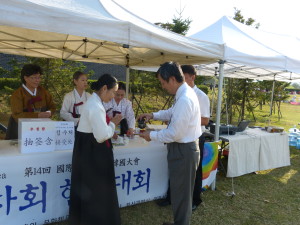
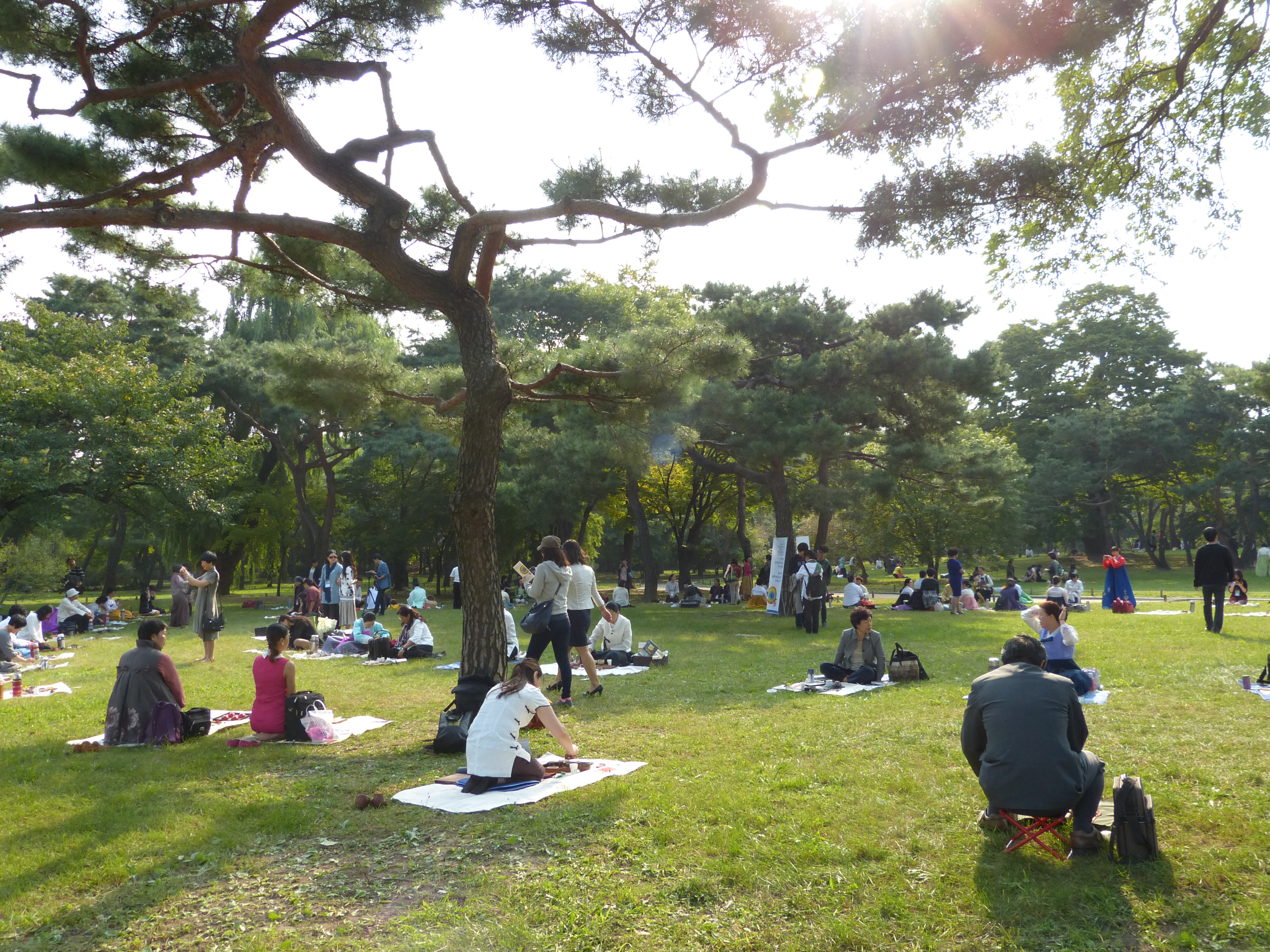
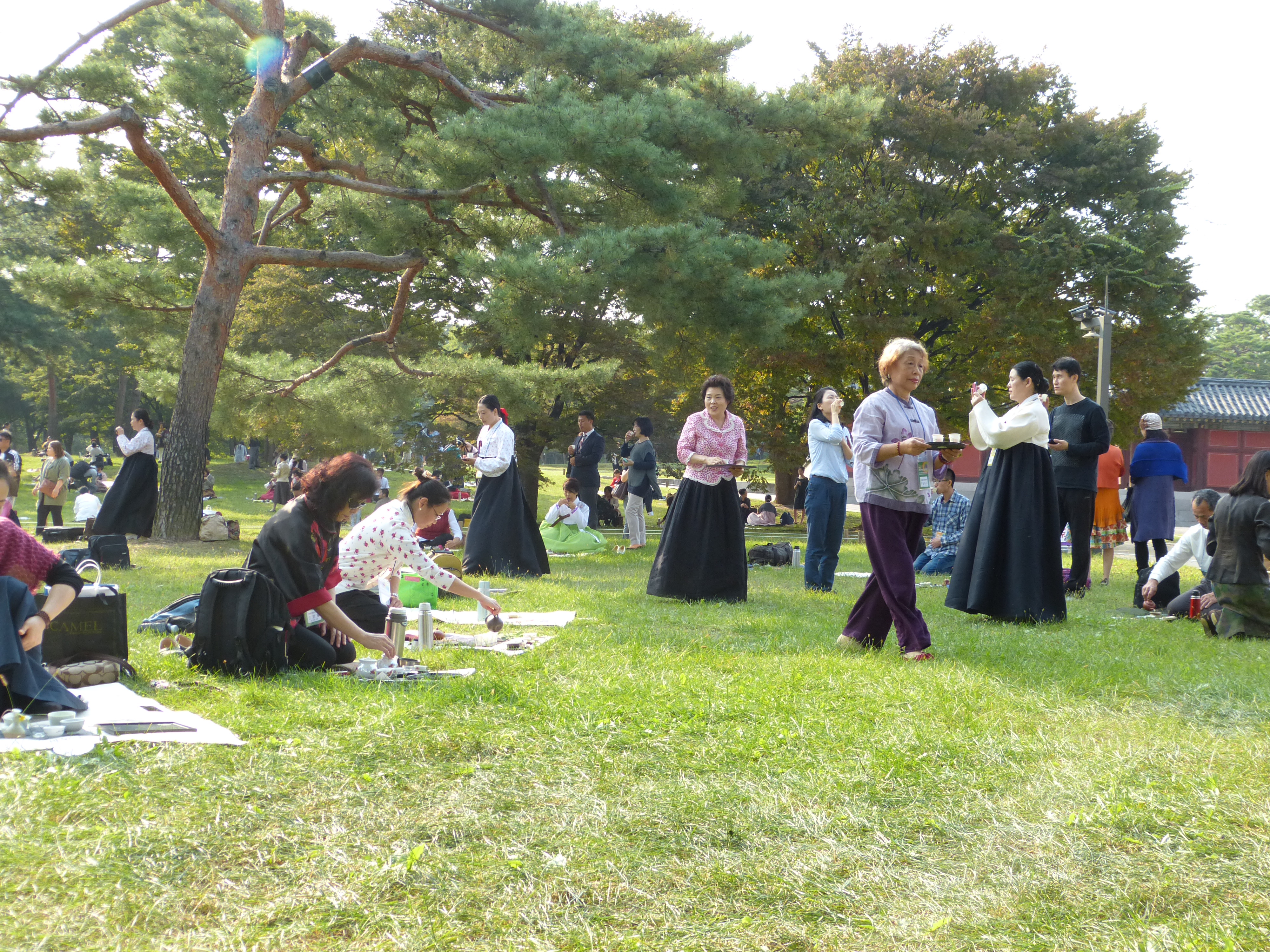
第14届国际无我茶会2013.10.14第3场,在韩国釜山举行。
原定地点海云台海边沙滩,因下雨改在酒店大


茶会完毕,雨停了,我们去海云台海边沙滩观看原定场地及散步。
(2880)
原定地点海云台海边沙滩,因下雨改在酒店大
茶会完毕,雨停了,我们去海云台海边沙滩观看原定场地及散步。
(2880)
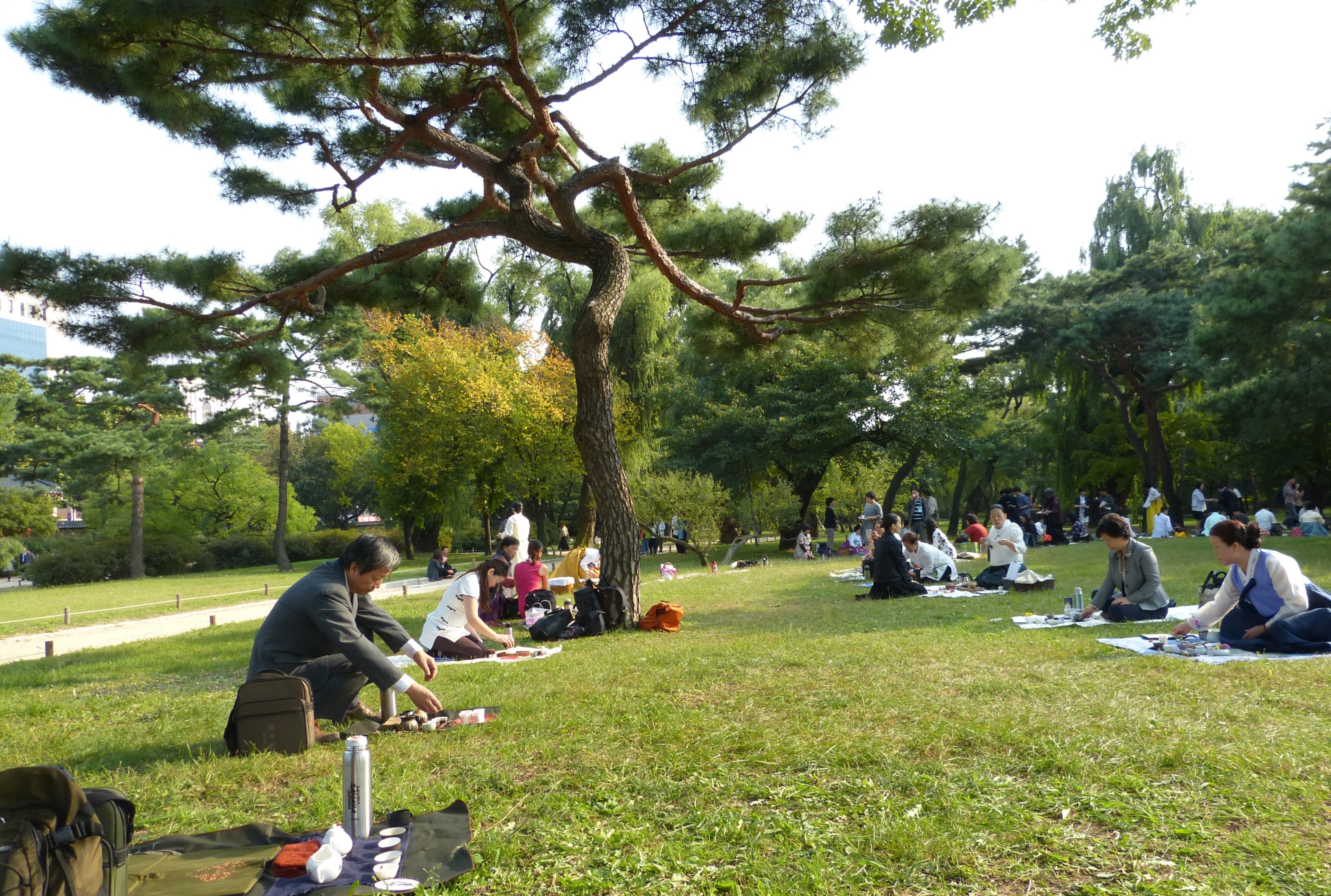
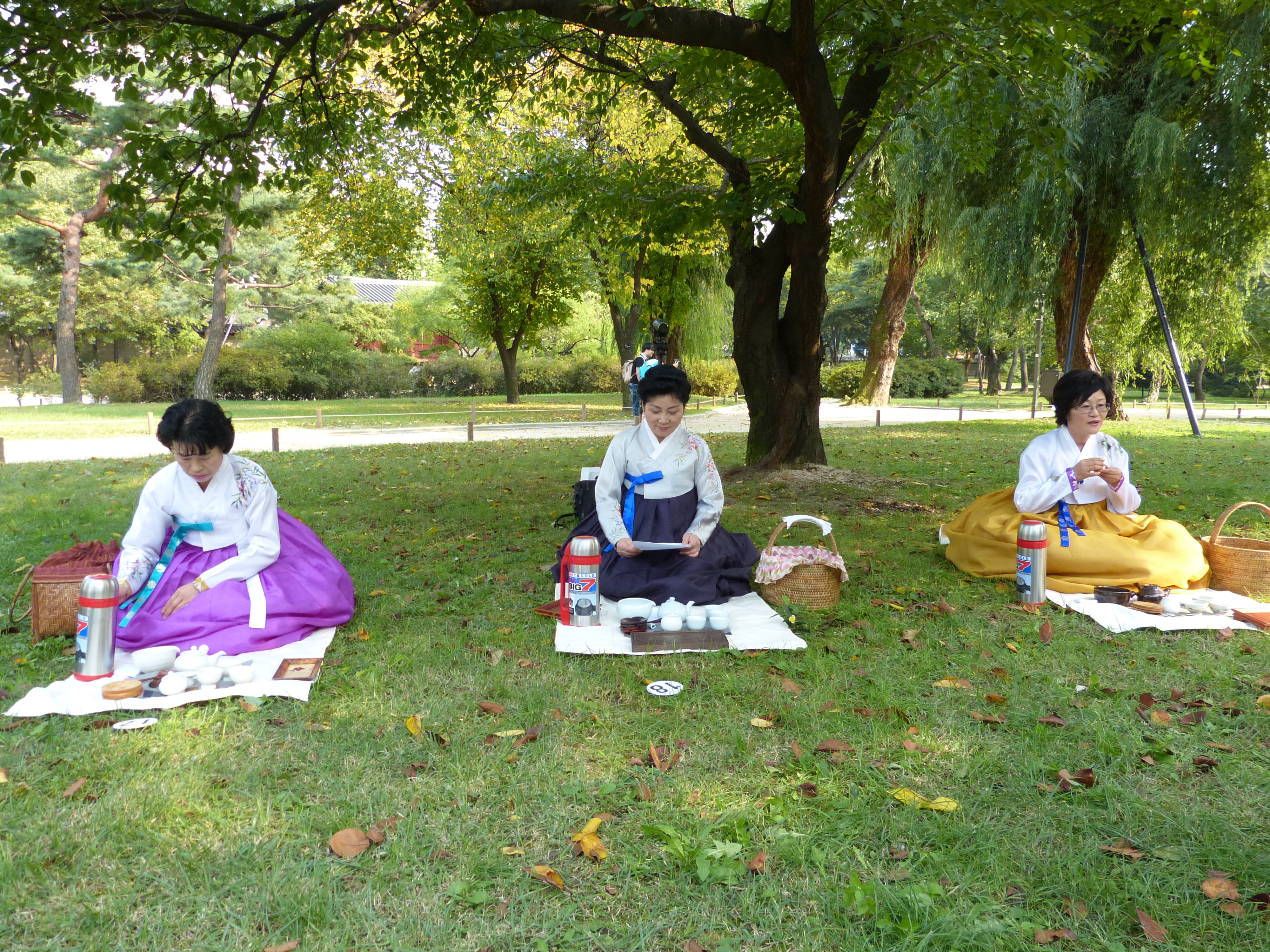
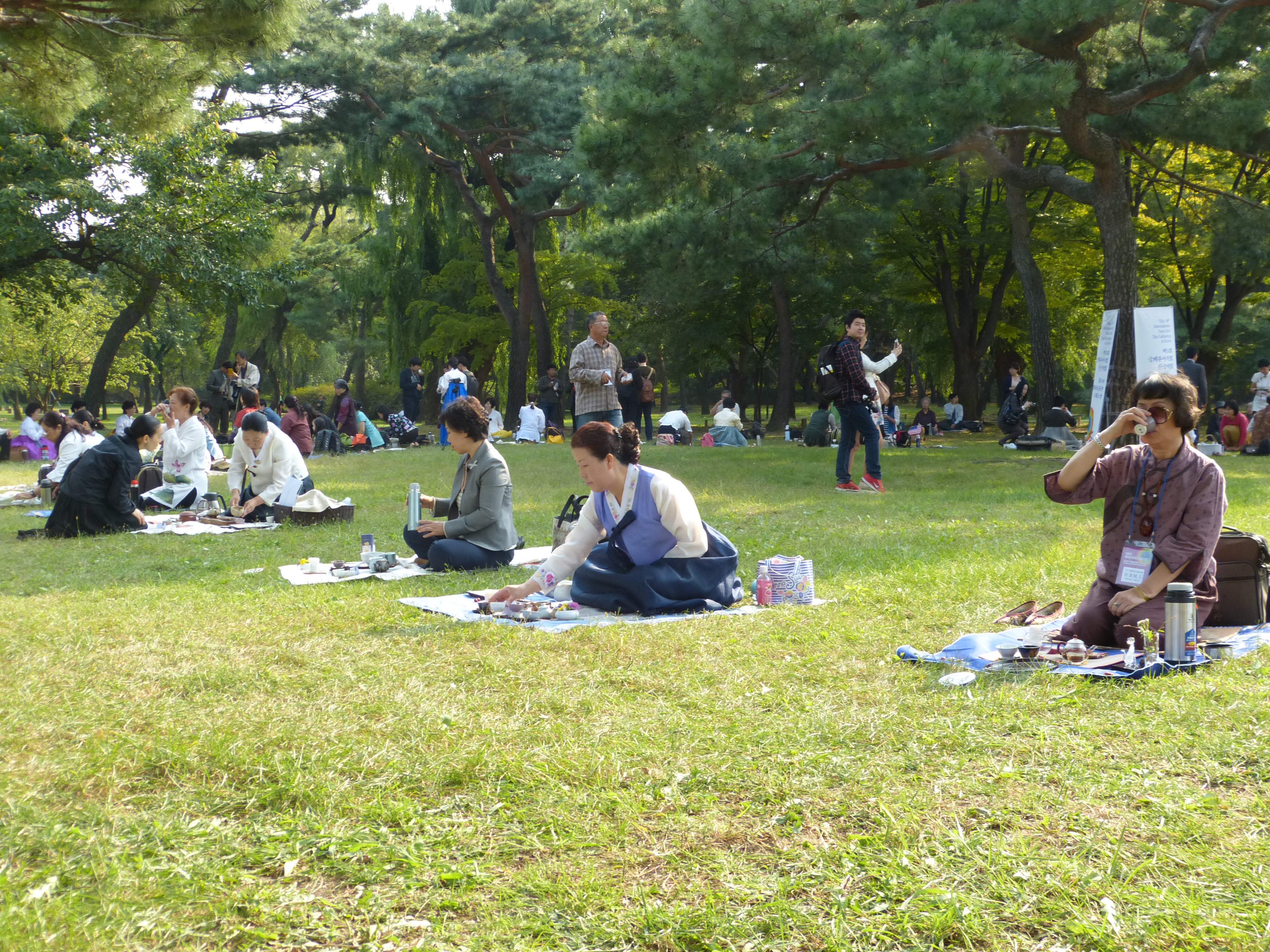
 (1894)
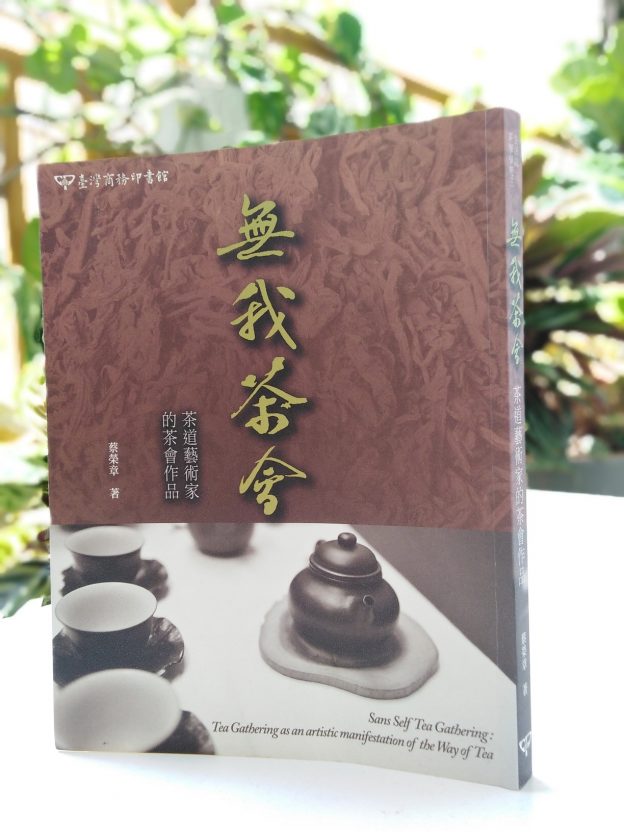
許玉蓮的跋–無我茶會的理想國《無我茶會-茶道藝術家的茶會作品》蔡榮章著
二0四八年二月一日.晴
我拿著老師給我的地圖,來到地球北緯24°4′51″,東經117°31′54″的所在地,那裏有個小山坡,斜坡路兩旁有大樹有草,空氣是靜、涼的。我一步一步往上走,坡上原來有座木头筑造的平台,由十二根大树头架起,約比我矮一點的高度,其棚顶用帆布遮盖,其南、北、西三面由許多蔓延性植物披挂下來當作圍牆,東面敞開,只見平台上滿滿坐了一地的年輕人,他們正全神貫注聽著面前一位長者說話。我再走前幾步, 只聽到那長者說: 「無我茶會最重要的是把茶泡好………」,我蹑手蹑腳爬上平台與那群年輕人坐在一起,一會兒,不懂從那裏走出一位少年,雙手捧著一碗茶畢恭畢敬奉給我。就這樣我也聽了半天長者的泡茶課。
太陽下山的時候,下課。那少年又冒出來把茶碗收回去。
我問:你們在做什麽?那長者是誰?
他說:他是我們茶道長者,已經百歲,定時在這茶道講壇開課,每一社區有志要成爲茶道老師的人都要來這裏聽他的課,我自小媽媽就叫我來做茶道義工,他住在講壇後的小屋,有十三位像我這樣的學生,輪流侍奉他的生活與上課所需。今天是我的奉獻日,我要負責老師的飲食和茶事。
隨後我說我要找地方投宿,奉茶少年說可住入他家,所以我就住入他的家了。
二0四八年二月二日.有風
奉茶少年要去探望舅舅,我跟著一起去。他說:半年前舅舅突然患疾,醫生一直無法醫治,舅舅便回到家裏修養。
到了舅舅家,看見有三個男人圍聚大飯桌,埋首在一張畫滿箭頭的地圖紙。
少年說:舅舅在我們社區的下水道防漏工作部服務了二十多年,他天天在下水道鑽來鑽去,最熟悉整個下水道的形勢、方向和道路的駁接補漏情況,他要在離世前把這些所有實際經驗都記錄下來,他說現有的地圖已經過時。那兩位是自願來幫忙畫地圖、代書的大學生。
舅舅看見我們,叫我們過去,指點給我們看下水道的來龍去脈。他因疾頭發脫落,身體瘦弱,說話聲音低低的,精神卻靈活。
舅媽捧出茶來,一碗一碗交我們手上,陪著我們喝。
茶後她問舅舅:社區豪華大墓園的人剛剛又來推銷豪華大喪禮,問你要不要預購?
有個小女孩從舅媽身後閃出來,抱著舅舅,她說:爸爸吩咐我們無須擔心,把他的骨灰撒在一號山頭就可以了。
二0四八年二月三日.大晴
早晨醒來,少年全家高高興興換上幹淨衣服,利落地各自准備了茶葉與茶具,說要泡茶去。少年叫我也收拾一套。
他說:我們每一個社區每周有自己約定的時間,到茶道廣場進行無我茶會。
我說:誰會去?
他說:大家都去,包括地方首長、明星、左鄰右裏,大家會將那個早上時間預先安排好,真走不開的話,每個家庭也有代表去。
我說:誰做工作人員呢?
他說:誰做都可以,我自小知道那個工作團好像自然形成的,誰有時間就誰做,誰要請假便找人代替。
抵達茶道廣場,大家默契地進入無我茶會的律動。
觀摩聯誼時聽到兩位老人對話,記錄如下。
甲:無我茶會強調對「無」與「有」的信念,到底是怎麽回事?
乙:你不喜歡的,就把它忘掉,那是「無」, 重新建立你喜歡的,那是「有」,生命永遠在你掌握之中。
甲:名譽地位是我喜歡的, 就無需丟棄了?
乙:不丟棄會變成包袱,要丟棄, 要不在乎它。重新再建構你喜歡你覺得榮耀的名譽與地位。每天清晨起來, 還沒有想到什麽事之前,是多麽輕松,我們每次參加完無我茶會都要還原成那個「什麽都無」的樣子,再去重建新的「有」。
甲:如果我原來就「無」任何東西,要怎麽建立「有」?
乙:如果原來就一「無」所有,原來就窮困潦倒,那窮困潦倒就是原來的「有」,現在要把它丟棄,從「無」中重建新的「有」,重建新生命。
二0四八年二月四日.陰
吃完早飯,少年的媽媽邀我入茶席,精精致致地泡了一道茶給我喝,並告訴我少年回校參加升學研討。學校聘請了各個學派的專家來演講,讓學子了解各流派學說以及自己的興趣後才思考進修那個科系。他會在校裏呆上一天。
媽媽叫哥哥帶我四處走走。哥哥說:散散步吧。我們就出發了。走到河邊銀杏樹下,我們發現一只跌失的錢包,厚厚的裝了很多鈔票,哥哥拾起幾根樹枝,在地上豎起成三腳架的樣子框住錢包。
我問:有什麽作用?
他說:讓路人看見,別把它原本位置錯亂,讓失主回頭找時容易發覺。
過了河,漸漸走到熱鬧街道,我們在候車站停下來,候車站有一排電腦設備,有幾人在操作,哥哥也去排隊,我問他要做什麽?
他說:報稅。政府定時告知確實的繳稅額。我們從銀行轉賬即可。
約五分鍾後,哥哥辦好了,他又告訴我政府各有關部門的計劃、事項、工程等都可以在路邊這些電腦系統詢知、討論和跟進。
接著哥哥帶我到市立圖書館,我們在歷史資料收藏室找到一位年輕管理員,哥哥把資料冊子交還,找了另一份新的資料擬登記帶走,年輕管理員望望那份資料的題目和日期,與哥哥說:這一份還不夠呢,另有三份更詳盡的類似資料,在某櫥某格某編號。
二0四八年二月五日.陰
傍晚,少年的爸爸給我們煮茶,正喝著時,鄰居氣敗急壞走進來說:新聞報道 A作家跳樓自殺,死了。他是我最喜歡的作家。
我們問:爲什麽呢?
鄰居說:都說他過時了,不受歡迎了,大衆都不買他的書了,他受不了這種冷落而消沈。
爸爸給鄰居大大力的擁抱,再給他一碗茶喝。大家一時間都陷入無言。
臨睡前,我聽到少年與爸爸在陽台上對話。
少年:人死了是何意義?
爸爸:完成了這一輩子的「活」、 這一輩子的「有」。
少年:死後又是什麽?
爸爸:死就是這輩子的結束,是種「無」 。
少年:死後的肉體與靈魂呢?
爸爸:都分解成各種最基本的原素了, 只是快慢不一。
少年:爲什麽快慢不一?
爸爸: 火化最快,自然腐化第二, 在冷凍環境最慢。靈魂分解速度與意志力有關。
少年: 分解後呢?
爸爸:再被其他生物與非生物所用, 不論是肉體的還是靈魂的。
少年:生死也是一種「有」與「無」?
爸爸:對,死是「無」,還原成各種基本原素是「有」, 基本原素組成新的生物或非生物又是另一次「無」與「有」。
少年:基本原素組成新的生物是不是叫投胎?
爸爸:不是, 只是原素的重新組合, 包括了生物與非生物。
二0四八年二月六日.雨
期限已到,我來到我第一天抵達的地方,准備啓程回家。
在一片細雨中,我看見茶道讲坛变了样子,其棚顶、其南、北、西三面墙由一种我不知名的金属器覆盖着,估计以防风雨,許多年輕人穿着雨衣往茶道講壇的方向走去,已经在平台上的年轻人魚貫而入找到自己的位置就坐下。同一時间,我也看見那茶道長者撐著雨傘緩緩走上講壇。
二0一三年二月一日.晴
回到家第一件事情,我打開筆記本,看看本學期最後一個研究項目,老師出的題:「你去看看他們的無我茶會做得怎樣了,地址與時間在這裏」。我將考察日記作爲交給老師的報告, 並在總結欄記下我觀察所得的答案:一切無恙,繼續前行。
許玉蓮
二0一三年一月六日
于紫藤茶藝學習中心
 (2669)
《無我茶會-茶道藝術家的茶會作品》Sans Self Tea Gathering:Tea Gathering as an artistic manifestation of the Way of Tea
2013.10.01,臺灣商務印書館:The Commercial Press,Ltd.
ISBN:9789570528749
蔡荣章自序:無我茶會——茶道藝術家的茶會作品
第一章無我茶會的基本形式與做法
001.無我茶會的基本形式
002.無我茶會特殊做法及七大精神
003.無我茶會為何非要單邊奉茶不可
第二章場地問題
004.室內以什麼場地為宜
005.室外以什麼場地為宜
006.一定要在幽靜與風景優美的地方舉辦嗎
007.下雨怎麼辦
008.舉辦夜晚無我茶會時,場地需要多亮的公共照明
009.地形特殊,無法達成連續性隊形,怎麼辦
010.在舞台從事示范性表演時的座位排法
011.作為紀念性無我茶會時,場地如何應變
012.席地而坐時,一個人的空間需要多少,兩人相隔的距離該多少,座位前面應保留多少活動空間
013.這個場地能容納多少人
014.茶會在野外舉行,衛生問題如何克服
第三章場地的准備
015.場地規划圖
016.座位的標示
017.號碼牌的排列方向
018.「向心坐」與「背心坐」
019.場地有外人走動時,怎麼辦
020.與圍觀群眾的區隔方法
021.號碼牌的制作
022.座位標示圖的應用
023.茶會名稱的標示
024.音響的設置
025.解說員與表演者的位置
026.紀念性無我茶會
027.座位的控制
第四章報到時段
028.抽簽、簽名等報到手續
029.人多時,如何縮短抽簽與簽名的時間
030.報到人數的掌握
031.人數與座位的控制
032.想讓沒帶茶具的朋友也一起參加茶會,怎麼辦
033.以無我茶會作為歡迎茶會時怎麼做
034.帶着幼兒一起參加,應否設置「母子簽」,坐折疊椅區者如何抽簽
035.「對時」如何實施
036.要設「引導人員」嗎
037.茶會進行間要不要有專人負責臨時發生的事情
038.缺席的座位號碼牌如何處理
039.工作人員何時入場
040.遲到的人怎麼辦
041.表演者、解說員等的座位安排
042.因無可奈何的原因使得茶會無法依原定時間進行,如何補救
043.無我茶會是大家一起參與的茶會
第五章與會者會前的准備
044.無我茶會茶具「精簡」的要求
045.無我茶會的基本道具
046.無我茶會的「茶具」應注意哪些使用上的功能
047.如何攜帶茶具才好
048.保護茶具的包裝器材有何應留意的地方
049.帶什麼「茶」才好
050.「茶」如何攜帶
051.泡兩種茶葉時,茶具如何准備
052.泡茶用水的准備及對保溫瓶的要求
053.無我茶會就座的方式
054.坐墊的功能要求
055.會前下過雨,或擔心坐在有泥的地方,應增加什麼配備
056.無我茶會的服裝與鞋子
057.茶會間安排有茶食享用時,如何准備
058.無我茶會泡茶法舉例之一:小壺茶
059.無我茶會泡茶法舉例之二:蓋碗茶
060.無我茶會泡茶法舉例之三:抹茶
061.上述泡茶法舉例,為何都沒有提到溫壺、燙杯等動作
062.無我茶會對「夜晚茶會燈」的要求
063.參加無我茶會應達成多少目的
064.如何輕松愉快地享受無我茶會
065.逍遙於茶會的廣場
066.無我茶會的茶具就是「旅行用茶具」
第六章就位與聯誼時段
067.每人的坐墊應如何放置才會整齊
068.就座后號碼牌如何處置
069.杯子正放還是倒扣的好
070.向圍觀者奉茶時,對外奉茶的杯子要陳列出來嗎
071.安排有「供應茶食」時,帶來的茶食要不要擺放出來
072.夜晚無我茶會時,茶會燈放哪兒比較好
073.戶外風大時怎麼辦
074.茶會前下過雨,場地潮濕怎麼辦
075.戶外昆蟲的問題
076.「茶具觀摩與聯誼」何時開始、何時結束、有何替代方案
077.茶具觀摩的禮節
078.如何發揮聯誼的效果
079.如何對圍觀群眾發放「簡介」
第七章無我茶會的泡茶與奉茶
080.無我茶會使用「簡便泡茶法」
081.何時開始泡茶、何時開始奉茶
082.第一道如何奉茶,杯子放在哪里
083.奉茶時,杯子由誰拿取,無法蹲下的人如何奉茶,走動不便的人如何奉茶,盲友的茶會如何應變
084.第二道以后如何奉茶
085.奉茶時要不要說「請喝茶」,被奉者要不要說「謝謝」
086.奉茶一定要依前后的次序嗎
087.奉茶時從座位的哪一邊出去
088.奉茶時遇「空位」及「不泡茶者」,怎麼辦
089.若許多位「品茗后活動」的表演人員未能一起泡茶,如何讓他們有茶喝
090.若設有解說員,如何奉茶給他
091.如何奉茶給圍觀的人
092.泡茶杯數與泡茶次數如何決定
093.泡兩種茶時,如何操作
094.泡茶用水不足時,如何補充
095.茶會間若安排有茶食享用,如何進行
096.茶會沒安排供應茶食,可因自己泡抹茶而提供茶食嗎
097.紀念性無我茶會等特種場合的奉茶法
098.對圍觀者的詢問及要求,如何因應
099.奉茶間的禮節
100.什麼時候開始喝茶,從哪一杯開始喝
101.喝茶時應快快地喝還是慢慢地喝
102.茶葉浸泡期間,做什麼才好
103.泡茶進度超前或落后時,有何調節的方法
104.如何避免攝錄像破壞氣氛
105.無好惡之心的真諦
第八章品茗后活動與收拾
106.何謂「品茗后活動」,如何進行,與「會后活動」有何不同
107.品茗后活動如何與演出者協商
108.品茗后活動要不要設置表演台
109.泡完茶,要不要當場清理茶具
110.如何預防收拾茶具后,壺盅的殘水外流
111.收拾茶具前之擦杯動作,意義何在
112.何時開始擦拭自己用過的杯子
113.收杯禮節
114.茶具如何收拾
115.泡茶結束后還剩有茶湯怎麼辦
116.個人泡茶位子的復原
117.茶會如何結束
118.公共設施的收拾
119.茶會后全體合影
120.有些「人」或「事」需要特別感謝或說明時,怎麼辦
121.無我茶會表現的茶道藝術
第九章茶會進行間
122.奉茶方法發生了錯誤怎麼辦
123.別人奉給您的茶少了一杯,怎麼辦
124.所泡的茶倒不完怎麼辦
125.遇到自己喝不下的茶怎麼辦
126.不愛喝茶,或今天不能喝茶,但又喜歡參加茶會,怎麼辦
127.奉茶時,發現自己的前一杯茶尚未被喝掉,怎麼辦
128.收杯時,遇到剩有茶湯怎麼辦
129.茶沒泡好,可以做些補救措施嗎
130.泡茶時發現水量或泡出的湯量明顯不足,有何應變方法
131.可以倒一杯給反方向的芳鄰嗎
132.杯子的衛生問題
133.不知道喝的是什麼茶,可以問嗎,可以贊美他嗎
134.最后一道茶奉完,可以走到景仰的人那兒要杯茶喝嗎
135.會后可以與別人交換茶具作紀念嗎
136.茶會結束后可以再約些人原地繼續泡茶嗎
137.無我茶會可以使用非茶的飲料嗎
138.無我茶會錯誤最多的地方
139.無我茶會的「自由」與「法制」
第十章主辦單位的會前准備
140.舉辦無我茶會的時機
141.如何擬定無我茶會的名稱
142.勘察場地
143.有哪些工作需要專人負責
144.誰是無我茶會的工作人員
145.「公告事項」的制作
146.「會前說明會」的舉辦
147.「工作檢查表」的應用
148.茶會記錄
149.如何掌握參加的人數
150.無我茶會的各項進度需要多少時間
151.參加無我茶會的人,應如何識別
152.無我茶會要義圖
第十一章茶會的推廣
153.無我茶會推廣工作如何進行
154.將無我茶會列入茶道教育課程
155.四學分的無我茶會課程安排
156.無我茶會又為茶道加了藩籬嗎
157.無我茶會道場的設置
158.無我茶會茶具完整性的重要
159.無我茶會的機動性與擴充性
160.如何使無我茶會的風格與特性突顯出來
161.無我茶會是隨意還是嚴謹
162.無我茶會為什麼不設貴賓席與長官致詞的時間
163.無我茶會進行間為什麼不放音樂
164.「品茗后活動」演出人員最好也是參加無我茶會的人
165.推廣性無我茶會的舉辦
166.無我茶會在其他場合的應用
167.無我茶會的英、日、韓譯
168.什麼是無我茶會的國際組織
169.無我茶會需要統一的會旗與會歌嗎
170.無我茶會的傳播
171.無我茶會的字面意義是什麼
172.無我茶會不只是一種茶會形式
173.一人到千萬人的無我茶會
174.無我茶會的四美
175.無我茶會是要求精致的一種茶道體系
176.無我茶會對個人與群體的影響
第十二章無我茶會簡史
177.無我茶會的創辦
178.無我茶會的出生背景
179.為什麼有無我茶會的誕生
180.從獨飲到無我茶會
181.第一次無我茶會的舉辦
182.第一次公開舉辦的無我茶會
183.第一次國際無我茶會
184.無我茶會專書的出版
185.第一座無我茶會紀念碑在武夷山
186.從「無我茶會推廣委員會」到「國際無我茶會推廣協會」
187.無我茶會大事年表(1989~2015)
第十三章對外解說稿
188.無我茶會解說稿
许玉莲跋1:無我茶會的理想國 (2923)
《無我茶會Sans Self Tea Gathering 180條》
蔡荣章著Author:Rong-tsang Tsai
ISBN978-957-9690-08-9 “无我茶会Sans Self Tea Gathering180,” First edition: 1999.9, Second edition: 2010.9《无我茶会180条》1999.9第一版 2010.9第二版 台北陆羽茶艺股份有限公司.2012.05.20修订版-English Translator : Katherine Yip英语翻译:叶德明
第十四章 無我茶會解說稿
無我茶會進行間是不設指揮與司儀的,但若在公共場所舉辦,為讓參觀的來賓知道是怎麼一回事,也達到推廣的目的,可安排一位解說員從旁說明茶會進行的方式及其意義。但仍然是對外解說的性質,而不是主持茶會的進行。
188.無我茶會解說稿
|
進度 |
話題 |
解說大要 |
|
1. 安置號碼牌 |
a. 活動報導 |
a.各位來賓,本會場將于ˍˍ時ˍˍ分舉辦一場「無我茶會」, 歡迎各位來賓參加,會中每位泡茶者都將奉茶給各位來賓。 |
|
b. 何謂無我茶會 |
b.無我茶會是一種茶會的形式,大家自備茶具圍成圈圈泡茶,泡完茶每人都要起來奉茶,因此每個人都可以喝到別人泡的茶。所以說無我茶會是人人泡茶、人人奉茶、人人喝茶的一種茶會形式。 |
|
|
c. 現場 動態 |
c.現在會場正在安置號碼牌。無我茶會是圍成圈圈泡茶,等一下與會者就憑抽到的號碼就坐。這是無我茶會的第一個精神:「無尊卑之分」。 本次無我茶會預計有ˍˍ人參加,所以號碼牌要圍成ˍˍ圈。 |
|
|
d. 留住 群眾 |
d.各位來賓,為能讓大家共同參與,本次無我茶會將泡茶四道,其中兩道茶要奉給參觀的來賓,請大家不要離開,等一下就可以喝到泡茶者自己帶來的各種茶(包括日本、韓國與中國……的茶)。 |
|
|
e. 主協辦 |
e.本次無我茶會名為ˍˍ無我茶會,是為(配合)ˍˍ而舉辦,由(國際無我茶協)、(與ˍˍ)主辦,ˍˍ、ˍˍ協辦(承辦),感謝協助這次茶會的單位與個人。 |
|
|
2. 報到 |
a. 抽籤 |
a.各位來賓,現在參加泡茶的人已陸續到來。無我茶會是以抽籤決定座位,誰會坐在誰的旁邊都不知道,這是茶道無尊卑之分的一種精神,而且隨遇而安。 |
|
b. 參加單位 |
b.今天參加ˍˍ無我茶會的有(都是)來自ˍˍ的茶友,(我們看到(日本)茶友已經到達會場……)。 |
|
|
c. 就位 |
c.抽完簽的茶友找到座位,把茶具擺設出來。 |
|
|
d. 茶器 |
d.各位來賓請注意他們所準備的茶器以及攜帶、包裝的方法。無我茶會是使用簡便的茶器,熱水也是用保溫瓶帶著來。另外也請大家留意,每人準備的茶器各有不同,甚至於(粉末茶)的器具也出現了,這表示無我茶會所用的茶器及泡茶法是不拘的,這也是無我茶會第二個精神:無地域與流派之分。 |
|
|
e. 觀摩、聯誼 |
e.將茶具準備妥當後,與會人員就起來看看別人帶來的茶器,並相互問候、交談,這是無我茶會「茶具觀摩與聯誼」的時間。他們利用這段時間拍照留念,等開始泡茶後,就不准起來拍照了,要拍照只有請不參與泡茶的人在圈外進行。 欣賞茶器時,如果不是主人在場、並徵得同意,規定是不能觸摸的。 |
|
|
3. 泡茶 |
a. 何時泡茶 |
a.「茶具觀摩與聯誼」到了快結束的時候,與會者就要回到自己座位,開始泡茶。這個進度都載明在事先發給與會者的「公告事項」內。無我茶會進行間是不設指揮與司儀的,一切都依事先的約定進行,這是無我茶會的第三項精神:「遵守公共約定」。—群人進行茶會,沒有指揮,可以讓大家體認群體律動之美。今天因為是為了讓大家知道何謂「無我茶會」,所以才設有對外解說,如果沒有我的干擾,場面一定會優雅許多。 |
|
b. 清場 |
b.開始泡茶後,圈內的人就要離開,圈內有人會破壞會場的完整性。拍照錄影的人也請在圈外,非要搶個鏡頭不可時,也要快快離開。 |
|
|
c. 清淨 |
c.開始泡茶後就不可以說話了,專心泡茶,奉茶時也不必說「請喝茶」,對方也不必說「謝謝」,如果碰面了,鞠個躬,笑一笑就可以。這樣寧靜的氣氛,才容易體會出茶會的美感,以及人與人間、人與物間、人與地間的互動關係。這是「無我茶會」另一項要求:「體會群體律動之美」。 |
|
|
d. 奉茶法 |
d.各位來賓,您看現在泡好茶的人要出去奉茶,每人奉茶給(左)邊三位茶友,最後一杯留給自己。這是無我茶會「同一方向奉茶」的規定。每個人都同一方向奉茶,這是一種「無所為而為」的奉茶方式,我奉茶給左邊的,但喝到的茶卻來自右邊。我們希望大家放淡「報償之心」,學習無所為而為地做一件事,這「無報償之心」也是無我茶會七大精神之一。 |
|
|
e. 無好惡之心 |
e.每個人喝到的四杯茶可能都是不一樣的茶,因為茶是由每人自己帶來。無我茶會希望每人都以超然的心情接納、欣賞這些茶,不要有好惡之心。好惡之心太重,會把很多福氣排除在外,因為你不喜歡的東西並不一定是壞東西。「無好惡之心」也是無我茶會所要推廣的茶道精神。 |
|
|
f. 求精進之心 |
f.這幾杯茶也不一定都泡得很好,可能有一杯泡得又苦又澀。這時應反省自己,是不是也把茶泡壞了,「把茶泡好」是茶道修行上最起碼的課程,否則對不起自己,對不起別人,對不起茶,因此「求精進之心」也成了無我茶會的第七大精神。 |
|
|
g. 第二道茶 |
g.今天的第二道茶要奉給參觀的來賓,大家可以品嘗到由各地(臺灣—-)茶友所沖泡的各種茶,這是和平的親善大會。用過的杯子暫時拿在手上,第四道茶還要奉茶給您。 |
|
|
h. 第三道茶 |
h.第三道茶是持茶盅出去奉茶,依然是奉給左邊原來的那三位及自己一杯。 |
|
|
i. 奉茶方向的變 化 |
i.奉茶的方向不一定非向左邊不可,也可以向右邊。奉茶的對象也不一定非相鄰的三位不可,也可以變化為二、四、六或一、三、五。只要在事前發給大家的公告事項中說明清楚即可。 |
|
|
j. 茶會簡史 |
j.無我茶會於1990年在臺灣正式推出,現在已演變成國際性的活動,中、日、韓、星、馬……等國平時已自行在國內進行,並於固定年份輪流在一個地方召開大型國際性的無我茶會。今年(明年)已是第ˍˍ屆,將於ˍˍ月在ˍˍ舉行。歡迎大家一起參加。 |
|
|
k. 第四道茶 |
k.現在是第四道茶,也是奉給參觀的貴賓,這次可能是不同的人奉給您不同的茶。茶道有項精神就是泡茶給別人喝,甚至給陌生的人喝,這項精神在無我茶會中更是突顯得清楚。 |
|
|
l. 來賓手上的杯子 |
l.各位來賓,您手上的茶慢慢喝,等一下收拾茶具時,奉茶的人會來把杯子收掉。我們不要造成大家任何的不方便,也不要造成環境任何的污染。(若是贈送的紀念性杯子,則改變說詞) |
|
|
m. 空白之美的應用 |
m.喝完茶,無我茶會往往會安排一小段音樂欣賞,讓大家回味一下茶味、回味一下茶會的種種,這是連接在品茗後的一段空白之美,所以音樂在大家喝完最後一道茶後自然響起,沒有介紹,也無需鼓掌,音樂結束時也一樣。大家在音樂的餘音消失後,開始收拾茶具,結束茶會。(不同之品茗後活動則變更說詞,若未安排此項活動則省略) |
|
|
4.品茗後 |
a. 品茗後活動 |
a.(不做解說) |
|
b. 擦拭杯子 |
b.與會者收拾茶具之前,要先把自己用過的杯子擦拭一下,當然只是做初步的處理,免得別人收回時太不整潔。這是茶道處處為對方著想的精神。全套茶具回去後再行清洗。 |
|
|
c. 收杯子 |
c.與會者擦拭完杯子,出去將自己的杯子收回,(順便收回參觀者手上的杯子)。這時依舊保持安靜。 |
|
|
d. 收茶具 |
d. 他們把杯子收回後,將茶具收拾妥當。 |
|
|
e. 旅行用茶具 |
e.各位來賓,請注意泡茶的人使用的這一套旅行用茶具。大家也可以準備一套這樣的茶具,以後出國、或與家人出去旅行,就可以這樣喝茶。請大家也注意他們包紮茶具的方法,杯子用杯套套著,一壺兩杯用一條包壺巾包裹,一盅兩杯又用另一條包壺巾包著。收拾茶具的時候要有條不紊,不能到了尾聲就亂成一團。我們有句話:收拾與開場一樣重要。 |
|
|
f. 服務台 |
f.各位來賓,(無我茶會推廣協會)在各地方設有指導老師與茶道教室,每星期固定的時間在各地還有教授無我茶會的聚會,詳細資料歡迎到會場服務台索取。 |
|
|
g. 感謝 |
g.本次ˍˍ無我茶會,承蒙ˍˍ提供……,在此特表謝意。(若無需要則省略) |
|
|
h. 結束 |
h.各位來賓,如果您對本次無我茶會有何寶貴意見歡迎提供給我們。感謝大家參與本次無我茶會,希望下次您能和我們一起泡茶。 |
|
|
i. 合影 |
i.無我茶會結束前都會安排合影留念,也藉此表達與會者依依不捨之情。各位來賓,本次無我茶會就到此結束,感謝各位來賓與我們一起共度這段美好時光。謝謝。
|
(2483)
《無我茶會Sans Self Tea Gathering 180條》
蔡荣章著Author:Rong-tsang Tsai
ISBN978-957-9690-08-9 “无我茶会Sans Self Tea Gathering180,” First edition: 1999.9, Second edition: 2010.9《无我茶会180条》1999.9第一版 2010.9第二版 台北陆羽茶艺股份有限公司.2012.05.20修订版-English Translator : Katherine Yip英语翻译:叶德明
第十三章 無我茶會簡史
172.無我茶會的創辦
無我茶會是在臺灣一九九○年代前後的茶思想與環境下所研發出來的一種茶會形式,一九八九年由當時在臺北陸羽茶藝中心擔任總經理的蔡榮章創辦,一九九○年正式推出。
173.為什麼有無我茶會的誕生
無我茶會誕生的內在因素已如前述,外在因素有二:一是原有茶道聚會方式都是一人泡茶、數人為客品飲,或是多人泡茶,更多人為客品飲,如此無法將茶道精神充分表達,所以亟思一種人人泡茶、人人奉茶、人人喝茶的茶會方式。二是原有茶道聚會方式難能大規模舉辦,導致推廣效果受限,如何才能讓眾多人一起享用「茶道」,成了構思無我茶會的另一觸媒。
184.第一次無我茶會的舉辦
這是在一九九○年五月二十六日,蔡榮章將擬好的無我茶會綱要在陸羽茶藝中心正在舉行的第一期「陸羽茶道教室師資研習班」上唸給大家聽,並聽取大家的反應與意見,討論完畢,大家決定於下一個月的二日在離陸羽不遠的「妙慧佛堂」舉行12人的實驗性無我茶會。這是第一次無我茶會的舉辦,會後於現場即席進行檢討,並決定第二次的無我茶會。如此進行了三次實驗性無我茶會,也將茶會的架構確立了起來。
175.第一次公開舉辦的無我茶會
每次「陸羽泡茶師檢定考試」後,都會有一次頒證茶會,一九九○年六月二十三日是第13屆泡茶師頒證典禮,在臺北市中山堂的光復廳舉行,這次即以無我茶會的方式進行,新舊泡茶師70人先進行一場無我茶會,會後舉行頒證,由舊泡茶師分別將「泡茶師證書」頒發給新泡茶師。這是無我茶會的第一次公開舉辦。
176.第一次國際無我茶會
利用茶文化交流的機會把無我茶會介紹給日、韓茶界友人,很快地他們也愛上了這樣的茶會方式,於是利用文字、影帶讓他們帶回去教給其他的茶友。1990年12月18日就在「十方禪寺」的臺北市禪修道場舉辦了第一次國際無我茶會,共有中、日、韓七十余位茶友參加。由於佛堂或禪修道場比較容易有廣大的室內空間,所以初期常以之為無我茶會舉辦的場所。
177.無我茶會專書的出版
為便於大家推動無我茶會,乃於1991年3月出版中、日、韓、英四種語文的《無我茶會》專書,簡單、扼要地介紹無我茶會的做法及其精神。
到了1997年初,為了教學上的需要,將這些年來遇到的問題整理成了180條綱要,作為課堂上研討的依據。1999年初,「中華國際無我茶會推廣協會」應各茶道教室的要求,決定編印六本茶學基本教材,討論的結果,將《無我茶會180條》列為這六本基本教材之一,並率先於同年9月出版。這是無我茶會較為完整的思想記錄與實踐手冊。
2012年冬,《無我茶會180條》完成了一些理念性詮釋的增補,並譯成了英文,於是以《無我茶會Sans Self Tea Gathering—茶人的茶會作品》为名再行出版。
178.第一座無我茶會紀念碑在武夷山
1991年10月17日上午,第二屆國際無我茶會在中國東南的福建省武夷山幔亭峰舉行。會前經大家的努力,尤其是「武夷山莊」劉彩華副總經理與林馨主任的協助,在幔亭峰下的武夷山莊庭園內設置石碑一座,正面刻上「幔亭無我茶會記」,文曰:「一九九一年十月十七日,百餘位來自各方的茶人聚集幔亭峰頂,各自攜帶茶葉茶具圍成一圈,每人泡茶四杯,三杯奉給左邊三位茶友,一杯留給自己,人人泡茶,人人奉茶,不分彼此,天下一家。」背面刻上「無我茶會之精神」,文曰:「座位由抽籤決定,無尊卑之分;奉茶到左,飲茶自右,無報償之心;超然接納四方之茶,無好惡之心;盡力將茶泡好,以求精進之心;依計畫行事,遵守公共約定,無需指揮,培養團體默契。」
感謝名書法家黃美豐先生為我們書寫碑文,名石雕師何雙水先生為我們雕刻,以及贊助經費的諸位茶友們。
179.從「無我茶會推廣委員會」到「中華國際無我茶會推廣協會」
無我茶會創辦後,除以陸羽茶藝中心為基地,使其逐漸成熟外,並以「無我茶會推廣委員會」的組織對外舉辦各項講習與活動。到了1994年8月,經臺灣政府核准立案,成立「中華國際無我茶會推廣協會」,組織成自主性的社團法人。會址設置于陸羽茶藝中心,辦公室也由陸羽茶藝中心撥用。
180.無我茶會大事年表(1990~2012)
1990.05.26 無我茶會初稿研討。
1990.06.02 第一次實驗性無我茶會。
1990.06.23 十三屆泡茶師頒證典禮以無我茶會方式在臺北舉行,為無我茶會首次對外公開舉辦。
1990.11.14 中日茶友20名於妙慧佛堂舉行「清淨無我茶會」,為無我茶會首次向國外茶友介紹。
1990.12.18 中、日、韓70位茶友在臺北市十方禪寺舉行首屆國際無我茶會,由創辦人蔡榮章召集。
1991.03.01 中、日、韓、英四種語文之「無我茶會」專書出版。
1991.03.27 台北陸羽茶道教室從第50期「泡茶講座」起,加入無我茶會課程。
1991.05.12 「母親節親子無我茶會」在臺北中正文化中心舉辦,70人與會。
1991.08.04 百位茶友在臺北植物園的荷花池畔舉行「觀蓮節賞荷無我茶會」。
1991.09.08 50位茶友在浩然敬老院舉行「返璞歸真無我茶會」。
1991.10.17 中日韓百位茶友在武夷山幔亭峰舉辦「第二屆國際無我茶會」,由武夷山市茶葉學會會長姚月明召集,並立碑紀念。
1991.10.20 參加第二屆國際無我茶會的臺灣團員在香港茶具文物館舉辦無我茶會說明會。
1992.05.05 在宜興第三屆陶瓷藝術節上舉行無我茶會說明會。
1992.05.07 在上海湖心亭舉辦無我茶會說明會。
1992.09.20 臺北、高雄兩地60位茶友在高雄佛光山大雄寶殿舉辦「佛堂無我茶會」。
1992.11.09 「第三屆國際無我茶會」,中日韓200位茶友在日本金閣寺、長安寺、天橋立舉辦三場無我茶會。由煎茶道賣茶真流家元正木義完召集。
1993.02.06 在茶友廖純瑜家舉辦的元宵花燈無我茶會中,創辦人蔡榮章提出以彩虹為無我茶會會旗的構想。
1993.10.13 「第四屆國際無我茶會」於韓國景福宮廣場舉行。中日韓茶友350人與會。由韓國國際茶文化交流協會會長釋龍雲召集。
1994.05.01 陸羽茶藝中心開闢「無我道場」,作為訓練無我茶會的場地。
1994.05.08 五百人「甲戌母親節親子無我茶會」在臺北中正紀念堂廣場舉行。
1994.08.10 國際經濟商管學生會亞太地區年會120位各國學生代表在臺北來來大飯店舉行一場無我茶會的講習。
1995.05.31 臺灣關渡基督書院茶道社完成首期茶學講座,當晚舉行頒證無我茶會。
1995.10.27 第五屆國際無我茶會在武夷山召開,由武夷山市茶葉學會會長趙大炎召集。分別於「雲窩」(27日)與「玉女峰」下(28日)舉行兩場無我茶會,各二百人參加。
1996.05.05 這年母親節親子無我茶會分別在臺灣十個城鎮同步舉行,共有一千二百多人參加。
1996.09.25 臺灣台東武陵外役監舉辦「茶香飄武陵,邀月共飲之」的夜晚無我茶會,典獄長與五十位受刑人一同參加。
1997.01.12 香港茶藝大賽中,於藝術館演講廳舉辦一場「無我茶會之舉辦與精神所在」的演講與示範,隨後在尖沙咀海邊舉行50人的無我茶會。
1997.01.14 於馬來西亞吉隆坡茨廠街的陳氏書院舉辦「無我茶會研習營」,30位當地茶友參加。
1997.02 將歷年來發現的問題整理成《無我茶會180條》題綱,作為教學依據。
1997.03.08 臺灣聯合晚報以三分之二版面介紹無我茶會及旅行用茶具,標題為「中國茶文藝復興——無尊卑無報償無好惡……無我茶會開展茶文化沉靜之美」。
1997.11.22 「第六屆國際無我茶會」在臺灣举行,由中華國際無我茶會推廣協會理事長涂國瑞召集。先是臺北中正文化中心的千人無我茶會,26日并在高雄中正文化中心舉辦五百人夜晚無我茶會。
1998.00.00 法國茶文化協會在巴黎百貨公司舉辦無我茶會。
1998.03.07 新加坡茶界聯合當地各族群舉辦了一場跨種族的百人無我茶會。
1998.05.04 北京大學東方茶文化研究會於北大百年校慶時,在校園舉辦了一場無我茶會。
1999.10.16 第七屆國際無我茶會在杭州、新昌、天臺舉行,由浙江省茶葉學會與浙江省科學技術協會聯合主辦。
2000.10.22 義大利威尼斯大學講師Mr.Livio Zanini在Lake Garda湖濱舉行無我茶會,中華國際無我茶會推廣協會理事長陳光偉組團參加。
2001.05.06 「全球母親節親子無我茶會」於全球11個城市同步舉行,包括臺灣八個地區,以及杭州、義大利、新加坡等地,計有一千多位茶友以無我茶會方式向母親奉茶致敬。
2001.10.07 第八屆國際無我茶會於日本召開,由煎茶道賣茶真流家元正木義完召集。分別於愛知縣(7日)、靜岡(8日)、引左町(9日)三地舉辦一場無我茶會,各約250位茶友參加。
2003.04.00 北京陸羽茶藝中心成立,無我茶會的課程在基礎班的「茶藝講座」中設置。
2003.10.16 海峽兩岸陸羽茶文化與茶產業發展研討會於湖北天門市舉行「陸羽獻茶無我茶會」,20日並於安徽農業大學舉辦一場「海峽兩岸茶人金秋無我茶會」。
2004.05.00 擴大每年五月的母親節親子無我茶會為「世界奉茶日」,邀請各地的茶友在每年五月的第一個週末,共同以無我茶會等形式,奉茶給周遭的親友與不認識的人。
2004.08.21 第九屆國際無我茶會於新加坡召開,由新加坡留香茶藝創辦人李自強召集。假濱海城公園舉辦一場五百人無我茶會。
2005.11.02 第十屆國際無我茶會於福建武夷山召開,由武夷山市人民政府召集。於武夷山國家旅遊度假區(2日)暨武夷山市體育館(3日)舉行二場無我茶會,各三百人與會。
2007.09.28 「天福茶學院」(後更名為漳州科技學院)於福建省漳州市盤陀鎮成立,其中「茶文化系」設置了為期一學年的「無我茶會」課程。
2007.10.13 第十一屆國際無我茶會於韓國召開,由韓國國際茶文化交流協力財團總裁李真秀召集。分別於益山圓光大學(13日)、首爾昌慶宮(14日)舉行兩場無我茶會,各約四百位茶友參加。
2009.10.18 第十二屆國際無我茶會於美國三藩市召開,由全美茶文化学會會長林烱志召集。共有來自中國大陸、臺灣、日本、韓國等地及美國當地的茶友一百多人參加。
2010.01.10 馬來西亞紫藤文化企業集團於吉隆玻本部舉行迎春無我茶會,由茶藝學習中心主任許玉蓮召集。
2011.05.22 英國倫敦Teanamu Chaya Teahouse的Mr. Peisiong Wang在Holland Park召開無我茶會。
2011.05.28 第十三屆國際無我茶會在臺灣召開,由中華國際無我茶會推廣協會理事長王春樹召集。29日是臺北中正文化中心的千人無我茶會,30日是日月潭畔的四百人清晨無我茶會,31日是阿里山彌陀禪寺的三百人晨曦無我茶會。
2011.06.17 開始將無我茶會相關資料收錄於http://www.contemporaryteathinker.com
2012.05.27 美國拉斯維加斯茶文化學會在當地舉辦一場「沙漠甘泉無我茶會」。
2012.09.09 汶莱中华文艺联合会邀當地居民30人舉行無我茶會,馬來西亞紫藤文化企業集團茶藝學習中心主任許玉蓮前往指导。 (2132)
陆羽茶道教室的课程变迁图
蔡荣章
20130911周三小方块WEDNESDAY TEA CORNER
首先将台北陆羽茶艺中心从1980年成立到2012年间,茶道教室所开设的各种课程统计如下:
a. 1980: 茶艺讲座
b. 1982: 壶艺讲座、评茶讲座、泡茶讲座(后改成“茶法与茶会讲座”)
c. 1988: 茶思想研讨
d. 1996: 师资研究班
e. 1999: 泡茶研习班
f. 2004: 评茶研习班
g. 2005: 茶席之花、四序茶会
h. 2007: 茶文艺讲座、无我茶会、香道
i. 2009: 日本茶道、專業英語、陆羽茶经
台北陆羽茶艺中心1980年10月1日开始营运后,同年12月就启动了茶道教室的工作。因为是茶文化复兴的初期,而且是非学校体系的教学,所以要从茶学基础开始,且是以泡茶、喝茶为主的综合性课程,当时称为“茶艺讲座”。初期课程分为八次,每次二小时。第一次是茶的制造,第二次是茶的识别,第三次是泡茶原理,第四次是泡茶演练,第五次是陶艺与茶艺,第六次是茶的历史与文化,第七次是茶艺观摩(即泡茶考试),第八次是笔试、研讨、与发证。后来在第六次后增加了无我茶会而变成九次课。
随着综合性课程之后开设的是分科教育:茶具跟在茶叶之后最先受到喝茶人的关注,市场行情一日千里,博物馆也争先举办古壶收藏展,“壶艺”之词不胫而走。于是“壶艺讲座”在1982年3月开始变成茶道教室的第二个招生班别。当时的讲座内容几乎80%倾向紫砂陶艺与紫砂壶,到了1996年师资研究班成立后,才将壶艺的应有面貌完整地呈现,也就是陶瓷兼顾、中西并重。
跟在壶艺讲座之后的分科教育是1982年5月开班的“评茶讲座”。这时茶行在台湾是五步一小家十步一大家,每个主要产茶区的茶比赛揭晓日都是万人空巷。茶叶已成待客最体面的饮料,大家急于了解茶叶品质的好坏,于是茶叶评鉴、感官审评变成了热门的话题。
1983年12月23日,陆羽泡茶师检定考试首次登场。在此之前陆羽茶道教室就一直强调泡好茶的重要性,买好壶、买好茶不都是为了泡好一壶茶来品饮?而且这时候的喝茶人开始意识到了茶道、茶艺术的存在。1982年12月,“泡茶讲座”(后改成“茶法与茶会讲座”)在茶道教室开始招生。这时是一期八次的时间全部拿来研究如何把茶泡好,而且每次都要在课堂上与老师一起练习。
刚才提到茶友们开始意识到茶道、茶艺术的存在,各种茶道课程也陆续展开,但在这茶文化复兴的起始阶段若没有走出正确的方向,等到大家都处在了错误的地方,扭转就费力了。1988年6月,收集了当时已显现分歧的观念与看法,开设了“茶思想研讨”班,从制茶、识茶、泡茶、茶器、茶史、茶道、应用、推广诸方面讲解与讨论。
泡茶师检定考试每年一至二届地举办着,几年下来就会聚集不少的泡茶师。泡茶师是茶道老师的摇篮,台湾茶文化从1980年发展到1996年,茶道老师在各地的社区大学、文化中心,以及个人的茶道教室都有所需求。于是“师资讲座” 在1996年4月针对已取得泡茶师证书的人开班了。这个课程不同于分科教育,是一年期长时间的培养,每周上课一次,每次3小时,全期40周,共计120小时。课程含盖了基础课的九次内容,而且以能讲授茶艺讲座的课程作为师资培养的目标。
陆羽茶道教室的基础与分科教育都是采取一周上课二次,每次二小时的模式,因为这是社会人士较易做到的进修方法。一个班别一个班别地修习,有一天就可以把各种茶学课程学完。学完基础与分科的课程之后,有些茶友还会要求进一步的学习,于是属于高级课程的“泡茶研习班”在泡茶讲座之后的1999年10月开始招生, 每次以“车轮式泡茶练习法”进行泡茶的磨练,希望把茶汤泡得精准、把茶道的艺术境界表现出来。另外一个高级班是“评茶研习班”,在评茶讲座之后的2004年5月开设,它的培养目标放在成就一位评茶员,不但要能稳定地为数种茶的品质排序,还要在泡得不标准的情况下判断茶叶的好坏。
无我茶会在1990年正式推出,1991年开始加入到“泡茶讲座”的课程内(这时的泡茶讲座也改成了“茶法与茶会讲座”)。2003年3月,北京陆羽茶艺中心成立,新开班的“茶艺讲座”就在台北原有的课程上另加了一次无我茶会,而变成是九次课的基础班,台北在2003年11月也跟进。2007年8月,由于无我茶会已发展到成熟的阶段,而且随后在9月开校的天福茶学院(后改名为漳州科技学院)就要在茶文化系上开设2学分的无我茶会课程,所以名为“无我茶会”的独立班别在台北开始招生。
为了主动促进茶文化的发展,陆羽茶道教室不断开设了许多茶学相关课程,诸如2005年3月开始的“茶席之花”,2005年9月开始的“四序茶会”,2007年5月开始的“茶文艺讲座”(藉茶画、茶书法、茶诗、篆刻等培养审美的能力,尤其是抽象艺术),2007年10月开始的“香道”(香气的欣赏与应用),2009年3月开始的“日本茶道”(日本的抹茶法与煎茶法),2009年7月开始的专业英语(以茶文化术语的英译为主),2009年10月开始的“陆羽茶经”(唐.陆羽《茶经》解读)。有些课程后来又增设了进阶班, 如茶席之花進阶班、无我茶会進阶班等。
为什么要关心台北陆羽茶道教室的课程变迁呢?因为该教室成立于茶文化复兴初期,到现在还继续进行着上述这些课程。到2013.08.14截止,最早的基础班“茶艺讲座”已办了458期,分科教育的泡茶讲座也办了123期,从它开设的班别与前后的顺序,我们可以理解茶文化教育,尤其是在民间发展的情形。
(2573)
《無我茶會Sans Self Tea Gathering (Wu-Wo Tea Ceremony)180條》
蔡荣章著Author:Rong-tsang Tsai
ISBN 978-957-9690-08-9,“无我茶会Sans Self Tea Gathering(Wu-Wo Tea Ceremony) 180” ,First edition: 1999.9, Second edition: 2010.9.《无我茶会180条》,1999.9第一版,2010.9第二版.台北陆羽茶艺股份有限公司.2012.05.20修订版.-English Translator : Katherine Yip,英语翻译:叶德明.
Chapter 12 Promoting Sans Self Tea Gatherings and its Meaning
156. How should we promote ‘Sans Self Tea Gathering’?
To promote Sans Self Tea Gathering, the Chinese International Sans Self Tea Gathering Promotion Association has engaged ‘Sans Self Tea Gathering Instructors’ and ‘Teachers of the Way of Tea’ to conduct classes and training at both permanent and ad hoc locations, while encouraging these teachers to introduce systematic ‘Classes on the Way of Tea’ at fixed venues. The curriculum covers not only Sans Self Tea Gathering but also other areas of the study of tea.
157. Incorporating Sans Self Tea Gathering into the curriculum of courses on the Way of Tea
Following the initial efforts in promoting Sans Self Tea Gathering, this unique form of tea gathering has been incorporated into the curriculum of various courses of the Way of Tea. Sans Self Tea Gatherings are organized the world over. 《Sans Self Tea Gathering: Tea Gathering as an artistic manifestation of the Way of Tea》is an elementary textbook for the teaching of Sans Self Tea Gathering.
158. Setting up ‘Sans Self Tea Gathering’ Community Centre
We wish that ‘Sans Self Tea Gathering’ Community Centre can be set up at different places for fellow tea drinkers to attend regularly-held Tea Gatherings. A weekly Sans Self Tea Gathering could be scheduled, and participants may get acquainted with each other before and after the tea gathering. Practices can be held regularly at the Community Centre when it is not used for hosting Sans Self Tea Gatherings. Similarly, the venue can be used for imparting knowledge about tea.
159. The importance of integrity to Sans Self Tea Gathering
The tea ware for Sans Self Tea Gathering can be of any design, which makes it simple for a beginner to put together a tea set for the occasion. Meanwhile, a complete set of user-friendly tea ware not only boosts one’s interest but also the desire to acquire the necessary items when one has built up his confidence.
It is fine to prepare ten to twenty sets of spare tea ware for beginners for practice purposes, but the students must be asked to acquire their own set when they have reached a certain stage in course of practice.
160. Flexibility and Reach of Sans Self Tea Gathering
Sans Self Tea Gathering is a very flexible form of gathering. It encourages floor seating, thus eliminating the need of tables and chairs. Participants bring along their own tea ware, seating mat and boiled hot water. As such, it is possible to have the tea gatherings both indoors and outdoors.
For Sans Self Tea Gathering, there is no need of any event conductor or leader. There is also practically no limit to the number of participants — it does not matter if some participants are blocked by buildings or knolls on site, or they spread across miles. Meanwhile, participants can offer tea to onlookers during a Sans Self Tea Gathering if this is intended for the event. For example, if there are 100 participants, and each brews four cups of tea for the onlookers, 400 onlookers will be served; and if each participant brews two rounds of four cups each, they will be brewing a total of 800 cups, which means that 800 onlookers will be served. If the Organizer has arranged for a presenter, he will brief a substantial number of onlookers the nature of ‘Sans Self Tea Gathering’ and ‘the Way of Tea’ as the event progresses. The reach and spread that can be achieved by a Sans Self Tea Gathering needs no further illustration.
161. How could we highlight the style and characteristics of Sans Self Tea Gathering?
It is important to emphasize the characteristics of a Sans Self Tea Gathering as soon as you begin promoting it. Make it clear that no one should speak once brewing starts, and there is no arrangement for guests to make speeches, etc. Otherwise, the special style of Sans Self Tea Gathering will be overlooked and undermined. If the Organizer fails to insist on the standard practice right from the start – for fear of the gathering becoming too serious – and allows fellow tea drinkers to engage in conversation while sipping tea and taking snacks, participants will think that there is no difference between Sans Self Tea Gathering and ordinary tea gathering, with the only exception being the loop formation and floor seating. This way, the unique characteristics of Sans Self Tea Gathering will become oblivious in due course.
To promote Sans Self Tea Gathering the way it should be, a clear understanding of the practice and meaning is essential. This is the only way to stay true to the format and convince participants and partners. For example, if a co-organizer requests to have the person-in-charge of their company deliver a speech, explain to him that this is inappropriate. Or, the musician invited for the post-tea performance may think that a five-minute performance is too short and ask for a longer introduction, explain clearly the reason behind this arrangement. Such clarification is important to the promotion of Sans Self Tea Gathering.
162. Why is there no arrangement for VIP seating and speech of attending officials?
There is no special seating arrangement – in the midst, outside or inside the loop formation – for local celebrities or attending officials. We welcome these guests to draw lots for seating and brewing as other participants. This is every way as appropriate as having these guests seated ‘apart from the rest’. If they are unable to brew with the others but like to learn more about or advocate such tea gatherings, invite them to stay outside of the loop formation and observe or be served tea like the other onlookers.
Likewise, speech-giving by the attending official would clash with the unique style of Sans Self Tea Gathering. Instead, invite the official to brew and serve tea along with the participants. This could be more impactful. Our experience shows that the official would agree to substitute speech-giving with tea-brewing, provided we explain the procedure and meaning of Sans Self Tea Gathering in details. If he wants to give special messages during the occasion, the Organizer may suggest to have him do so during the group photo session, or after the tea gathering, or during ‘post event activities’.
163. Why don’t we have background music during a Sans Self Tea Gathering?
No music is played or being performed throughout a Sans Self Tea Gathering – from the time when registration begins to packing up – because it may weaken the ‘flavour’ of such a unique tea gathering and does not serve the purpose of music appreciation. Some people may think that background music can contribute to the atmosphere; the reality is, music can be a source of distraction; this would be worse if the songs are familiar to us. Without music, we will channel all our attention to tea, brewing, interpersonal relationship and the spirit of the tea gathering. This way, the style of Sans Self Tea Gathering will become more prominent, and the impact of the Way of Tea on everyone present will be stronger.
Music can be introduced after the last cup of tea to accentuate the ‘beauty of the void’. At this juncture, everyone at the tea gathering can sit back and listen to the music, while relishing the aftertaste of the tea. If more time for music appreciation is preferred, the Organizer may allocate a longer period for music performance as part of the ‘post-event activities’.
164. ‘Post-tea activities’ would best be carried out by participants
Organizing a Sans Self Tea Gatherings should be hassle-free. It is important to keep administration to a minimum; there are no specially-appointed organizing team members – tasks are shared by fellow tea drinkers (with the exception of special tasks such as video filming). By the same token, it would be best if participants are responsible for post-tea activities. They may stay in their respective places, or move slightly to the side where the musical instrument is, and sing or play a piece of music. This is the easiest way to fulfil the intention of illustrating the ‘beauty of the void’ because the performers are also participants.
165. Organizing a promotional Sans Self Tea Gathering
Any quiet place will be good for a Sans Self Tea Gathering among friends. However, if a Sans Self Tea Gathering is to be organized to create awareness among members of the public, it is advisable to find a popular spot with a lot of traffic. It is essential to have a presenter at promotional Sans Self Tea Gathering; otherwise, onlookers would be at a loss. Meanwhile, it would be more effective to get onlookers warm up to the idea of Sans Self Tea Gathering if they will be offered tea.
To enhance the effect of a Sans Self Tea Gathering where the public will be briefed, prepare a set of written information introducing this form of gathering, including places where those interested can take relevant lessons. It is even better if the Organizer can include a ‘trial’ tea gathering at the end of the tea gathering. Find out how many people are interested, and assign one participant as mentor to each person interested. These mentors would lend their sets of tea ware to the newcomers. As the presenter explains the procedure, the newcomers will practise with the help of their mentors by the side. This is ideal as the newcomers can put into practice – with readily-available tea ware –what they saw and heard a while ago. Pre-event preparation would be necessary. The Organizer should remind participants to bring one extra flask of hot water (or have hot water refill on site), an additional cup (or have paper cups for everyone), and put more tealeaves in the teapot (the same tealeaves can be used for brewing during this trial round).
166. Application of Sans Self Tea Gathering for other occasions
Sans Self Tea Gathering is an occasion when tea is used as a means to get together. It can also be adopted in the following ways:
a. As a teaching method for ‘tea identification’ in the study of the Way of Tea. For example, the teacher will divide students into groups of four and ask each one in a group to bring along a certain kind of tea. Adopting the format the Sans Self Tea Gathering, each member of a group will serve the tea brewed with tealeaves he has brought along. As the end, each member of a group would have sampled and learned about the characteristic of each of the four teas.
b. As a form of practice for brewing in the study of the Way of Tea. For example, the teacher will bring along, or ask the students to bring along a particular tea, with which everyone will practice brewing according to the format of Sans Self Tea Gathering. This way, each student will be able to drink four cups of the same kind of tea (assuming each serves four cups) and assess if each cup is well brewed or poorly brewed.
c. As a form of engagement or wedding ceremony. The time for ‘Tea Ware Appreciation and Networking’ session can be used for the engagement or wedding ceremony, after which the newly-wed couple can brew with fellow tea drinkers. The bride and groom serve tea to each other’s parents; while other participants serve tea according to the agreed conditions of Sans Self Tea Gathering (The seats of the bride and groom are considered those of non-brewers). ‘Serving tea to onlookers’ is effectively serving tea to guests attending the ceremony. Post-tea activities could be singing by friends and relatives, and the tea gathering may or may not be followed by a wedding banquet. What’s being advocated by Sans Self Tea Gathering can be applied to marriage, and adopting the tea gathering as a form of wedding ceremony is both symbolic and appropriate.
d. The tea gathering can also be held in memory of a person. For this purpose, The time for ‘Tea Ware Appreciation and Networking’ session can be used for ‘paying tribute to a person ’, followed by participants offering their first cup of tea to the subject of tribute. After this, tea could be offered to fellow tea drinkers or other participants of the memorial gathering. Post-tea activities could be chanting or group singing of remembrance. Such arrangement enables the subject of tribute to take the same cup of tea with everyone present – and ‘drinking literally from the same cup’ makes the occasion so much more touching and memorable.
167. ‘Sans Self Tea Gathering’ in English, Japanese and Korean
Sans Self Tea Gathering is known as 「無我茶會」in Chinese, Japanese and Korean, as the Chinese-, Japanese- and Korean-speaking audiences can readily recognized the term. In English, this unique form of tea gathering was first translated as Anatman Tea Convention, followed by Wu-wo Tea Ceremony. In spring 2012, we decided to rephrase it to ‘Sans Self Tea Gathering’, given the fact that the tea gathering celebrates the realization of ‘無’, literally ‘the absence of’ or ‘void’. ‘無我’ should be understood as ‘I who understand the idea of nothingness’. Sans, an archaic French word meaning ‘without’, has been made popular by some of the greatest literary works through the ages, including William Shakespeare’s comedy “As You Like It”. To call it a tea gathering, instead of a tea ceremony, is to better reflect its nature as the founders see it.
168. What is the International ‘Sans Self Tea Gathering’ Organization?
Tea drinkers in different countries and regions have undertaken to promote Sans Self Tea Gathering. They take turn to host large scale ‘International Sans Self Tea Gathering’ at regular intervals at agreed locations. The Organizer of an international Sans Self Tea Gathering is the Sans Self Tea Gathering Organization of the country or region. The Leaders’ Convention of an International Sans Self Tea Gathering is the occasion when member organizations of the International Sans Self Tea Gathering Organization meet up to discuss issues pertaining to the promotion of Sans Self Teat Gathering and the host of the upcoming event.
169. Is there a need of a standardized flag and anthem for the Sans Self Tea Gathering?
We had introduced a flag and an anthem for Sans Self Tea Gathering when it was first launched. These are still used in certain countries and regions. However, they have not been stated as the standardized flag and anthem, because we do not regard this an important issue.
170. What is the meaning behind ‘Sans Self Tea Gathering’ ?
‘Sans Self Tea Gathering’ is a way of thinking and a form of tea gathering pertaining to the study of tea. ‘Sans Self’ should be understood as ‘I who understand the idea of nothingness’. Only in the state of ‘nothingness’ can ‘something’ be born. One can hardly attain wellbeing if one’s mind is preoccupied with wealth, fame, status, beauty and endless chores. The state of nothingness is neither a state of ignorance nor death. An analogy of such a state will be the colourless light which is effectively a convergence of different colours. The colours in our life are distilled by ‘tea’; this enables us to enter into a state with an ‘absence of colours’.
171. Sans Self Tea Gathering for one to thousands and millions of participants
Sans Self Tea Gathering may have begun with one person. When a person brews and enjoys tea with no disturbance or distraction, it is more likely that he can savour the taste of tea, understand the brewing process, contemplate how a brewer’s state of mind affects the taste of tea, calm himself and come face to face with his true self. In fact, we encourage everyone to take tea alone, and look upon this as the basis of the Way of Tea.
When you have a clear idea of what it is like having tea on your own, you may invite your closest friend and ‘have both drinking tea alone’ – the two of you will brew tea on your own, serve each other tea, all in silence. A deeper understanding between you two can be achieved in the course of brewing, serving and drinking tea. As distraction is kept to the minimum, you will understand each other better. You will be able to experience more and learn the way to staying quiet in others’ presence. When you have achieved an understanding of a state of nothingness in the presence of another person, you may proceed to invite a small group of three to five good friends, and introduce them to this way of having tea. Practise the Way of Tea together in the spirit of ‘emptiness and solitude’. Feel the tranquility and freedom in the midst of a larger group. This way, the number of people for a Sans Self Tea Gathering can reach thousands and millions.
(2491)
 第14届国际无我茶会,2013-10-12~16韩国举行,2013-09-23最新报告
进入倒数19天了,我们提醒大家:
一.无我茶会将举行3场,您的茶叶、茶具准备好了吗?
二.论文《茶会》,您完稿了吗?截止报名时间:2013年9月30日
三.茶道展演,各地域代表呈现茶道展演,每代表约20分钟,10月13日晚宴上。您准备好了吗?
四.茶席世界冠军赛(韩国TeaStory茶席)10月15日举办。您报名了吗?准备好了吗?
下图:韩国TeaStory茶席(一张泡茶席需预备1泡茶师8品茗者的席位)

第14届国际无我茶会,2013-10-12~16韩国举行
2013-09-08最新消息,由主办方韩国国际茶文化协会发布
论文主题:茶会
报名时间:2013年8月1日~9月30日
报名方式:邮箱 (napolee4419@hanmail.net)
发表时间:2013年10月14日, 周一, 18:30 ~ 19:30
发表地点:庆州 K酒店 玄鹤琴大厅
论文投稿格式:
一.题目
二.论文简介(关键字写在题目下方,5个以上)
三.目录
四.本论(包括脚注)
五.参考文献
六.英文简介
下图:夜晚无我茶会在漳州科技学院。

最新消息(2013.08.160
(1)请于2013-08-17(星期六)17:00点之前发电邮至韩国国际茶文化协会报名。因为食宿酒店安排有点紧张,故需要提前通知。为了食宿的预约以及大会的圆满进行,请务必将参会团体的预计人员数告知我方International Tea Club.Korea联络人:Jeon, Jong-Min
电邮:(napolee6578@daum.net)
电话 82-70-7011-5247
(2)第14届国际无我茶会将于10月14日 18:00(第三天)在庆州的K酒店举行以“茶座”为主题的国际茶学术大会。有意呈交论文者,于9月14日前发送论文(作者自备韩文翻译)至电邮:(napolee6578@daum.net)
The Latest Notice and Detailed Schedules in Korea
The 14th International Sans Self Tea Gathering
(1)Please let us know how many participants will come from your group
: By August 17th, in 2013, you have to email us(napolee6578@daum.net) Otherwise, we cannot reserve meals and accomodations .
(2)During the 14th Sans Self Tea Gathering, we are going to hold International Tea Conference at Hotel K in Kyeongju, at 18:00 on the 3rd day(October 14th, 2013). The Theme of the conference is “setting for tea gathering”.
Those, who want their own article to be on our journal, have to submit their own article to us by email (napolee6578@daum.net) by September 14th.
제 14회 국제무아차회 안내
(1)참가단체별 예상 참가인원 보고 요청
: 숙소 및 식사 예약 및 행사의 원활한 진행을 위해 참가단체별 예상 참가인원을
8월 17일까지 이메일(napolee6578@daum.net)로 회신하여 주시기를 부탁드립니다.
(2)국제차학술대회 안내
: 제 14회 국제무아차회 기간 중 10월 14일 18:00(3일차) 경주K호텔에서 “찻자리”를 주제로
국제차학술대회가 진행됩니다.
참가국별 논문 투고 희망자는 논문을 준비하여 9월 14일까지 제출하여 주시기 바랍니다.
第14回無我茶会のご案内
参加団体別の予想参加人数連絡のお願い
(1):宿泊、食事の予約及びイベントの円滑な進行のために、参加団体別の予想参加人数を8月17日までに
メール(napolee6578@daum.net)で返信して下さるようお願い致します。
(2):第14回国際無我茶会期間中、10月14日18:30(3日目)慶州Kホテルで茶席を主題に国際茶学術大会が行われます。
論文投稿希望者は参加国別に論文を準備して9月14日までに提出して下さい。
2013-10-12~16 第14届国际无我茶会,韩国举行-行程表
第14届国际无我茶会,韩国举行
举办日期:
2013.10.12(星期六) ~16(星期三)
地点:韩国
首尔光化门
庆州皇陵
釜山海云台
活动费:usd$550
(包括住宿,落地交通,已订的膳食与其他相关费用。飞机票费用不在内。)
※活动费用将依据银币兑换率的调整而调整。
*无我茶会将举行3场(每场40分钟)
每位参与者必须带备自己的泡茶用具。
参与者被鼓励穿代表地域的传统服饰。下图:2011年第13届国际无我茶会在台湾

*茶道展演
10月13日晚宴上,各地域代表呈现茶道展演(自行准备茶具),每代表约20分钟。
“茶席世界冠军赛”
10月15日举办“茶席世界冠军赛”。此比赛需要事前做准备和报名。
※比赛章程请参看第4页。
必需品
茶具,茶叶,保温瓶,传统服饰(如有),私人用品。下图:无我茶会预备的茶具、茶叶

| 行程表 | ||||
| 日期 | 时间 | 行程 | 地点 | 备注 |
| 第1天 | ||||
| 12-Oct | 14:00 | 抵达仁川,入住酒店 | 仁川 | |
| 18:00 | 晚餐。领队会议。自由时间 | 首尔 | 领队会议 | |
| 第2天 | ||||
| 13-Oct | AM | 早餐。参观景点(景福宫, 历史博物馆,仁寺洞) | 首尔 | |
| 14:00~16:00 | 午餐。宫廷服饰表演 | |||
| 无我茶会 | 光化门 | |||
| 18:00 | 晚餐。茶道展演。表演 | |||
| 21:00 | 自由时间 | 首尔 | ||
| 第3天 | ||||
| 14-Oct | 8:00 | 前往庆州(约4小时) | ||
| 12:00 | 抵达庆州。 | |||
| 午餐。参观景点(佛国寺,石窟庵,雁鸭池,瞻星台) | ||||
| 13:00 | 参观景点 | |||
| 无我茶会 | 庆州 | |||
| 18:00 | 晚餐和国际交流 | |||
| 19:00 | 前往釜山(约1小时) | |||
| 20:30 | 入住酒店。自由时间 | 釜山 | ||
| 第4天 | ||||
| 15-Oct | 7:00~8:00 | 早餐。参观景点(太宗台) | 釜山 | |
| 12:00 | 午餐 | |||
| 无我茶会 | ||||
| 15:00~17:00 | 茶席世界冠军赛 | |||
| 闭幕仪式 | ||||
| 18:00 | 晚餐 | |||
| 第5天 | ||||
| 16-Oct | AM | 早餐 | 釜山 | |
| 参观景点(世峰楼) ,购物 | ||||
| 午餐 | ||||
| 告别再会 |
报名表格
请于2013-08-26(星期一)17:00点之前发电邮至napolee8300@hanmail.net
|
分类 |
内容 |
备注 |
|
茶席世界冠军赛 茶席的题目 |
韩文/中文/英文 | |
|
茶席简介 |
韩文/英文 | 请预先提出所需要的用具 |
|
主题 |
韩文/中文/英文 | |
|
内容 |
韩文/英文 | |
|
团长姓名,联络方法 |
团长姓名,手机号码,电邮信箱地址 | |
|
代表机构的联络人 |
名称,手机号码,电邮信箱地址 | |
|
团队总人数
|
如未最后确定,请先告知预算人数,确定后再最后通知我们。 | |
|
参加者名单 |
所有团员姓名的名单,请附英文。 | |
|
韩国行程表 |
包括抵达韩国日期,时间,航班号码。 | 包括离开韩国日期,时间,航班号码。 |
注:以上内容,英文为主办方(韩国-国际茶文化协会)原文,中文为翻译。如有疑问之处,应依据英文。
主办;
International Wu-Wo Tea Convention Organization of S.Korea国际无我茶会推广会–南韩
International Tea Club(国际茶文化协会地址–南韩), #377-2 Napo-ri, Napo-myeong, Gunsan, Jeonbuk
•Contact(国际茶文化协会地址–南韩,联络人) :
Jeon, Jong-Min (TEL. 82-70-7011-5247 / napolee8300@daum.net)
中国地域联络处:福建漳州科技学院:刘贞淑老师tean1112@hotmail.com
以下为韩国茶席世界冠军赛的参考样本,一张泡茶席需预备1泡茶师8品茗者的席位。


(3522)
莫让比赛规则改变茶道艺术的纯度
蔡荣章
201306《海峡茶道》专栏
「如果茶艺竞赛或茶艺师证照考试的规则要求我们得穿旗袍或唐装,然后在成绩评定标准上又有服装这一项,我们肯定会穿旗袍或唐装。如果没有要求穿哪一款式的服装,但在成绩评定标准上有服装这一项,我们也会想办法穿件出奇制胜的衣服以求得这个项目的高分。这样长时间实施的结果会不会误导茶文化界与社会大众,以为茶道艺术就是要这样穿着或这么重视打扮?」
「会的,这是比赛或考试的规则制定与出题时应留意的。如果主办单位想要利用服装的穿着令社会大众重视茶道艺术,可以在参加资格上注明要穿着〝适合泡茶的正式服装〞,且在成绩评定上保留服装这一项,如此才可以避免将茶道艺术制式化。至于什么是方便泡茶的正式服装,泡茶者可以有自己的打算,茶文化界也可以提出意见或做出样品。然而到了茶道艺术发展成熟后,成绩评定栏上就不必要有服装这一项了。」
「为什么到了茶道艺术发展成熟后,成绩评定栏上就不必要有服装这一项了?」
「因为服装不是茶道艺术的本体,就像音乐,大家不会将音乐家的服装视为音乐的一部分。如果茶道艺术的成绩包含了服装,就稀释了茶道艺术的纯度。你会说服仪也影响了茶道艺术的表现,没错,但在茶道艺术本身的评价上是要将服装隔离的。」
「如此说来,茶席的设计以及茶席上的插花、焚香、挂画也都不能视为茶道艺术的本体了?」
「没有错,茶席上的〝茶具设置〞直接影响茶道艺术的表现,应视为茶道艺术的本体,但装饰的部分如插花、焚香、挂画,以及泡茶者的穿着只是影响着茶道艺术的对外感染力,只能视为茶道艺术的包装。若以一套茶具为例,包装保证了它在搬运中不被打破,这是属于上述的〝茶具设置〞性质,应视为茶具商品的一部分,但包装的华丽部分就纯粹属于打扮了,在从事这套茶具泡茶功能评估时就要将华丽与否分离开来。」
「为什么还看到比赛或考试的评分标准上有配乐这一栏?且注明要与茶艺主题相协调,若欠缺艺术感染力,要行扣分。这不也稀释了茶道艺术的纯度?」
「对的,就纯艺术的角度来看,茶道艺术是茶道艺术,音乐是音乐。再说,茶道艺术有自己的声音,如煮水、倒茶叶、倒茶汤、茶具与人的移动、人的话语、风的吹送、屋外的鸟叫等等,不需要再拿另外一首音乐与茶道艺术同台演出。有人说,有音乐为伴泡起茶来较自在。那是因为泡茶者尚缺独挑大梁的能力,我们喜欢茶道艺术的纯度。」
「有次参加茶艺竞赛,评分标准上有仪容仪表礼仪一项,赛后评委讲评时两个人强调了微笑的重要性。泡茶时是不是从头到尾都要保持微笑才好?」
「泡茶时专心泡茶,脸上表情自然就是一副认真的样子,如果他是属于安然自若型的,表现出来的就是轻松愉快的,如果他是属于严肃型的,表现出来的就是一板一眼的,如果他是属于紧张型的,倒茶时手都会有点抖动,但只要是认真的、有把握的,这抖动的仪态还是优美的。到了奉茶的时候,亲切热忱,面带微笑总是要的,但如果将面带微笑列为茶道艺术必备的表情,那就强制性地掺入了不一定必要的原素,而且会有如加上音乐、加上强烈视觉效果的服装、加上夸张的肢体语言一般,削弱了茶道艺术的纯度,分散了欣赏茶道艺术的专注度。」
「刚才说到夸张的肢体语言,有人认为只是平铺直叙地泡茶只见功能性而没有艺术性,所以喜欢增加一些手势,甚至于舞动着身体。增加的这些可不可以算是茶道艺术的一部分?」
「如果泡茶者认为填加的这些手势与身体的舞动是属于他所要呈现的茶道艺术,那我们就要以加进去这些后的全部来衡量他的茶道艺术,如果我们认为加进去的这些动作太稀释了茶道艺术,如茶的成分已降到70%以下,我们会将之视为茶艺歌舞。茶道艺术是以泡茶、奉茶、茶汤为媒介所呈现的艺术,内涵的充实与否,表现的技法优良与否都要在泡茶、奉茶、茶汤的本体上评估,否则就有如研判声乐家歌唱得好坏还要从他的肢体舞动上打分数一样可笑。」
「我参加的那一次茶艺比赛,在评分标准上有〝茶艺创意〞一项,所要求的是〝表演富有创意,视角独特,形式新颖〞,这是茶道艺术高低的衡量标准之一吗?」
「不应该是,不只对茶道艺术不可以如此鼓励,对其他艺术项目也不可以将之列为分数加减的项目,否则大家为了得高分,拼命呈现创意,呈现视角独特,呈现形式新颖,结果不见得是件好作品。例如一幅水墨画,在人体上涂上墨汁,让他在纸上滚个一圈,完成了一件抽象性的作品。这在当时算是创举,富有创意、视角独特、形式新颖,此项分数准得高分,但难保就是件好作品。
早期的茶艺竞赛上也看过温壶时先在壶盖与壶口间垫张纸,然后从壶外淋水,淋过一阵子后,打开壶盖,取下纸张,再行置茶。说是壶内全干,置茶闻香与泡起茶来的效果更佳。这样的做法在当时应该也是富有创意、视角独特、形式新颖,但是不是就可以把茶汤表现得好、茶道艺术的内涵与形式表现得深刻就不得而知了。
然而有了这项评分标准,参赛者容易掌握,得分容易,往往就因此获得名次,社会大众也因此被误导为艺术创作理当如此、茶道艺术表现理当如此。要知道,所有的创意必须建构在更丰富的内涵、更耐人寻味的美感境界、更隽永的物质与精神享受才有意义,否则徒然稀释了艺术的纯度,大众被创意吸引,忽略了该项艺术的本质与本体。
梵谷的绘画被重视,不能解释为他用了如火焰般的创意笔触。梵谷这种笔法可以说是富有创意、视角独特、形式新颖没错,但评论界不会以此作为着力点,大多说到他的每一笔都充满了激情,是欣赏其作品所呈现的意涵与境界。」
「茶道艺术可以分解成:茶汤30分、茶艺演示30分、茶席茶具20分、仪容仪表20分吗?」
「不可以的。在教学上可以提醒同学要留意茶汤、泡茶动作、茶席设置、茶具、服饰—-,但茶道艺术是整体的表现,不但不可以依上述诸原素分别论功行赏,甚至于主体部分的泡茶、奉茶、茶汤也无法拆开来看。分开来评分的结果,经常发生茶汤泡得不怎么样,但动作、服仪优美者夺了冠。要知道茶道艺术的核心在茶汤,茶泡不好,只有动作与服仪仍然不及格。评委的组成如果是从评茶界找一位、从表演界找一位、从设计界找一位、从音乐界找一位,他们对茶道艺术要有认知、有合理的评分标准,否则也容易发生上述的结果。
绘画作品的评比是不可以这样设计评分标准的:色彩30分、线条结构30分、布局10分、透视合理性10分、创意10分、装裱10分。如果大小的比赛规则都是如此订定,绘画艺术将被封死在这样的棺材内。依此类推,音乐的评比或欣赏也没人会将旋律、音色、合声等分开。
泡茶可以很随意,就如任何人都可以随便哼唱两声,泡茶可以很严谨地进入茶道艺术领域,就如歌唱进入音乐的殿堂。当泡茶要进入了茶道艺术的时候,应该以艺术的方法栽培它、呵护它,茶界的前辈们要以艺术的角度评判它。」
(2067)
茶道艺术家精炼功夫
四. 泡茶师的着装规则
许玉莲
20130715周一喝茶慢MONDAY SLOW TEA
「茶汤作品欣赏会」就是泡茶师在从事一项「茶汤作品」创作的「工作」出来让大家享用。泡茶师在「茶汤作品欣赏会」工作时有工作适合穿的「工作服」,所以不必再另外以营造了什么氛围、什么主题来决定泡茶师的「工作服」,「茶汤作品欣赏会」的氛围与主题就是「茶汤作品欣赏会」,泡茶师的「工作服」的着装规则:
一.不要戴帽子、头巾、太阳眼镜、围巾、披肩、手套。
二.不要低胸、tube top、吊带、露肚皮、小背心的衣着。
三.内衣不要外露。长裤要穿在腰上,不要露出内裤。
四.不要无袖、短袖的衣着。
五.不要胸口挖空、裙摆开叉的衣着。
六.不要过宽、过紧的衣着。不要「强调身体」的衣着。
七.穿裙不要短过膝。
八.衣料不要透明可透视内衣裤。
九.不要睡衣、短裤、袜装裤子、破烂衣装、牛仔裤、运动装的衣着。
十.不要穿露趾鞋子、球鞋、走路不安全的鞋。
十一.衣服上不要有不雅字眼、不安全的铁片、铁链装饰。
十二.头发全部梳拢上去,不要遮着额头和脸。头发上不要有发饰品,不用气味强的发油。头发保持自然色。
十三.不要化浓妆、不用气味太强的化妆品。不涂会脱色的口红。不涂香水。不搽指甲油、不留长指甲。
十四.不要戴饰物:项錬、手錬、手环、绳子、腕表、戒指。
十五.不一定要穿民族礼服或「国服」。
十六.不一定要穿传统造型服装。
十七.不一定要穿(公司或团体)制服。
十八.不一定要穿「茶服」。
十九.不一定要穿什么颜色的服装。
二十.不一定要什么款式。
二十一.要穿隆重、正式的泡茶师「工作服」:衣料、款式要有品质,要整齐干净,要显得专业和自信。
二十二.要可安全实施茶汤创作的「工作服」:衣服大小适中合身约比体型大二寸,这样才能操作自如。太窄行动不便,取拿煮水壶、泡茶器使不出力、站不稳,产生危险,连手也伸不到品茗者前方,要怎么奉茶呢。太阔会绊倒泡茶席的茶具,站起、坐下、走路都会有障碍。
二十三.衣领开口离开颈项约一至二寸之间即可。
二十四.衣袖要合身、袖子长度要手臂的3/4之长度。
二十五.穿裙长度要过膝,席地而坐裙子长度要盖完双脚。
二十六.外套要扣上纽扣。
二十七.领带要夹住、蝴蝶结要系紧。
二十八.需要脱鞋时预备替换的干净袜子。
二十九.要穿包脚趾的正式鞋。
(注:以上不包括宗教规范的着装。)
(3034)
「无我」与「茶会」如何理解
蔡荣章
201305《海峡茶道》月刊专栏
〝无〞是一个很可爱的字眼,因为只要无了,一切就可以重新开始。所有的事物都是从无中产生的,要在这片土地上种玫瑰花,就得先把杂草除掉,盖房子也是从无中起造的。您说:〝不是的,有些只是改造。原本对自己的工作很不满意,经过一番心情改造与努力,现在已天天过得很高兴。〞但这也是把先前的坏心情排除掉了才重新塑造的新乐园呀。
我爱极了这个无字,于是在构想了一个类似性质的〝茶会作品〞时,就想把它叫做〝无茶会〞,但是这样的名称太不合逻辑了,于是就在无字的后面加了一个我字,而变成无我茶会。但是等无我茶会叫开后,很多人却将这里的无我解释为不自私或理解为空。我八五高龄的老师特别爬上楼来告诉我:不要把自己给忘了。我告诉老师,不会的。无当然要在有的对照下才能被认知(没有〝有〞哪有〝无〞?),而且这个有是要我来排除的,如果无法将有排除,我喜爱的无也就没有办法产生了。
为什么说无我茶会是与无同性质呢?因为无我茶会是围成圈圈泡茶,大家抽签决定座位,无尊卑之分,这是第一个无。泡好了茶,大家依同一方向奉茶(如规定向左,则大家都要向左,奉茶给左边的茶友,但喝的是右边奉过来的茶),无报偿之心,这是第二个无。喝到的茶都是茶友自己带来,可能都是不一样的茶,都要一一欣赏,无好恶之心,这是第三个无。喝到泡得又苦又涩的茶,要反省自己是不是也把茶泡坏了,存着求精进之心(无傲慢之心),这是第四个无。茶会间大家依事先的约定(即公告事项)进行各项进度,不设司仪,无需指挥,这是第五个无。茶具自备,泡法不拘,无流派与地域之分,这是第六个无。泡茶奉茶间不准说话,又无指挥,体现群体律动之美(学习无干扰的大自然节奏),这是第七个无。这七个无也就是无我茶会的七项特殊做法与七大茶道精神。因为具备了这么多的无,所以说无我茶会与无的意义同性质。
再说茶会,有人认为茶会必须从头到尾有完整的仪轨,英译的时候会用tea ceremony。有人认为茶会就等同于聚会,英译的时候会用tea gathering。我对无我茶会的茶会是采用后者的解释,虽然无我茶会有七大特殊的做法,形成了一定的聚会程序,但不要把它仪式化了,应该将重点放在内涵上。除了上述两种对〝会〞的解释外,对〝茶〞的解释有其绝对的约束力,也就是必须要以〝茶〞会友,以酒会友不能叫做茶会,在无我茶会的時候甚至不可以使用非茶的茶(如药草茶或米漿)。上述这个对茶会的解释也影响了对茶道的理解,有些人以为要有一定的形式才能叫茶道,有些人则认为只要有目标与内涵。
无我茶会早期英译成Wu-Wo Tea Ceremony,后来发现使用英语的人们不理解Wu-Wo的意义,而且会从Tea Ceremony将无我茶会视为一种茶道表演。二0一二年春(2012.04.18),我们决定将无我茶会的名称英译定为「Sans Self Tea Gathering」。sans 一词取自于莎士比亚剧作《皆大欢喜》,原为法文,是「无」、「没有」和「不」的意思,莎士比亚借用此词形容人生七个阶段,意境深邃,后来sans一词被广泛应用于英语著作中,成了中古英语,且沿用至今。gathering正表示聚会的意思,调整了ceremony被误为是一种表演形式。
(2969)
《無我茶會Sans Self Tea Gathering (Wu-Wo Tea Ceremony)180條》
蔡荣章著Author:Rong-tsang Tsai
ISBN 978-957-9690-08-9,“无我茶会Sans Self Tea Gathering(Wu-Wo Tea Ceremony) 180” ,First edition: 1999.9, Second edition: 2010.9.《无我茶会180条》,1999.9第一版,2010.9第二版.台北陆羽茶艺股份有限公司.2012.05.20修订版.-English Translator : Katherine Yip,英语翻译:叶德明.
Chapter 9 Problem Solving for Sans Self Tea Gathering(Wu-Wo Tea Ceremony)
128 How do we remedy the situation if an error occurs when tea is served?
Each participant is expected to know all the rules of a Sans Self Tea Gathering by heart. But errors do occur. Rectify the situation where possible if this does not disrupt the progress of the tea gathering. Leave it the way it is if you are not sure how to set it right, or if doing so will undermine the event flow. For example, your fellow participant has misplaced the cup served to you. All you need to do is to gesture him to move the cup back to the right position. This is considered a correctable error. However, if the person has mixed up the person to be served, which is hard to set right without disturbing the progress, then just let it be and consider this an uncorrectable error.
129. What if you are served one cup less?
You may start drinking when you have returned to your place after serving the others, and when your fellow participants have finished serving tea to you. However, if you have waited for an extended period, and there is yet one cup to be filled, then you may want to start drinking to avoid lagging behind. Sometimes, the other party may have taken too much time serving, or he may have simply made a mistake. It is more important to keep pace with the progress.
130. What if I can’t finish pouring the tea I have brewed and there is some left behind?
The amount of water for each brew is determined by the number and size of the cups you have brought along (as well as the ones provided by the organizer for serving onlookers). Calculation has to be done beforehand to ensure there is no surplus or shortage of tea. If the amount of water falls short, or the teapot is too small, then pour a little less tea into each cup. Conversely, if there is too much tea and can’t be finished in one round, then keep it till the next. If there is still some left behind at the end of the last round, just take it yourself.
Some people prefer to bring this surplus infusion home in the thermal flask; the problem is, it is hard to eliminate the smell of tea afterwards. Some people may keep this surplus infusion in the upturned cap of the thermal flask, and pour it away when the tea gathering ends; others may even pour the infusion away there and then if the gathering is held in the countryside. None of these ways are advisable; the fact that you have made an effort to brew well makes the infusion ‘precious’. Discarding it would go against the intention to serve the best brew possible. Just bear in mind that controlling the amount of tea infusion and brew well is very important; should there be any infusion left behind, the best way is to take it yourself.
131. If the tea infusion is too difficult to stomach, what should I do?
When the tea is described as ‘difficult to stomach’, it probably means that the tea is too strong for the palate. If this is the case, and the infusion is bearably strong, just drink it. You may also dilute it with some water if you worry that you body may not be able to take it because of the concentrated strength. If the cup is filled to the brim, you may pour half of the infusion into a cup you have finished drinking from and add water to the infusion.
Such a cup of tea reminds us that we should make it a point to brew well and spare the others of the frustration. In any case, if you have made an effort to bring along the tea, tea ware and hot water for brewing and serving, but come up with a brew that is ‘too difficult to stomach’, it will be a disgrace to not only you but also the tea.
132. If I attend the tea gathering but am not able to take tea on the day, what should I do?
This is rare and very unlikely. Having said that, there may be people who ‘are not tea drinkers but enjoy such an activity’; or, someone may not want to take tea at this juncture out of health considerations. If this is the case, fill each cup with hot water after taking the first brew. This sends the signal to fellow participants that you would not be taking any more tea. If you are not able to take even the first brew, just leave the cups of tea as they are at the original spots. When it time to wipe the cups after the last brew, pour the tea infusion in each cup into the upturned cap of the thermal flask and discard it when the tea gathering is over.
Sans Self Tea Gathering is an activity of tea aficionados that promotes the Way of Tea. A ‘love of tea’ is essential in nurturing an enjoyment of this ‘activity’. If one enjoys the ‘activity’ but lacks a ‘love of tea’, he will be taking away the aura of ‘nothingness’ that makes a Sans Self Tea Gathering so special.
133. What should I do if the previous cup served has not been taken when I am about to serve the second brew?
When you serve with the ‘pitcher’ (or ‘spouted tea bowl’ for powdered tea) after finishing brewing for a second round, you discover that the first cup you served has not been taken. What should you do? At this juncture, observe and decide if the person has yet to do so, or he does not want to take it anymore. If he is about to finish the cup when you show up, you may wait for a little while. If he does not want to drink, then there is no need to offer tea to him. Consider health condition rather than the quality of the brew as the primary reason for his declining the offer.
The situation would have been handled differently if we are serving tea at home. Teachers of the Way of Tea would advise us to ask, “Would you like a cup of freshly-brewed tea?” If your guest agrees to this, pour away the tea which has become cold into the crucible, and refill the cup with some fresh brew. As the spirit and act of ‘frugality’ is embraced by the Sans Self Tea Gatherings, such follow-up offers are not promoted.
134. What if there is still tea infusion in the cup when I come to collect it?
A Sans Self Tea Gathering could be organized in honour of a dedicated person or occasion known as ‘an identified target’, to whom or to which the first cup of the first brew would be offered. One can drink the tea after collecting the cup if the infusion remains not taken at the end of the gathering. For Sans Self Tea Gatherings in general, however, any infusion not taken is considered the responsibility of the person to whom the tea is offered, in the sense that he is the one to clear the teacup of any content even if the tea infusion, for some reasons (such as the brew is too difficult to stomach, too much to finish or being left there out of oversight), remains in the cup when it is time for cup collection. What if the other party has overlooked this rule of a Sans Self Tea Gathering when you turn up to collect the cup? Just take your cup back and pour the infusion into the upturned cap of the thermal flask, and discard it after you have packed the tea ware (you may also pour it away at a suitable spot if the tea gathering is held in the countryside). It pays to find out if it has something to do with poor brewing or other reasons.
135. Is there anything I can do if the tea is not brewed to perfection?
Brewing a good pot of tea is a must for anyone serious about tea. Do the necessary if you notice that the tea infusion is either too strong or too weak before you serve – if the infusion is too weak, you may pour it back into the pot and steep a little longer; if the infusion is too strong, you may add some hot water to the infusion. If the infusion is far too strong and you want to dilute it but the tea pitcher is already full, you may pour a cup first and keep it for yourself. Take others’ tea first, pour half of the strong infusion into one of the emptied cups and add water to dilute.
If you are not sure whether the infusion is too weak or too strong when you pour the tea, you may pour some into your own cup first and try it to make sure it is of the desired strength.
136. If I don’t have enough water for brewing, or there is clearly too little tea infusion, what should I do?
Both scenarios may be attributed to inadequate preparation, or an unexpected increase of cups to be offered to onlookers. When you notice that there is not enough water for brewing during the last round, and there is no supply of hot water on site, you may gently ask the neighbours on your left and right if they have some to spare. If you have finished brewing and discover that there is a lot less infusion than you intend to serve, and the shortage could not be made up by simply having less infusion for each cup, you may need to brew one more time; the amount water would have to be adjusted according to what is needed. In this case, the two rounds of brewing would combine to make one brew.
137. May I offer a cup to my neighbour in the opposite direction?
In the event that there is still some infusion left in the pitcher after serving, you want to know if you could pour some tea into an emptied cup of your neighbour whom you want to get acquainted with but in the opposite direction (for instance, the neighbour to your right, if it is agreed to serve fellow participants to your left). By the same token, you want to know whether you could offer a cup to a senior some distance away whom you want to introduce yourself to. The answer is ‘no’, given the fact that each activity has its own rules and restrictions instrumental to its success.
138. Concerns about hygiene for teacups
Each participant of Sans Self Tea Gathering brings along his own tealeaves and tea ware. At the gathering, everyone brews, and takes tea brewed and offered in teacups by fellow participants. This has prompted some doubt about hygiene. Some people have come up with ideas about alternative arrangement. They suggest that one’s teacups be placed at one’s own ‘tea serving area’, and fellow participants pour tea into the teacups using tea pitchers (or spouted tea bowls). While this may allay worries about ‘the cleanliness of others’ teacups’; it will nonetheless create unnecessary distance among participants which should not be the case. Come to think about it, human interaction is not as clinically hygienic as we imagine it to be – we shake hands with each other and we hug each other ever so often. What Sans Self Tea Gathering advocates is a natural and truthful flow of feeling among individuals; and hence the particular way of tea serving. Having said that, we should make sure the cups, tea ware, our hands and body are clean before attending the tea gathering. Equally important are quality tealeaves and clean water for brewing. At the tea gathering, we use the best of our knowledge and skill in brewing a good pot. Not to be forgotten is a pleasant disposition and positive mindset to make you a great person to be with.
139. Could we find out the name of the tea we are served? And utter some words of praise if appropriate?
Sans Self Tea Gathering is to proceed in silence and no one should speak. As such, you should not try to find out what kind of tealeaves it is when you are enjoying the tea. But it would be hard to have the question hovering in your mind throughout the event, wouldn’t it? This is why you should focus on the brew without bothering about its name. Likewise, when we offer tea to, say, the first, third and fifth fellow participants to our left, we do not need to know their names. We do not need to know the name of the mountain to appreciate its grandeur, nor the name of the cloud to appreciate its ethereal beauty. But if you just happen to know that the cup of tea was brewed by a certain participant, it is acceptable for you approach him after the tea gathering and find out more about his brew. Furthermore, if the brew is a very good one, it is perfectly fine to let the person know by way of praising. Tea drinking will become a chore if you keep bothering yourself about the name of the brew and its respective brewer, or reminding yourself how poor the brew is.
140. After offering the last brew, would it be possible for me to approach the tea guru I revere for his brew?
There were past incidents where participants went up to meet a certain tea guru after offering the last brew. It might have started with just one participant, but before long, others followed suit until the crowd disrupted the procedure of the rest of the tea gathering. This was brought up during the post-event review, and it was felt that such disruption should be stopped. It is understood that the opportunities to get up close and personal with famed tea gurus may be difficult to come by; but this is best done during the ‘tea ware appreciation and networking’ session, or the ‘post-event activities’. One should bear in mind that in this case, reverence shown to some could be the cause of suffering, inconvenience and unpleasant experience of the others. This is certainly what tea aficionados would not want to happen.
141. Is it fine to exchange tea ware with fellow participants at the end of the tea gathering?
At the end of the Sans Self Tea Gatherings held over the past few years, some participants were seen exchanging tea ware as mementoes. At the beginning of the post-event review session, some people thought this was quite meaningful, especially for tea gatherings with international participants. As the discussion progressed, there were more and more opposing voices — they worried that if this becomes a trend, participants would have to make great mental effort in choosing the tea ware in case they need to exchange it with fellow participants. While tea ware which has long been in one’s possession may not be highly-priced physically, it could have great emotional value, and the possibility of parting with it during a tea gathering could put one in distress. With this in mind, it is agreed that there should not be any exchange of tea ware during a Sans Self Tea Gathering.
142. Is it permissible to ask a few friends to stay back for more brews when the tea gathering is over?
Seating arrangement of a Sans Self Tea Gathering is decided by random drawing. As a result, friends and old acquaintances may not be sitting next to each other. Some of them tend to stay back after the tea gathering and continue to make more tea together. This may create the impression that they only enjoy each other’s company and were forced to offer tea to other participants just now.
It is natural that people sit with their friends if not for seating arrangement by random drawing; for international events, people from the same country or region will certainly frock together. And yet, this would not have any contribution to the spirit of a Sans Self Tea Gathering. The tea gathering may be a picture of harmony free from national divides, ideological differences and personal relationship; but the small circles emerged after the event would surely defeat the purpose of a tea gathering that is supposed to be ‘san self’. Considering this, the organizer would not approve of any self-formed groups staying behind for more brews.
143. Is beverage other than tea allowed during Sans Self Tea Gatherings?
A ‘Sans Self Tea Gathering’ is the expression of the unique characteristics of ‘tea’ in the form of a tea gathering. It is certainly not an occasion that picks ‘tea’ as the beverage of choice. To fully appreciate the spirit of a ‘Sans Self Tea Gathering’, the ‘love of tea’ is imperative. It will be superficial and manipulative if one adopts its format and rules without the tea.
As such, non-tea beverage is not advisable. However, there is no restriction as to the type of tea used, and whether it is flavoured or floral-scented.
(2038)
《無我茶會Sans Self Tea Gathering(Wu-Wo Tea Ceremony) 180條》
蔡荣章著Author:Rong-tsang Tsai
ISBN978-957-9690-08-9 “无我茶会Sans Self Tea Gathering(Wu-Wo Tea Ceremony)180,” First edition: 1999.9, Second edition: 2010.9《无我茶会180条》1999.9第一版 2010.9第二版 台北陆羽茶艺股份有限公司.2012.05.20修订版-English Translator : Katherine Yip英语翻译:叶德明
第九章 品茗後活動與收拾
113.何謂「品茗後活動」,如何進行,與「會後活動」有何不同
所謂品茗後活動是指喝完最後一道茶,大家靜坐原位,聽一段音樂,回味一下茶的滋味,回味一下剛才大家泡茶、奉茶、喝茶的情景,等樂聲消失後,擦拭自己用過的杯子,出去收回自己的杯子,收拾茶具,結束茶會。這段品茗後靜坐聆聽音樂的過程是無我茶會「空白之美」的應用。
無我茶會的「品名後活動」是視為品飲的一部分,所以大家喝完最後一道茶,自動靜坐於原位上,演奏或演唱的人看到大家大致坐定,即開始他的音樂時間,不必有解說或介紹式的開場白,以免打斷茶香、茶味與寧靜氣氛的綿延;音樂結束後,也不要鼓掌,讓大家在樂聲的迴響消失後,從靜穆中覺醒過來繼續收拾茶具。
由於是品飲後空白之美的應用,所以時間不宜長,三分鐘即可,不要超過五分鐘,否則氣氛不容易連貫。品茗後活動除了音樂演奏與演唱外,也可以安排大家閉目靜坐幾分鐘。喝完最後一道茶,個別自動閉目靜坐,到了約定時間,開始擦拭杯子收拾茶具。
茶會結束,大家收拾好茶具,主辦單位還可以安排一些「會後活動」,如茶會在山上舉辦,可繼續登山、健行,若在室內舉辦,可繼續一場演講或研討會。所以「品茗後活動」是無我茶會的一部分,而「會後活動」是無我茶會後的另外一個活動。不論是「品茗後活動」還是「會後活動」,都要在「公告事項」上說明清楚,讓與會者知所遵循。
114.品茗後活動為什麼不能太長,如何搭配為妥
品茗後活動是品茗後的一段「回味」時間,時間只宜三、五分鐘,太長了,延續性效果會斷裂。要把這種安排的意義充分讓演出者知道,否則他會覺得怎麼才讓他演出那麼短的時間!尤其是特別邀請來參加的專業性音樂家更會覺得委屈。
如果讓邀請來的音樂家只做品茗後短暫的演出會覺得遺憾,可在收拾完茶具,茶會結束後再以「會後活動」的方式安排一次音樂會,大家輕鬆就坐,好好欣賞一下的音樂。
同樣這種觀念,如果有其他如插花、書畫、舞蹈等團體參與無我茶會,為讓大家也能欣賞插花、書畫、舞蹈之美,將之作為會後活動,比安排在茶具觀摩與聯誼時間更恰當,因為保持了無我茶會的完整性。
115.品茗後活動要不要設置表演台
品茗後活動是視為品茗的一部分,所以不要有凸出的做法。演奏者或演唱者就在泡茶的隊伍裡面,如果參與泡茶,就在泡茶席上演出,如果樂器必須另外有個空間擺置,則放在泡茶席的旁邊,等到要演奏的時候才移到樂器放置的地方。表演者有數人時,只要讓他們坐在一起即可。若是脫離泡茶者的座位,在中央區設置表演台是不恰當的,容易將品茗與表演分割成兩部分。
大家席地而坐時,表演者也席地表演是最佳的方式,有所不便時才起立或坐在椅子上。但不論以何種方式表演,都不可於表演時才入場,即使不泡茶,也要在茶會開始時就到位。至於「會後活動」就可以設置表演台或演講台了,不再受「品茗後活動」的種種限制。
116.泡完茶,要不要清洗茶具
無我茶會是採用簡便泡茶法,泡完茶後不當場去渣、涮壺,等回去後才清洗茶具。
旅行中,晚上清洗茶具,壺、盅等可用高溫熱水燙過,開口向上放著,借著熱氣的蒸發,很快就會乾燥,出門前將茶放入壺內就沒什麼問題了。
117.如何預防收拾茶具後,壺盅的殘水外流
由於泡完茶沒當場去渣清理茶具,所以最後一道茶的「倒茶」要將茶湯倒得特別乾,這樣收拾茶具後,才不會有殘水流出弄濕了杯套、包壺巾等物品,包紮後,也儘量把壺正放於茶具袋內。最後一道的奉茶,要留意有沒有把茶盅內的茶倒完,如果還留有一些,自己將它喝掉,免得等一下不小心就這樣把茶盅打包起來。
118.收拾茶具前之擦杯動作,意義何在
品賞完最後一道茶,如果安排有音樂欣賞,也聆聽過了,這時把自己用過的杯子用茶巾或紙巾擦拭一下,放在原來的地方讓別人前來收拾回去,自己也出去收回自己奉出去的杯子。
將杯子擦拭一下,一方面是表示禮貌,一方面是預防自己在杯子上留有口紅或杯內尚留有一些殘水,別人收拾時不方便。但這畢竟只是初步的清理,回去後大家還是會徹底清洗的,所以茶會上擦拭杯子只要輕輕擦拭即可,不要太用力而顯得粗糙。
119.何時開始擦拭自己用過的杯子
喝完最後一道茶,如果大會沒有安排「品茗後活動」,就可以開始擦拭自己用過的杯子,如果安排有品茗後活動,則在「品茗後活動」結束後才擦拭自己用過的杯子。
在沒有「品茗後活動」時,如果自己的動作稍慢,別人前來收杯子時自己尚未喝完茶或尚未擦拭完杯子,應優先將前來收杯那人的杯子清理出來(如果您知道是哪一杯的話)。在安排有「品茗後活動」時,如果自己的動作稍慢,在活動開始後尚有茶未喝完,可繼續喝完它。
120.收杯禮節
無我茶會所謂的「收杯」是指出去收回原先自己奉出去的杯子。收杯時是端著奉茶盤,自行取回杯子,即使被奉者也在座位上。平日茶道的禮節是由被奉者端取杯子放回主人的奉茶盤上,但無我茶會是由奉茶的人自行為之,因為只有奉茶的人才知道自己的杯子放在哪裡,被奉者也被要求不要特意去知道哪杯是哪個人的。
收杯時如果被奉者也在座,收完杯要相互行禮致意,若自己正要出去收杯,巧遇有人前來收杯,應稍候一下,等對方收完杯子,行禮致謝後才離開。收杯時如果發現對方尚來不及喝茶或擦杯子,可先收拾下一位的,免得對方心慌。收杯子時若發現對方未將杯子擦拭,可能他忘了,或許他未帶茶巾或紙巾,依舊將杯子收回,回座位後自行擦拭。
若曾奉茶給圍觀的來賓,收回茶友的杯子後也順便將來賓手上的一次性杯子收掉,這時不一定是收回您原來奉出去的那些,多收幾個、少收幾個無妨。
121.茶具如何收拾
茶具的擺置與收拾沒有一定的程席要求,只要有規劃、有條不紊地進行即可,因為雜亂無章地擺置與收拾會破壞寧靜的心情,所以妥善地規劃、事先的演練是必要的。
122.泡茶結束後還剩有茶湯怎麼辦
應該帶多大的茶壺,應該沖多少的水方能恰好供應所需要的杯數,這是事先需要作準備的。臨場操作時,萬一湯量少了,每杯可以少倒一些,或是不足的一杯留給自己。萬一多了,下一道少沖一點水,若是到最後一道還剩有茶湯,那就自己多喝一些把它喝掉。不要忘了,做什麼事都要有足夠的準備,將湯量控制得剛剛好是無我茶會的要求。
123.個人泡茶位子的復原
收拾完茶具,自己的座位與周遭環境應該是乾淨、整潔的。座位號碼牌如果是紙片做的,就坐時就把它收掉,連同報到時抽到的號碼簽一起放入茶具袋內;如果號碼牌是件紀念品,泡完茶收拾茶具時一併收拾起來。在室內泡茶,收拾完泡茶巾,發現地板或地毯弄濕了,要用茶巾、紙巾擦乾或吸乾。若曾奉茶給圍觀的來賓,檢查一下有沒有遺留下來的杯子。
茶會開始前,若發覺場地不夠整潔,負責場地佈置的茶友與到達會場的與會人員都應該及時清理。茶會進行間,有一塊紙屑在走道上是錯誤的。
124.茶會如何結束
茶會在收拾完茶具,若沒有安排全體合影,就算結束;若安排有合影,則拍完照後結束。若沒有安排合影,個人收拾完茶具,看一看有沒有可以幫忙收拾的公共物品,如果沒有,與鄰近的茶友打打招呼,然後回家。離開會場的路上,遇見茶友,不論熟與不熟的都要打招呼,因為奉茶給陌生人都要恭恭敬敬,哪能見面不打招呼?自己收拾完畢,鄰座還只是開始收拾,不妨陪他一下,免得大家都走了,留下他一人太孤單。
125.公共設施的收拾
無我茶會要求各項行政工作儘量簡化,桌椅等不便搬運的設備儘量不用,如抽籤時不用籤筒而改以紙袋或布袋,簽名簿改以「簽名條」回收黏貼的方式,座位標示圖平躺於地面而不設「立式看板」……,所以公共設施的收拾應該不太費力氣,但原則上還是由負責該項工作的茶友負責回收。如何在輕鬆愉快的情況下辦好活動是無我茶會的一項考驗。
126.茶會後全體合影
茶會後大家合拍一張紀念照是很有意義的,把茶會名稱的標示牌也移過來拍攝進去作紀念。會後合影、以及在什麼地方拍攝,也要注明於公告事項上。
127.有些「人」或「事」需要特別感謝或說明時,怎麼辦
無我茶會並沒有在茶會間安排主辦單位說話的時間,有什麼「人」或「事」需要特別感謝或說明時,可利用大家拍團體照,集合好,拍攝前為之。如果人數眾多,需要擴音設備時,剛才品茗後活動的音響可移作這時使用。
(3087)